Counter-Democratic History Education Plans in the US under Trump?

Körber, Andreas (10.02.2025): „Counter-Democratic History Education Plans in the US under Trump?“ In. Historisch Denken Lernen. Blog des AB Geschichtsdidaktik.

The US government under Donald Trump wants to make history teaching – under the pretext of abolishing ideology via an Executive Order– once again an ideological celebration of its own greatness and the glory of its own, purely white nation:
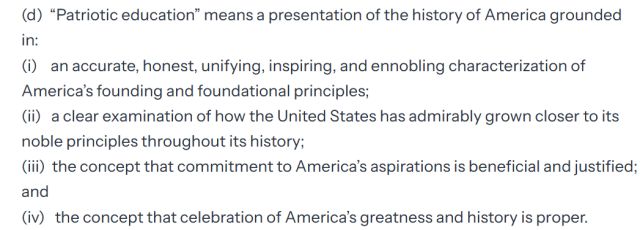
"(d) “Patriotic education” means a presentation of the history of America grounded in: (i) an accurate, honest, unifying, inspiring, and ennobling characterization of America’s founding and foundational principles; (ii) a clear examination of how the United States has admirably grown closer to its noble principles throughout its history; (iii) the concept that commitment to America’s aspirations is beneficial and justified; and (iv) the concept that celebration of America’s greatness and history is proper."
History-Education-related Excerpt of President Donald Trump’s Jan 29th, 2025 Executive Order on Patriotic Education. https://www.whitehouse.gov/presidential-actions/2025/01/ending-radical-indoctrination-in-k-12-schooling (Sec. 2; (d))

This not only means a politically motivated distortion of history itself and presumably a serious encroachment on the freedom of scientific historical research, but also a disregard for all the findings of historical didactic research and development. In particular, it may also be a state-prescribed renunciation of one of the central concepts of history teaching in recent decades, namely the ability to think independently – and necessarily critically – as the central goal of learning history at school.

That such independent critical thinking is necessary not only in the domain of history, in view of the alterity of past life-worlds and ways of thinking, but that it is also a core concern in view of the changed communication structures (“digitality”) and the associated contact of everyone with unfiltered assertions (to a certain extent as a “price” for improved access to the “market of opinions” with one’s own statements) is also necessary in general as a competence for members of modern societies has been the central topic of Sam Wineburg at Stanford in recent years.

But Trump’s executive order makes it clear that, when it comes to history, there is and must be more at stake than overcoming a tendency, real or imagined, that we all have to view the past through modern eyes (“presentism”). Historical thinking consists of more than taking the past seriously as belonging to a different time and culture and being able to recognize and think about it with the help of primary sources.

History is not (only) the exotic, strange and therefore incomprehensible, daunting or interesting past, but rather the access to this past that takes place out of a present interest and works with present questions and concepts, and the processing of its knowledge. The knowledge of its otherness and its connection to other times, the present and the possible future for the purpose of one’s own or someone else’s orientation. This insight only seemingly contradicts Wineburg’s quoted concern, namely only if in such access to the past, the present, the today’s as well as socially, culturally, and politically own conceptions would be set absolutely. But that would be precisely a non-critical historical thinking. Such historical thinking is critical, reflective and reflexive when it does not absolutize the past or its own and subordinates the other “pole” to it, but when the past is considered in the light of the present, but then in the light of the recognized past and its connections. This process is called sense-making (Jörn Rüsen). Historical thinking aims to make sense of the connections between human (and natural) conditions, states, actions, developments, etc., located at different times, in order to orient us today. Such enabling sense is neither found in the past as pre-formed nor imposed on it from the present. Rather, such meaning becomes capable of orientation when it is approached in the form of interests, questions, hypotheses, concepts, etc. to the data of the past, in contact with them, in the recognition of the past as the past, is changed and sharpened. This is the process of historical thinking in its synthetic, re-constructive mode. It results in historical narratives of very different kinds and media presence – from short statements in which the different points in time may only appear implicitly (“then it was like that” implies that today it is different or the same, but that both are worth mentioning and probably also open to some kind of explanation), in short reports, to extensive presentations. It is the nature of such historical statements that they – precisely as constructions of meaning over time – make a claim to validity, because unlike, for example, fictional stories, their very basis is that they refer to an actual past. Their relevance and concrete significance do not arise from the fact that what is narrated in them in a meaningful and orienting way seems plausible as a thought, but that it refers to an actual past.

Our world is full of such historical statements – statements and stories of very different quality. They are each told from specific, particular points of view and perspectives and with equally particular interests, but they are not necessarily bound to be orienting only for their authors – on the contrary: the vast majority of stories make a well-founded claim to validity that extends beyond the respective author’s own perspective. This is connected with assertions of relevance and significance that must be honored. And it is by no means a binary question of for whom such a story can be relevant and orienting – whether only for its author or for “everyone”. No, in such stories very different statements are made about who (which “we”) they are supposed to apply to and who the respective counterpart (an “you” or also a “they, the others”) is. Similarly, norms and values are incorporated into such stories, the validity of which can either only be asserted or justified. The same applies to a whole range of other elements of history – images of humanity and the world, explanatory models, etc.

Moreover, all these facets can be related to all temporal levels of history – and in no way uniformly. Whether and how, for example, a stable historical depth dimension is constructed to link authors and addressees to the present “we” (e.g. “our ancestors”), whether the two are opposed to each other (“then enemies – now together”), whether and to what extent present and past norms and values are presented as the same or as having changed, whether, for example, the past is narrated as fortunately overcome, as the basis of a positively evaluated development, as unfortunately lost or differently related to the present – meaning is always presented.

In addition to the ability to independently construct plausible (and recognized by others) orienting meaning in the sense of the above-mentioned synthetic re-construction, what is needed in today’s society (and actually for some time or even always), especially in democracies, is the ability of everyone to analyze the endless number of such “finished” narrated stories that they (all of us) encounter, to question them about what they specifically tell us, why and how they do it and how plausible it is (deconstruction).

In this sense, critical historical thinking is not reduced to distinguishing “good”, i.e. credible or trustworthy, from “bad” historical stories, and then ignoring the latter and trusting the former. Precisely because all stories, even the problematic ones, not only make claims to validity, but also offer validity and orientation, it requires the willingness and the ability to analyze them in terms of their construction logics and the elements incorporated into them – that is, “we”/they” conceptions, norms, world and human images, explanatory models, etc.

Against this background, the goal of democratic history teaching should not be to provide the members of a democratic society with a single narrative decreed from above, an interpretation of history that everyone must accept not out of an understanding of its orienting power in the face of current challenges, but by means of state decree and pedagogical measures (grades) – and certainly not a historical narrative that either excludes significant parts of society from the “we” or forcibly incorporates them into a particular “we” while disregarding their (also) specific positions, perspectives, identities and orientation needs.

As – in democracies – society and the state must acknowledge different political interests of their members which need to be both formed into a common interest still acknowlegding the different perspectives and safeguarding their very cores, so democratic history education must be history teaching that is not arbitrary, but does not deny the diversity and variety of positions, perspectives and orientation needs, but recognizes and takes them up for two purposes: (1.) to get to know and recognize not only one’s own (particular) position, perspective, world view and interpretation of history, but also those of others, even where one does not share them, and thus to broaden one’s own horizons, also to recognize one’s own particularity, and (2.) to piece together different stories and the experiences on which they are based in such a way that they do not merge into a single homogenized story, but into a spectrum of different stories that are recognized as such but compatible with each other from a superordinate perspective.

Furthermore, democratic history education should acknowledge that — as it is the normal state of democratic decision-making to acknowledge a diversity of interests — people’s historical perspectives and interpretations are different.

Consequently, historical judgments (both in the form of factual conclusions and value-based judgments) should not be imposed on students in the form of pre-formulated interpretations and evaluations, but rather be made possible for them as an independent achievement in the course of joint, guided considerations and discussions. Whether (or rather, to what extent) a story is “ennobling” and “admirable” should not be prescribed, but rather discussed, considered, and judged in a differentiated way – controversially if necessary.

But there is more at stake: in the way the executive order uses the term history, it is nothing more than an uncritical and irresponsible celebration of the self, and as such an instrument of indoctrination. The potential of history to not only affirm the existing (and also coercive), but to orient, is completely hidden. History always has the potential to question one’s own existence, a question that can yield both affirmative and transformative and reorienting results – and not as alternatives, but usually closely interwoven. If a nation’s history is so noble, this should not be difficult. Imposing such judgments from above is more a testament to the fear of independent judgments – especially when they are well-founded.

In this sense, Trump’s executive order is not only an expression of authoritarianism in a state under the authority of the law in terms of the politics of history, but also in pedagogical and historical-didactic terms.


Neuer Artikel zum Historischen Lernen an/mit und über Denkmäler

Körber, Andreas (2023): Elaborating Historical Thinking on Monuments. Available online at https://www.pedocs.de/volltexte/2023/28266.

Im Rahmen einer seit längerem laufenden kollegialen Diskussion über historisches Denken- Lernen an/mit und über Denkmäler habe ich heute einen Artikel auf pedocs veröffentlicht, der u.a. eine Antwort auf einen jüngeren Artikel von Stéphane Lévesque (Ottawa) darstellt. Der Artikel ist open access frei verfügbar.

As part of an ongoing collegial discussion about historical thinking – learning at/with and about monuments, I published an article on pedocs today that is, among other things, a response to a recent article by Stéphane Lévesque (Ottawa). The article is freely available open access:

Körber, Andreas (2023): Elaborating Historical Thinking on Monuments. Available online at https://www.pedocs.de/volltexte/2023/28266.

Vortrag auf Konferenz zum Geschichtslernen in Maceió (Alagoas, Brasilien)

Körber, Andreas (30.7.2022): „Gradual Elaboration of Historical Thinking as History Education Times of Denial.“ Key-Note-Vortrag auf der Konferenz „XXI Congresso Internacional das Jornadas de Educação Histórica / VI Congresso Iberoamericano / IV Seminário Nacional de Ensino de História – UFAL ‚Educação Histórica em tempos de negacionismos e pandemias: teorias, práticas e pesquisas‘; 27.-30.07.2022 an der Universidade Federal de Alagoas in Maceió (Alagoas, Brasilien).

Körber, Andreas (30.7.2022): „Gradual Elaboration of Historical Thinking as History Education Times of Denial.“ Key-Note-Vortrag auf der Konferenz „XXI Congresso Internacional das Jornadas de Educação Histórica / VI Congresso Iberoamericano / IV Seminário Nacional de Ensino de História – UFAL ‚Educação Histórica em tempos de negacionismos e pandemias: teorias, práticas e pesquisas‘; 27.-30.07.2022 an der Universidade Federal de Alagoas in Maceió (Alagoas, Brasilien).

Vortrag zum Verhältnis von Wissen und Kompetenzen beim Historischen Lernen

Körber, Andreas (5.5.2021): Knowledge and/or/in Competencies of Historical Thinking? A German Perspective. Online-Vortrag im Rahmen der Reihe HEIRNET Keynotes. HEIRNET, 5/5/2021. Available online at https://youtu.be/QD_egiBxycY.

Am 5. Mai werde ich im Rahmen der von Roland Bernhard (Wien) und Jon Nichol (Exeter) organisierten Vortragsserie „HEIRNET Keynotes“  des „History Education International Research Network HEIRNET)“ einen Online-Vortrag halten zum Thema „Knowledge and/or/in Competencies of Historical Thinking? A German Perspective„.

Der Vortrag findet als ZOOM-Sitzung statt und wird später auf dem Youtube-Kanal der HEIRNET-Keynotes verfügbar sein.

.

Die nächste HEIRNET Keynote wird stattfinden am 2.6.2021.

Die Vorträge der Reihe sind bisher:

  1. Chapman, Arthur (UCL London): „Powerful Knowledge in History Education“. HEIRNET Keynotes, 3/3/2021. https://www.youtube.com/watch?v=VqfWux9Udnw.
  2. van Boxtel, Carla (Universiteit Amsterdam): „Historical knowledge as a resource for understanding past, present and future“. HEIRNET Keynotes, 4/7/2021. https://www.youtube.com/watch?v=WtnPdHCnipE.
  3. Körber, Andreas (Hamburg): Knowledge and/or/in Competencies of Historical Thinking? A German Perspective. HEIRNET Keynotes. HEIRNET, 5/5/2021. https://www.youtube.com/channel/UC7eWJuWGeZVfw1S62y9UqfQ (Video in Vorbereitung).

Commemoration and Types or Patterns of Historical Meaning-Making (Narrating)

Körber, Andreas (2020): Commemoration and Types or Patterns of Historical Meaning-Making (Narrating) (Blogbeitrag)

(This is a text from last year’s discussion with Stéphane Lévesque and Gabriel Reich on narrative patterns‘ role in reflecting on monument and memorial policy. I never got round to finishing ist. Sorry for the delay.)

In their texts and in the earlier discussion (first on Public History Weekly: Lévesque, Stéphane (2018): Removing the Past?, then on Active History CA: A new approach to debates over Macdonald and other monuments in Canada, Part 1 and Part 2), Lévesque suggested a model of different levels of historical competencies following Jörn Rüsen’s typology of narrative patterns.

While I agree that there is a lot of plausibility in a sequential development of these types of narrating throughout (Western) history, and that the genetic type is the most complex and advanced one, I don’t find much plausibility in the idea that in the development of student‘ thinking within their lifetime, the traditional type should have any priority to the other ones. Instead, I think that students encounter full-fledged narratives as well as simple statements of all types simultaneously from the beginning, and will acquire them alongside each other — but only gradually learn to recognize them for what they are, grasping their logic.

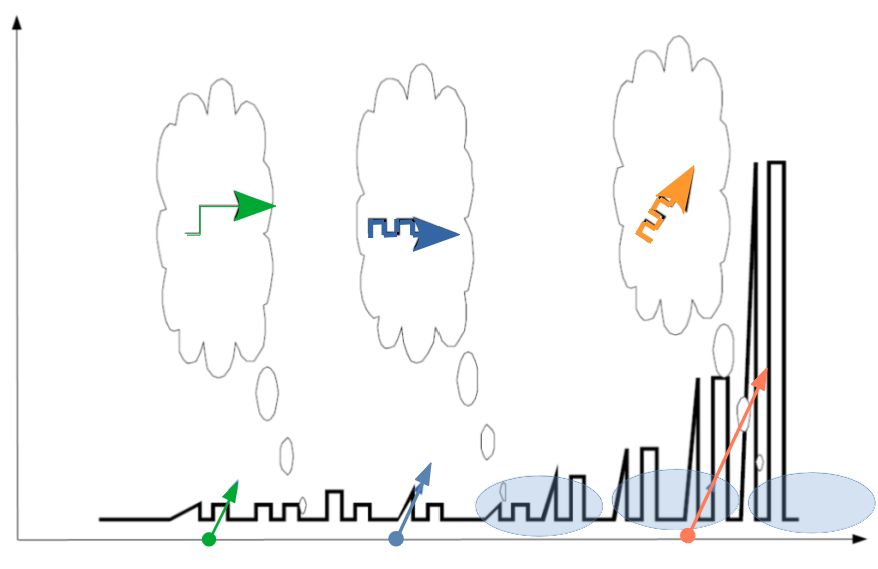
Consider the following graph:

(c) Andreas Körber 2018

It is to visualize the idea that increasing recognition of change in historic time (the x-axis) first leads to the development of the traditional type (asking for the origin of the currently valid, in cloud 1), then the experience that what has originated can also perish again and therefore asking for origins is not enough, lead to the development of the exemplaric type, asking for patterns and rules behind the change on the surface (cloud 2), and only modern experience of increased/accelerated change then led to the development of the genetic type, asking for the direction.

Each of these patterns leads to different expectations for the future. Initially (green perspective), the future may seem quite similar from the present. What is perceived as having begun, stays valid. Only from the (later) blue perspective, a pattern seems discernible, leading to the expectations that the future will also yield similar patterns of events as are detected in the past. From the (still later) orange perspective, an (additional?) increase in their „magniture“ can be perceived and its continuation be expected.
The graph also is to show that the rules and patterns as well as ideas of origins have not been rendered obsolete by each new type, but are superimposed or integrated into it.

I use this graph in my lecture. I now have added the small arrows. They are to indicate the learning-necessities of a person within a relatively short time-span of life or even youth. While in pre-modern times, they only encountered the then-developed patterns (if the model is valid), in modernity, they will have to use all patterns simultaneously, in order not make sense differentially.

The idea of a homology is problematic in another way, also. It might suggest that people in antiquity (or pre-modern-times) were developed rather like children or youths, not really grown-ups. This idea is not new, but is very problematic. As you might be aware of, Rudolf Steiner, founder of anthroposophy, suggested that the „ancient“ Greek had a mental age of about 7-years-olds. And there was a very influential German „didact“ of history in the 19th century (Friedrich Kohlrausch), who combined a similar idea of the homological development in the way people conceived „god“ with that of becoming of age. So only the modern man was really „grown up“ (and is was the Germans who did so — very nationalist).

Because of Rüsen’s idea of a „homology“ in the sequence of development of narrating types between mankind (phylogenesis) and individuals (ontogenesis), Bodo von Borries (and I as assistant to him) did a large-scale research in the early 1990s, were we presented students with items of different typological logic to dilemma-situations, like Rüsen himself has used for qualitative research and for explaining the narrative types. We did find a predominance of agreement to „traditional“ items with 6th-graders (abt. 11 yrs), but found no linear development. In fact, 9th-graders seemed even to regress. All this is published in German only, I fear.

I would strongly suggest to distinguish between the historical development and hierarchy of these patterns on the one hand and progression in learning on the other hand, for which I suggest the third dimension.

As for Lévesque’s revised table of competencies in a further comment in PHW and his evaluation that Gabriel Reich is correct in that the genetic type provides no solution to the question of whether to keep or get rid of monuments: Do these types really lead to specific political positions — especially if they are always combined? Or do they rather characterize part of their underlying understanding? I think there are different positions and solutions possible by each narrative. The value of the differentiation of types of meaning making and narration is rather analytical than prescriptive.

And that is also the pedagogical value: I think these typologies (your table and mine) can be used for classifying and discussing statements of people in the political debate. It will enhance students ability to recognize the logics behind specific political stances. And it may well show that both suggestions of keeping and of getting rid of can be underpinned by different types of narrative, but that would generate maybe different policies:

Take an example from Gabriel Reich’s patch, again: civil war monuments in Richmond.

One could argue for keeping the statutes on Monument Avenue on grounds of purely traditional thinking: to mark the origins of the specific state of things. This is both possible in partisan ways (only „our“ heroes), but also in a more „inclusive“ form, asking for such monument of both sides to be presented, to mark the origin of the countries „division“. Equally in traditional mode (but with different political background), one might call for their removal. If you hold that the division they mark is no longer given, they might be removed.

In exemplaric mode (as I opined earlier), one could speak out for the preservation of the monuments on the grounds that they exemplify a certain time and culture which we can still consider as „overcome“, but one can also argue for their removal because they represented outdated or politically non-supportable relations to the past, and that our time needs to find new ones, not „progressed“ ones, but such which reflect the „characteristics of our time“.

I do agree that to hold a specifically genetic view makes it hard to envision the whole question as one of keeping vs. removing, — but it doesn’t exclude it to the full extent.

If people are thinking predominantly in genetic mode, experiencing the country to having overcome that division, they object to a traditional logic they perceived the monuments to have. In this case, it would be the tension between one’s own genetic mode of thinking and that perceived in the monuments, which would generate a political position.

If the genetic perspective was upon how to improve commemoration, one might ask for making such commemorations „more inclusive“. This may have been behind erecting a monument for Arthur Ashe among the confederate generals – not a very consistent move, though, given that is merely additively combines monuments. In fact, it creates a „memorial landscape“ of a rather complex narrative structure, part of which is traditional („heroes“) and exemplary („each group“), but by doing so enforces a new kind of traditionality (keeping the racial groups apart, assigning each „their own“ tradition to hold up). So the intended „progress“ by inclusivity („An avenue for all people“) may in fact have created a multi-traditional narrative.1

But there are other possible solutions suggested by genetic thinking.  The concept of past people being „children of their own time“ is as genetic as it can get, referring to a fundamental change in time, so that morals and actions might be considered incommensurable across times. This concept has been used for exonerating past peoples views and actions. On this ground, one might call it „useless“. But it isn’t. Genetic historical thinking entails both — to recognize the temporal change and moral and political contexts for past actions different from ours, AND to recognize that our own context is valid, too.

From this point of view, it may underpin a present position transgressing the „keep/remove“-divide, namely to find ways of memorializing civil war „heroes“ (and/or „villains“ that is) that do NOT inadvertently invite for traditional or exemplaric heroic reading, but specifically marks the distance of time.

It is imperative, this thinking goes, to keep these memorials, but not as heroic marks to the past or as ambivalent markers. One should not just remove them, for that would put into oblivion not only the past, but also the whole discussion and reflections, the uneasiness about its representation which sparked the discussion in the first place. Genetic thinking would not be content to just remove the heroism (especially that of the wrong, side) with the effect to have no memory at all, but would call for a memorialization which specifically marks the change between that time and ours today.

Again, take a Hamburg example. In an earlier contribution to this discussion I already hinted to counter-memorialisation. One of the best examples is here in Hamburg-Altona:

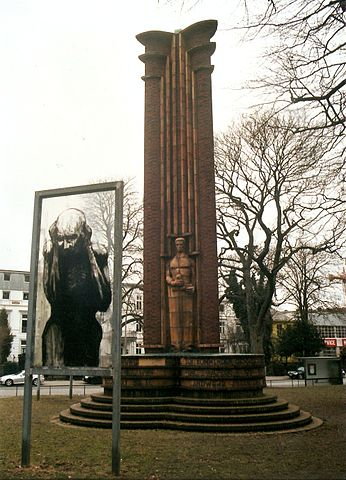
Monument and Counter-Monument next to at St. Johannis-Church in Hamburg-Altona2

Next to Altona’s St. Johannis Church, a monument had been erected in 1925 for the members of the 31st Infantry Regiment in WW1, commissioned by survivors of that regiment. Each of the three sides of the column-like monument made of clinker features an oversized, half-naked figure, representing a warrior with some antique weapon.

The inscription below reads „To the fallen for a grateful memory, to the living for a reminder, to the coming generations for emulation.“3. Clearly a very traditional proto-narrative, both extending the own warriorship of the soldiers into antiquity and calling for its emulation, lacking any transcendence. The formula was coined by August Böckh for Friedrich Wilhelm III of Prussia, and was used on monuments remembering the „liberation wars“ against Napoleon, but also later on those for the „unification wars“ of 1870/71. After the losses of millions in WW1, its usage – especially of the third element – is remarkable, albeit not alltogether uncommon4.


In the mid-1990s, the church’s congregation commissioned a counter-memorial, created by Rainer Tiedje, consisting of three acryl-glass-plates, each directly confronting one of the warriors, depicting „dark, emaciated, fearful creatures“, as the explanation on the page „denkmalhamburg.de“ states (thus on http://denkmalhamburg.de/kriegerdenkmal-an-der-st-johanniskirche/, my translation). It concludes „In the center the heroism and the exaltation, in front of it it the horror of war. A successful mixture.“ (my translation).


Gegendenkmal zum 31er Kriegerdenkmal (aus: Gedenkstätten in Hamburg. Wegweiser zu den Stätten der Erinnerung an die Jahre 1933-1945. https://www.gedenkstaetten-in-hamburg.de/gedenkstaetten/gedenkort/gegendenkmal-zum-31er-kriegerdenkmal/

To me, this countermemorial is not just a (exemplaric-mode) juxtaposition of (tradtional-mode) heroism and horror of war, but there is fundamentally genetic part in it: the counter-memorial does not merely point to timeless horrors of the consequences of warfare, but leans on a visual vocabulary established in Holocaust memorials: The „suffering men“ who wriggles with pain (and fear) on eye-level with the warriors, look like „muselmen“, the completely debilitated and immiserated inmates of the Nazi concentration camps. In its iconography, the counter-memorial belongs to the generation of monuments which coerce the viewer, the public to find and answer, not providing one themselves, either in being abstract or – as here – by visualizing death and disappearance in any but heroic form5. It is this feature, using a visual code depending not only abstractly on hindsight but on concrete knowledge about what such heroism-propaganda did help to bring about, together with the effective placing which renders impossible „commemoration ceremonies, at which the plaques are not noticed“, which indicate to a specific genetic thinking below it, trying to transgress the thinking of the time.

  1. Cf. https://onmonumentave.com/blog/2017/11/20/an-avenue-for-for-all-people-how-arthur-ashe-came-to-monument-avenue []
  2. Photo by 1970gemini in der Wikipedia auf Deutsch, CC BY-SA 3.0, https://commons.wikimedia.org/w/index.php?curid=19523318 []
  3. See http://denkmalhamburg.de/kriegerdenkmal-an-der-st-johanniskirche/  []
  4. Cf. Koselleck, Reinhart (1996): Kriegerdenkmäler als Identitätsstiftungen der Überlebenden. In: Odo Marquard und Karlheinz Stierle (Hg.): Identität. 2., unveränd. Aufl. München: Fink (Poetik und Hermeneutik, 8), S. 255–276; p. 261f []
  5. Cf. Koselleck, Reinhart (1994): Einleitung. In: Reinhart Koselleck und Michael Jeismann (Hg.): Der politische Totenkult. Kriegerdenkmäler in der Moderne. München: Fink (Bild und Text), S. 9–20, here p. 20 []

„Facts“ vs. „Fictions“ – the wrong opposition

„History is the fiction we invent
to persuade ourselves
that events are knowable
and life has order and direction“
(( Watterson, Bill (2010): „Calvin and Hobbes“ 19.7.1993; In: The complete Calvin and Hobbes. Book 3. Kansas City: Andrews McMeel., p. 210 ))

The question of „facts“ does not let go of historiography, history didactics and history teaching. A few years ago it had been the subject of a public controversy about the teaching of history – also and especially in the context of the Hamburg Historians‘ Conference – on which I also commented here in the blog.1 And, — according to the reports of some participants* on Twitter — it has been raised again at the (still running) „histocamp 2019“ in Berlin.

Finally, it was also the subject of the 2018 issue of the Zeitschrift für Geschichtsdidaktik, which I edited, where it was contrasted with „fictions“. Since I did not elaborate on it the necessary form and clarity in my introduction, I would like to argue here that both the concept of „facts“ and the opposition to „fictions“ are part of the problem, but not part of the solution (the repetition of this question already points to the problem). So what is the problem?

There is much truth in the quotation given as the motto of this article – as much about the function of history (orientation) as about the desire to simply „know“ and „convey“ things (events).

Exactly this latter need is what caters to the idea of „facts“ as given entities only to be taken note of and considered as the basis for all efforts of higher historical thought processes. Even if the concept of historical knowledge — contrary to some ideas in the broader public — cannot be reduced to it (procedural knowledge about procedures of gaining knowledge, conceptual and also metacognitive knowledge are widely acknowledged), the idea of „knowledge“ of facts as the basis, the starting material of historical thinking and the gaining of historical insights is still often part of it. The article quoted in the controversy quoted at the beginning „Pupils must learn facts“ by my Berlin colleague Thomas Sandkühler is just one example.

The idea that the availability of such knowledge is a rather low level of historical learning also underlies the widespread taxonomy of learning objectives according to Benjamin Bloom – at least its modelling of the cognitive dimension. This distinguishes in ascending order in the image of a pyramid „knowledge“, „comprehension“, „application“, „analysis“, „synthesis“ and „evaluation“.
Similarly – and perhaps even more sharply – it is formulate in the revised version after Lorin Anderson and David Krathwol, in which the nouns are replaced by verbs indicating operations and where the order is slightly reversed and the last stage is changed: „remember“, „understand“, „apply“, „analyze“, „evaluate“ and „create“.

The idea of progression of learning underlying this gradation is – at least for the domain and discipline of history – highly problematic: US historian and history educator Sam Wineburg recently postulated that historical knowledge cannot be the basis and starting point of historical thought, but rather is to be regarded as its result. He calls for the taxonomy, according to Bloom, to be rotated by 180° in order to turn it from head to toe, so to speak.2 In the background of this position stands Wineburg’s well-known position that historical thinking is not something innate to man — an „unnatural act“. Without a process of learning that is quite strenuous, we would be able to understand all the phenomena of the past with the help of the information that is available to us from our present lives – „presentist“, that is.

Not only must we learn abstractly that the past was different, that people had different (and by no means inferior) perspectives, horizons of understanding, and worldviews, but we must (according to Wineburg) laboriously train ourselves to assume and recognize this otherness in dealing with questions of the past and materials from the past. This also applies to the identification of what was the case. „Knowledge“ about the past with regard to its actuality is thus the supreme result of historical thought – but by no means an easy prerequisite.3 By the way, this also fits in perfectly with a statement of the German colleague Karl Ernst Jeismann, according to which value judgements („evaluation“) are by no means at the end, but at the beginning of many historical thought processes – at least in the form of relevance decisions, which set the preoccupation with the past and its meaning in motion.4

I myself consider Wineburg’s criticism of the taxonomy of Bloom or Anderson/Krathwol to be justified, but his solution its 180° rotation is not a solution, for it overlooks the fact that „knowledge“ or „remembering“ – like most abilities and activities – never exist only in a quality or elaboration stage. It would also be wrong to locate knowledge only at the end of long learning processes. This applies equally to the operations of application, synthesis, evaluation – and of course also to understanding. For all these operations apply, however, that they not only occur in simple everyday forms as well as in highly elaborated studies by experts and researchers, but are explicitly addressed.

Keeping in line with Wineburg’s pictorial metaphor, I therefore suggest that the taxonomies not be rotated by 180° but rather by 90° and that their pyramid form be dissolved. This would yield a set of „columns“ for the individual abilities and operations, which then can be differentiated individually as to the quality of the operation resp. ability described. „Learning“, then, is not to be understood as the progress from one operation to the next after the first one has been „completed“, but as a process of elaboration both of the individual operations or abilities and their respective connections.5

But then „facts“ are neither simply prerequisites nor the sole final goal of historical thought and learning processes. Rather, they are mental summaries of facets of past life, action, suffering and being at different levels of abstraction and reflection for the purpose of naming and communicating them and including them in further argumentation. They are neither a prerequisite nor a result, but complexes of knowledge, distinctions and assignments of meaning gained in a (historical) thinking and judgement – and as such they are both a result and a prerequisite of historical thinking. But with that they are not simply „given“, but require reflection and understanding again and again. This is especially so because the demarcation of such „facets“ of the past from others is by no means predetermined, for the „differentiation of things as they were and of things as we see them“ is, with Peter von Moos, „from the outset ‚an empty gesture‘, because we are exclusively confronted with a selection of linguistically composed memorabilia (or ‚facts‘) from myriads of events, filtered by interpretation and to be interpreted“.6. What can be isolated as a „fact“ is not only a question of the accuracy of historical work, but also a question of perspective, of questioning, of interest, of the ability to distinguish (so to speak the „glasses“), which is shaped by the horizon of perception and perception.

Not only must we learn abstractly that the past was different, that people had different (and by no means inferior) perspectives, horizons of understanding, and worldviews, but we must (according to Wineburg) laboriously train ourselves to assume and recognize this otherness in dealing with questions of the past and materials from the past. This also applies to the identification of what was the case. „Knowledge“ about the past with regard to its actuality is thus the supreme result of historical thought – but by no means an easy prerequisite.3 By the way, this also fits in perfectly with a statement of the German colleague Karl-Ernst Jeismann, according to which value judgements („evaluation“) are by no means at the end, but at the beginning of many historical thought processes – at least in the form of relevance decisions, which set the preoccupation with the past and its meaning in motion.

I consider Wineburg’s criticism of the taxonomy of Bloom or Anderson/Krathwol to be justified, but his solution its 180° rotation is not a solution, for it overlooks the fact that „knowledge“ or „remembering“ – like most abilities and activities – never exist in one quality or elaboration stage only. It would also be wrong to locate knowledge only at the end of long learning processes. This applies equally to the operations of application, synthesis, evaluation – and of course also to understanding. For all these operations apply, however, that they not only occur in simple everyday forms as well as in highly elaborated studies by experts and researchers, but are explicitly addressed.
The taxonomies must rather (if one already follows Wineburg’s pictorial solution) not be rotated by 180°, but by 90° and their pyramid form dissolved, so that several „columns“ for the individual abilities and operations arise, which can be „stepped“ individually in each case. „Learning“ is then not to be understood as the progress from one operation to the next after the first one has been „completed“, but as a process of elaboration both of the individual operations or abilities and their respective connections.7

But then „facts“ are neither simply prerequisites nor the sole final goal of historical thought and learning processes. Rather, they are mental summaries of facets of past life, action, suffering and being at different levels of abstraction and reflection for the purpose of naming and communicating them and including them in further argumentation. They are neither a prerequisite nor a result, but complexes of knowledge, distinctions and assignments of meaning gained in a (historical) thinking and judgement — and as such they are both a result and a prerequisite of historical thinking. But with that they are not simply „given“, but require reflection and understanding again and again. This is especially so because the demarcation of such „facets“ of the past from others is by no means predetermined, for the „differentiation of things as they were and of things as we see them“ is, with Peter von Moos, „from the outset ‚an empty gesture‘, because we are exclusively confronted with a selection of linguistically composed memorabilia (or ‚facts‘) from myriads of events, filtered by interpretation and to be interpreted“.8. What can be isolated as a „fact“ is not only a question of the accuracy of historical work, but also a question of perspective, of questioning, of interest, of the ability to distinguish (so to speak the „glasses“), which is shaped by the horizon of perception.
Does this now lead to a relativism? Not at all, – or at the most with regard to the aspect of delimitation and identification of the „facts“ mentioned last, but not with regard to their actuality. Whoever rejects the concept of „facts“ by no means asserts arbitrariness and by no means necessarily speaks for (free) fiction, even if all names of facts and events always adhere to conjectural parts due to the particularity of tradition, selectivity and perspective. The problem with the „facts“ does not consist in their factuality, but in their presumed and maintained character as given units, which as such one can know and know, without considering the perspectivity and the interest that led to their differentiation. „Auschwitz“ (to take a very clear example) is not a „fact“. This sentence does not deny that there has been Auschwitz, but it recognizes that (1.) the term „Auschwitz“ designates more than a neutral, clearly delimitable and also not further decomposable unit of the past, which only in retrospect gains reference to and meaning for others. No, what we call „Auschwitz“ is gradually different for the people who suffered and were murdered there, for the survivors and their descendants who also suffered, but also for the perpetrators and their descendants, and finally for us today. There is not one Auschwitz, there were and there are many. But this does not mean that they had nothing to do with each other, that they existed separately, or even that Auschwitz was „only“ constructions.

What is at stake here, however, is not whether „Auschwitz“ is „a fact“, but rather the facticity of the events and experiences specifically described by the term „Auschwitz“. This is very well documented (in the vast majority of cases). The opposite of speaking of the „fact of Auschwitz“ is therefore not the assertion of its fictionality. Not „fact“ or „fiction“ is the correct opposition, but „presupposed fact“ or „insight into the past and its facticity gained by thinking“. Both, the respective concrete delimitation and summary as well as their property of „factuality“ can be gained in the mode of historical thinking, are the results of such thought processes. Otherwise „fake news“ and lies could not be identified and separated. The „memories“ of „Benjamin Wilkomirski“ (actually Bruno Dösseker) and the „Auschwitz“ figuring therein (only „identified“ outside the book), for example, could and had to be denied factuality, without this also applying to Auschwitz as a whole.

The fact that both the identification and delimitation of the respective event or occurrence and its factuality are results of thought processes does not prevent them from being addressed as facts in communication about the past and history. To let such „facts“ learn as „as such“ and to „convey“ them to schoolgirls as a prerequisite for interpretation and interpretation undermines the development of the competences that are necessary to be able to exist critically thinking in the diverse and problematic historical culture.

Not only order and sense („order and direction“), but also the „knowledgeability“ of events (and, add: circumstances)9 are thus result, but not condition of historical thinking – and should also figure as such in historical learning processes. And if it were not for the slightly ironic-fatalistic tone of Calvin’s wisdom (which serves him in the comic to want to write a „revisionist“ biography of himself), much of the quote would be quite seriously worth considering. One would, however, have to replace the terms „fiction“ and „invent“ not by their opposites („facts“ and „find out“), but by „narratives“ and „create“ — or even „construct“. „Stories are the narratives we construct to convince ourselves that we know something [about the past] that offers us order and orientation in our lives.“

That is what is meant by historical thinking being „contingency management“ („Kontingenzbewältigung“). The concept of „contingency“ here describes far more than „coincidence“. It refers to the uncertainty that arises between the two beliefs (a) that everything in the world and in life is clearly predetermined, and (b) that there are no connections between details of life whatsoever (both within and across times).
The first conviction would make historical thinking unnecessary, because we ourselves would have to judge ourselves as completely determined and thus without any possibility of decision, without any freedom of attention, perception, judgement and decision. „Orientation“ would not only be useless – we would not even come up with the idea of searching for it. The latter position in turn (complete coincidence) would have to lead us into an absolute aporia, because strictly speaking we could not expect anything with any degree of certainty. The fact that we also always have a connection of some kind between phenomena, circumstances and occurrences in life, even beyond time, is thus an essential element of contingency (con-tingere, lat.: to touch, to transfer), but also that this connection is not simply given and recognizable, but offers comprehensive (albeit not infinite) degrees of freedom. It is this area of contingency between presupposed, but not unquestionably and unambiguously determinable meaning of the past for the present and the future, for our expectations and plans, that makes historical thinking necessary – and with it „knowledge“ about the past, which, however, is not simply given. Knowledge of „facts“ can also be opened up historically thinking, in the form of conclusions about the factuality of details, namely, as such about synchronous and diachronic connections and, finally, also as conclusions and evaluations about significance and meanings for our own and all present and future.

What consequences could be drawn for history education and history lessons in schools? Does it mean that no more „facts“ are allowed to appear in teaching units and lessons, that it were no longer permissible or acceptable to no longer present facts (structures) and occurrences (events, event sequences, actions, etc.) in teacher lectures, timelines and tables, author texts in books, etc. — to make them available to students as material for their work? Not at all! Such references are not only instruments of school learning, but also part of social communication about history. And depending on the concrete question and task, it is not only helpful but also necessary to make them available to pupils or to let them work them out themselves. However, this does not mean that these occurrences and structures should not or even must not come into the focus of reflective, differentiating and evaluative thinking in the course of working with them. QUite to the contrary: it is almost part of the task of historical learning not only to consider, but also to examine and, if necessary, reformulate, differentiate or reject statements and assertions made in the materials (especially those in primary sources and accounts from different perspectives).

And more: The understanding of „facts“ (if one does not want to drop the term completely) not as givens, but as references to facets of history, „provisionally“ being formulated within the course of thought, research and communication not only renders it possible to differentiate and to interpret them, but also to compare culturally and linguistically different forms not only of their designation and interpretation, but also of their definition. This enables the explicit thematization and reflection of such different terms as „Seven Years‘ War“, „French and Indian War“, „3rd Silesian War“, „Great War for the Empire“, „Guerre de la Conquête“ and „Third Carnatic War“ as terms both for different, but also (more or less) connected events and – even more – for the political, cultural and temporal perspectives inherent in such terms (some of these terms only being possible retrospect). It is also possible to explicitly discuss designations in Simple and Easy Language with regard to their power (for the development of the facts and the participation in the learning processes and interpretations) and limitations, and the need for further explanations and additions.

The consequence of the problematization of the concept of „facts“ due to its possible connotation (especially in the case of learners) of them being – so to speak – „upstream“ of historical thinking and learning and thus also partially detracted from it, and from the alternative focus on „factuality“ as the actually intended and relevant characteristic, is, therefore, not relativism, but rather the necessary facilitation at all times of the thematization and reflection both of the constitution of the individual „facts“ and of their qualification as „factual“. The latter operations are represented by the concept of validity („Triftigkeit“) or plausibility, above all in empirical terms10, which renders it possible – in an elementaryized, or more precisely: graduated form – for students to arrive at their own conclusions on the factuality of asserted events. Finally, the focus on factuality instead of on „facts“ also opens up the construction of a learning progression in the recording and reflection of these dimensions of historical thought and historical communication that can be taught and learned „step by step“ so to speak.

  1. Cf. History – Competences and/or Facts? To some current newspaper articles and to the question of chronology and Progress of the „debate“ about the facts in history didactics []
  2. Wineburg, Samuel S. (2018): Why learn history (when it’s already on your phone). Chicago: University of Chicago Press, S XXX. []
  3. Wineburg, Sam (1999): Historical Thinking and Other Unnatural Acts. In: The Phi Delta Kappan 80 (7), pp. 488-499. and Wineburg, Sam (2001): Historical thinking and other unnatural acts. Charting the future of teaching the past. Philadelphia: Temple University Press (Critical perspectives on the past) [] []
  4. Jeismann, Karl-Ernst (2000): ‚Geschichtsbewusstsein‘ als zentrale Kategorie der Didaktik des Geschichtsunterrichts. In: Karl-Ernst Jeismann: Geschichte und Bildung. Beiträge zur Geschichtsdidaktik und zur historischen Bildungsforschung. Hg. v. Karl-Ernst Jeismann und Wolfgang Jacobmeyer. Paderborn: Schöningh, S. 46–72, p. 66. []
  5. Cf. also Körber, Andreas (2012): Graduierung historischer Kompetenzen. In: Michele Barricelli and Martin Lücke (ed.): Handbuch Praxis des Geschichtsunterrichts. Historisches Lernen in der Schule, vol. 1. Schwalbach/Ts.: Wochenschau Verlag (Wochenschau Geschichte), pp. 236-254. []
  6. Moos, Peter von (1999): Gefahren des Mittelalterbegriffs. Diagnostische und präventive Aspekte. [Dangers of the concept of Middle Ages. Diagnostic and preventive aspects]. In: Joachim Heinzle (Ed.): Modernes Mittelalter. Neue Bilder einer populären Epoche. 1st ed. Frankfurt am Main, Leipzig: Insel-Verlag (Insel-Taschenbuch, 2513), pp. 31-63, here p. 54; trans. AK []
  7. Cf. also Körber, Andreas (2012): Graduation of historical competences. In: Michele Barricelli and Martin Lücke (ed.): Handbuch Praxis des Geschichtsunterrichts. Historisches Lernen in der Schule, vol. 1. Schwalbach/Ts.: Wochenschau Verlag (Wochenschau Geschichte), pp. 236-254. []
  8. Moos, Peter von (1999): Dangers of the concept of the Middle Ages. Diagnostic and preventive aspects. In: Joachim Heinzle (Ed.): Modern Middle Ages. New Images of a Popular Era. 1st ed. Frankfurt am Main, Leipzig: Insel-Verlag (Insel-Taschenbuch, 2513), pp. 31-63, here p. 54 []
  9. „fact“ here does not mean that something from the past is given to us in a clearly recognizable way, but the conditions found by acting and suffering people at their time, here thus structures of the past. []
  10. Rüsen, Jörn (2013): Historik. Theorie der Geschichtswissenschaft. Cologne: Böhlau, p. 57ff; Rüsen, Jörn (2017): Evidence and Meaning. A Theory of Historical Studies. Unter Mitarbeit von Diane Kerns und Katie Digan. New York, NY: Berghahn Books Incorporated (Making Sense of History Series, v.28), pp. 38; cf. Körber, Andreas (2016): Translation and its discontents II. A German Perspective. In: JCS 48 (4), S. 440–456. DOI: 10.1080/00220272.2016.1171401. []

Neue Publikation

Körber, Andreas (2019): Presentism, alterity and historical thinking. In: Historical Encounters. A Journal of Historical Consciousness, Historical Cultures, and History Education 6 (1), S. 110–116 http://hej.hermes-history.net/index.php/HEJ/article/download/113/104.

gerade erschienen:
Körber, Andreas (2019): Presentism, alterity and historical thinking. In: Historical Encounters. A Journal of Historical Consciousness, Historical Cultures, and History Education 6 (1), S. 110–116. http://hej.hermes-history.net/index.php/HEJ/article/download/113/104.

Gastvortrag zum Thema "Assessment of History learning Outcomes/Exams"

Stegers_1
am kommenden Freitag, 1.7. spricht Steven Stegers, Programmdirektor von EUROCLIO an unserer Fakultät (in englischer Sprache) unter dem Titel „A Bird‘s Eye View of History Exams across Europe. Why the assessment of Historical Competences matters“ über (kompetenzorientiertes) Prüfen und Diagnostizieren beim Geschichtslernen.

Aus der Ankündigung:

„In this presentation, Steven Stegers, the Programme Director of EUROCLIO (European Association of History Educators) will share his experience of working on history education projects across Europe. He will focus on the implications of the way assessment – especially exams – are impacting the way history is being taught. He will compare and contrast di!erent practices in terms of the relative importance of central exams: what is being assessed, and what are the aims of history education in the first place.“
Wir laden herzlich ein.

"Geschichtsbewusstsein", "historisches Denken" oder "Kompetenzen" — ein Beitrag aus Dänemark

Kollege Jens Aage Poulsen diskutiert aktuell drei Konzepte historischen Denkens und die sich aus ihrer Nutzunge ergebenden Konsequenzen für Geschichtsunterricht:

Poulsen, Jens A. (2015): Historisk bevidsthed, tænkning og kompetencer? ‚Historisk tænkning‘ og ‚kompetencer‘ er nytilkomne i den historiedidaktiske debat. Hvilke sammenhænge er der mellem dem og velkendte begreber som ‚historiebevidsthed‘ og ‚historisk bevidsthed‘?: ‚Historisk tænkning‘ og ‚kompetencer‘ er nytilkomne i den historiedidaktiske debat. Hvilke sammenhænge er der mellem dem og velkendte begreber som ‚historiebevidsthed‘ og ‚historisk bevidsthed‘? http://historielab.dk/historisk-bevidsthed-taenkning-og-kompetencer/. gelesen 19 Sep. 2015.