Gibson, Lindsay (7.9.2020): What is historical thinking?

Arbeitsbereich Geschichtsdidaktik / History Education, Universität Hamburg

In der letzten Woche wurde über eine aktuelle Studie zum Vergleich von Quereinsteiger:innen und „traditionell ausgebildeten“ Lehrpersonen hinsichtlich ihrer professionellen Kompetenzen (insbesondere Fachwissen, fachdidaktisches Wissen, Professionswissen, aber auch Beliefs und Mustern der Selbstregulation) berichtet.1
So interessant die Studie in vielen Teilen ist, wirft sie aber die Frage auf, ob die Messung von Kompetenzen und Professionalität mittels der Erhebung der Verfügung über definit formuliertes Wissen und Überzeugungen (anhand der Zustimmung zu entsprechenden Items) ausreicht und die Sache trifft. Inwiefern die nicht nur akademische (universitäre), sondern auch spezifisch erziehungswissenschaftliche Bildung von Lehrpersonen darauf abzielt, dass diese vornehmlich die Anforderungen des Lehrberufs nach den Standards gegenwärtigen professionellen Wissens erfüllen und ihn ihnen bestehen können, oder ob es vielmehr (auch!) darum gehen muss, selbstverantwortet, selbstständig und als professionell zuständige an der Wahrnehmung und Reflexion der Veränderung solcher Bedingungen in einer noch nicht absehbaren Zukunft teilzuhaben (mehr als nur als Bürger:innen), wäre intensiv zu diskutieren. Der Charakter des Lehrberufs ergibt sich ja (so etwa Frank Olaf Radtke 1999/2000)2 vornehmlich daraus, dass es 1. kaum standardisierte oder standardisierbare Handlungssituationen gibt, sondern vielmehr eine unübersehbare Vielfalt immer anderer/neuer Konstellationen, die sowohl wahrgenommen als auch eingeschätzt und beurteilt werden müssen, und in gerade nicht standardisiert gehandelt werden kann, und 2. durch die (ähnlich Ärzten und Anwälten …) besondere Eingriffsqualität und -tiefe des Handelns in Lebenschancen der Lernenden.
Es geht beim Lehrberuf also nicht einfach (nein, schon das ist nicht einfach) darum, zu wissen, was entweder auf der Basis von Experten oder großer empirischer Studien geeignet ist, wie man bestimmte Situationen ‚richtig‘ beurteilt, sondern wie man mit solchen Situationen vor variablen Bedingungen umgeht.
Kompetenz und Professionalität zeigt sich nicht allein darin, dass man Standard-Anforderungen des Berufs in den gegenwärtigen Strukturen und nach gegenwärtig als bedeutsam geltenden Kriterien bewältigen kann. Das ist nur die notwendige Bedingung. Kompetenz und Professionalität zeigt sich vielmehr in weiteren, darüber hinaus gehenen Fähigkeiten, Fertigkeiten und Bereitschaften. Dazu gehört, zum Einen, dass man sein eigenes Denken und Handeln anhand gültiger Kriterien selbstständig und selbstverantwortlich auf eine bereits gegenwärtig unüberschaubare Vielfalt unterschiedlicher Einzelfälle ausrichten kann.
Zum anderen aber ist ebenso unabdingbar, dass man für sich selbst, die Institution(en), das Fach und die Gesellschaft professionell an der ständigen Überprüfung von Prinzipien, Handlungsmuster, Kriterien, Theorien usw. und an ihrer Weiterentwicklung für (derzeit nur partiell absehbar) geänderten Rahmenbedingungen teilhaben kann.
Es reicht somit nicht aus, die „Qualität“ von Lehramtsanwärter:innen und Quer- oder gar Seiteneinsteiger:innen reichen daher Messung an Hand von Wissens- und Einstellungstests zu messen, die gegenwärtige Kenntnisse, Prinzipien, „What Works“-Einsichten und Haltungen messen,um zu beurteilen, ob die (später auch voll-)akademische (universitäre) Lehrerbildung richtig und nötig sei. Sie wurde – außer durch berufs- und standespolitische Motive – wesentlich auch durch die Einsicht vorangetrieben, dass es nicht um „die Regeln handwerklichen Tuns“ gehe, sondern um Lehrer als Persönlichkeit „auf der Bildungshöhe ihrer Zeit“. Es gelte, „geistig bewegliche, mit fortschreitender Entwicklung wandlungsfähige Lehrer zu schaffen, wie es etwa der für die Gestaltung der (in Anknüpfung an die Regelungen 1927) für alle Lehrämter universitären Lehrämter in Hamburg einflussreiche Oberschulrat Franz Jürgens 1958 formulierte.3
Die Nachlagerung der seit 1947 noch dominierenden praktischen Unterrichtsausbildung im Studium in einen Vorbereitungsdienst 1967 (wie er für das Höhere Lehramt schon vorher bestand) ist denn auch u.a. als eine Konsequenz zu sehen aus Forderungen nach einer Entlastung des Studiums von „einem Übermaß an berufspraktischer Vorbereitung“ (OSR Jürgens schon im März 1958)4, so dass Freiheit für eigenständige Auseinandersetzung mit grundlegenden Fragen. Deshalb auch waren – wie schon 1927ff – die Fachstudien nicht gedacht zum Erwerb des in der Schule zu vermittelnden Fachwissens (die Volksschullehrer:innen unterrichteten ja mehrere Fächer), sondern zur exemplarischen Einführung in wissenschaftliches Denken.
Auch dass mit der Verlagerung der Praxisanteile in den Vorbereitungsdienst die Fachdidaktiken nicht dorthin verschoben wurden, sondern universitär verblieben (und gar zu vorher in HH nicht vorhandenen Professuren aufgewertet wurden),5 bedeutete zudem, dass auch diese nicht konkrete Unterrichtseinübung, sondern grundlegendere Fragen fachlichen Lehrens und Lernens in den Blick nehmen konnten. Nicht mehr wöchentliche Unterrichtsbesuche und -nachbesprechungen, sondern Fragen der gesellschaftlichen Bedeutung sowie der theoretischen Fundierung fachlicher Bildung, neuer Herausforderungen angesichts gesellschaftlicher, medialer, kultureller Veränderungen etc. konnten nun ins Zentrum nicht nur von Forschung, sondern der Lehrerbildung in der ersten Phase gestellt werden.
Solche Veränderungen und die Fähigkeit von Lehrpersonen, darauf nicht nur situativ und nach entsprechender Fortbildung reagieren zu können, sondern selbst an der Revision, Weiter- und Neuentwicklung fachlicher Lehr-/Lernkonzepte beteiligt zu sein – nicht zuletzt aufgrund der Expertise zu den konkreten Heraus- und Anforderungen, die sie durch ihren täglichen Kontakt mit unterschiedlichsten Lernenden und ihren Bedingungen haben – wird in Zukunft an Bedeutung nicht verlieren – eher im Gegenteil. Gerade auch daher ist „Lehrerprofessionalität“ und Kompetenz nicht nur darin zu sehen, über die gegenwärtigen Einsichten, Standards und ein Handlungsrepertoire zu verfügen, sondern in der Befähigung zu selbst- und eigenverantwortlichem Umgang mit dem Wandel.
Ein Beispiel: Die genannte Studie6 gibt — verständlicherweise — für die untersuchten Kompetenzen nur Beispiele der Items, die in das jeweilige Instrument eingegangen sind. Insofern sind die folgenden Überlegungen keine Kritik an der Studie, sondern Fragen an die Interpretation und Bewertung ihrer Aussagen.
Ein Item etwa lautet „Für welche der folgenden Aufgaben bietet sich Gruppenarbeit besonders an“. Es geht hier um einen Wissenstest, d.h. es gibt (mehr oder weniger) als richtig geltende Antworten. Das ist sinnvoll mit auf Anforderungen des Berufs unter mehr oder wenige gegebenen Bedingungen. Inwiefern solche Instrumente aber auch erfassen, ob bzw. wie Lehrpersonen in der Lage sind, diese Fragen nicht nur unter gegebenen Bedingungen, sondern variabel einzuschätzen und zu reflektieren, wäre zu diskutieren.
Ähnliches gilt für das Item zur Klassenführung: „Die Lehrerin ruft die Schüler(innen) der Reihe nach auf. Sie beginnt in der hinteren linken Ecke und geht die Reihen durch. Was denken, Sie, wird wird die Klasse sich verhalten?“
Insofern für solche Items nicht einfach das Treffen vorgegebener Antworten bewertet und bepunktet wird, sondern zumeist individuelle Antworten kategorisiert werden, erfasst das Instrument durchaus eine gewisse Bandbreite an Kompetenzen: Es wird eingeschätzt, welche Aspekte die Probanden ansprechen, einbeziehen, etc. Es geht somit gar nicht unbedingt darum, das Verhalten der Klasse „richtig“ einzuschätzen. Gleichwohl bleibt die Frage, inwiefern man wirklich „das Verhalten“ „einer Klasse“ als Konzept voraussetzen kann (oder geht es gerade darum, zu prüfen, inwiefern die Proband:innen genau diese Setzung annehmen, reflektieren?), inwiefern implizierte Homo- oder Heterogenität der Lernenden, Konventionen von richtigem oder problematischem Verhalten, der Bedeutung von „Drannehmen“ etc. in den Items vorausgesetzt werden.
Geht es nicht auch darum, die in solche Situationsbeschreibungen und Items eingegangenen Annahmen, Voraussetzungen, Konzepte nicht nur zu verstehen und „anwenden“ zu können, sondern sie dahingehend zu reflektieren, ob sie zur Einschätzung, Beurteilung und Gestaltung der jeweiligen Situation passen.
Nun müsste man gerade mehr wissen. Ist es vielleicht Ausweis eines höheren Kompetenzniveaus, solche Fragen gerade nicht sicherer zu beantworten, sondern im Gegenteil flexibler, mit Vorbehalten zu argumentieren, die Voraussetzungen der Fragen einzubeziehen? Inwiefern wird das bzw. kann das berücksichtigt werden?
Vor diesem Hintergrund stellt sich dann die Frage, ob die jeweilige Qualität „traditionell-lehramtsspezifischer“ oder „nicht-traditioneller“ Ausbildung sich weniger im Grad der Verfügung über solches Wissen zeigt als vielmehr in der Art und Weise, wie mit solchem in Handlungs- und Entwicklungszusammenhängen umgegangen wird: Das Kriterium, an dem sich die Lehrerbildung messen lassen muss,wäre dann nicht, ob die nicht-traditionell (aus-)gebildeten Lehrkräfte über vergleichbares Wissen und Handlungsroutinen etc. verfügen, sondern wie sie erworbene Kenntnisse und Fähigkeiten selbstständig und verantwortlich in unterschiedlichen Zusammenhängen in Wert zu setzen und auf neue Bedingungen anzupassen in der Lage sind.
All dies ist kein Plädoyer, auf Quereinsteiger:innen zu verzichten oder den Quereinstieg gar unmöglich zu machen — wohl aber dafür, gerade auch in Zeiten des vermehrten „Rückgriffs“ auf Quereinsteiger:innen in Zeiten von Lehrepersonenmangel, nicht nur auf die unmittelbare „Einsetzbarkeit“ zu setzen, sondern auch bei ihrer Vorbereitung genügend Zeit und Freiraum zur Auseinandersetzung mit gesellschaftlichen und pädagogisch-erziehungswissenschaftlichen Grundlagen des eigenen Handelns einzuplanen. Die weitsichtige Orientierung der akademischen Lehrerbildung an Zukunftsfähigkeit sollte auch in Zeiten der administrativen Not nicht aufs Spiel gesetzt werden.
Introduction:
Reference:
Körber, Andreas (2014): De-Constructing Memory Culture. In: Helle Bjerg, Andreas Körber, Claudia Lenz und Oliver von Wrochem (Hg.): Teaching historical memories in an intercultural perspective. Concepts and methods : experiences and results from the TeacMem project. 1. Aufl. Berlin: Metropol-Verlag (Reihe Neuengammer Kolloquien, Bd. 4), 145-151 + CD-File.
Über Reenactments als Geschichtssorte1 werden in letzter Zeit viele analytische Untersuchungen publiziert. Dazu gehört auch das (sehr empfehlenswerte) neue Buch von Ulrike Jureit, in welchem sie anhand unterschiedlicher Reenactments jeweils einen systematischen Aspekt der performativen Vergegenwärtigung von Vergangenheit erörtert.2 An einer Formulierung daraus möchte ich kurz einen Aspekt zum Charakter historischer Sinnbildung in Reenactments aufzeigen.
In Jureits Kapitel über Reenactments des Amerikanischen Bürgerkriegs heißt es:
„In der geschichtskulturellen Debatte über Ursachen und Ziele des Amerikanischen Bürgerkriegs verengt sich die Kontroverse gegenwärtig darauf, welche Rolle die Sklaverei und ihre Abschaffung beziehungsweise ihre von der Konföderation angestrebte Beibehaltung für den War between the States spielte. Die internationale Forschung hat dazu bereits zahlreiche Studien vorgelegt, die den Civil War in erster Linie als einen für das 19. Jahrhundert typichen Staats- und Nationsbildungskrieg kennzeichnen.“3
An der hier zitierten Charakterisierung des Krieges lässt sich gut eine Spezifik historischer Sinnbildung aufzeigen: Begriffe dieser Art, welche Ereignisse bzw. Ereigniskomplexe einer bestimmten Ausprägung einer Typologie zuordnen, sind alles andere als rein typologisch. Sie sind selbst narrativ, insofern sie in der Dichte eines einzelnen Terminus einen Verlauf verdichten, der über das Ereignis hinausreicht. Solche Begriffszuweisungen sind nur retrospektiv möglich, in hindsight. Zum einen lässt sich erst in diesem Rückblick das Ereignis „Amerikanischer Bürgerkrieg“ überhaupt gänzlich fassen.
Selbst wenn bereits zeitgenössisch eine Bezeichnung als ein Bürgerkrieg benutzt worden sein sollte, musste sie in der konkreten Abgrenzung wenig sicher und unklar bleiben. Zeitgenössisch sind denn — wie Jureit auch vermerkt —4 ganz andere Bezeichnungen verwendet worden, so „War between the States“ aus konföderierter Perspektive (die Sezession voraussetzend und die Normalität und Legitimität des Konflikts als zwischenstaatlich betonend) bzw. „Rebellion“ — nicht nur die Unrechtmäßigkeit, sondern auch die Innerstaatlichkeit, d.h. die eigentlich weiterbestehende Zusammengehörigkeit hervorkehrend.
Jeder dieser Begriffe erzählt somit eine andere Geschichte. „War between the States“ setzt zunächst eine tatsächliche Abspaltung an den Beginn, „Rebellion“ leugnet ihre Tatsächlichkeit. Aber der wissenschaftliche Begriff des „(typischen) Staats- und Nationsbildungskriegs“ rekurriert neben der abschließenden Abgrenzung des Ereigniskomplexes noch auf mindestens zwei weitere Elemente: Zum einen eine Regelhaftigkeit solcher Prozesse, wenn nicht über alle Zeiten, so doch innerhalb einer Zeitspanne (hier 19. Jh.), zum anderen aber auf die Kenntnis der Wirkung und des Nachlebens des Abgeschlossenen Konflikts. „Nationsbildungskrieg“ kann nur sein, was der Nationsbildung geholfen hat. Dem tun auch bereits im Krieg erkennbare Bestrebungen keinen Abbruch, genau eine solche Nationsbildung explizit anzustreben — wie etwa schon in Lincolns Gettysburg Address vom 19. November 1863 erkennbar.5
Im vollen Sinne aber setzt die Qualifikation des Krieges als „Staats- und Nationswerkungskrieg“ nicht nur die erkennbare Absicht, sondern die entsprechende Wirkung voraus. Für die Zeitgenoss:innen der Auseinandersetzung — sei es als Politiker, Soldaten, Angehörige — aber kann der Konflikt diese Qualität nicht gehabt haben. Für sie war es ein Konflikt nicht nur mit offenem Ausgang, sondern auch mit erhofften und befürchteten, nicht aber mit garantierten oder eingetretenen Wirkungen.
Bei den Reenactments von Schlachten dieses Bürgerkriegs nun mischen — nein: kombinieren und durchdringen — sich nun die unterschiedlichen Perspektiven und ihre Narrative — und sie tun es gewissermaßen „schief“: Auf kleinem Maßstab — also mit hohem Abstraktionsgrad — überwiegen Betonungen von Gemeinsamkeit und Versöhnung. Sie implizieren zudem die Anerkennung des tatsächlichen Ergebnisses, weshalb sie auf größerem Maßstab (also bei Betrachtung einzelner Gebiete, Schicksale, in einzelnen kleineren Erinnerungsformen) aus Unionsperspektive auch überwiegen dürfte, wogegen auf dieser selben Ebene Narrative des „Lost Cause“, der Verursachung des Krieges durch die Negation der „States‘ Rights“ etc. eher bei Anhängern konföderierter Sichtweisen vertreten sein dürften.
Gleiches findet sich im Reenactment. Es gibt Beispiele dafür, dass Darsteller*innen ihre zu spielenden Truppen nicht nach ihrer eigenen Interpretation des Krieges auswählen, sondern aus deutlich pragmatischeren Gründen — etwa Wohnortnähe. Das stützt die Interpretation, dass es um das Erinnern an die von Nord- und Südstaaten(soldaten und -bewohner:innen) gemeinsam durchlittene Prüfung geht. Es kommt der Interpretation des „Second Birth“ und der retrospektiv attestierten Nationsbildungswirkung am nächsten.
Gleichzeitig aber hat Reenactment auch eine zumindest partielle Facette der Aufhebung des retrospektiven Wissens und somit der aus hindsight erstellten oder bestätigten Charakterisierung des Krieges. Im Erleben des wiedervergegenwärtigten Kampfes — insbesondere bei den Tacticals, welche nicht einen realen Ablauf abbilden, sondern quasi ergebnisoffen ‚ausgefochten‘ werden, findet sich so etwas wie eine symbolische und psychische „Wiedereinsetzung in den vorigen Stand“ (um eine juristische Formulierung zu entlehnen).
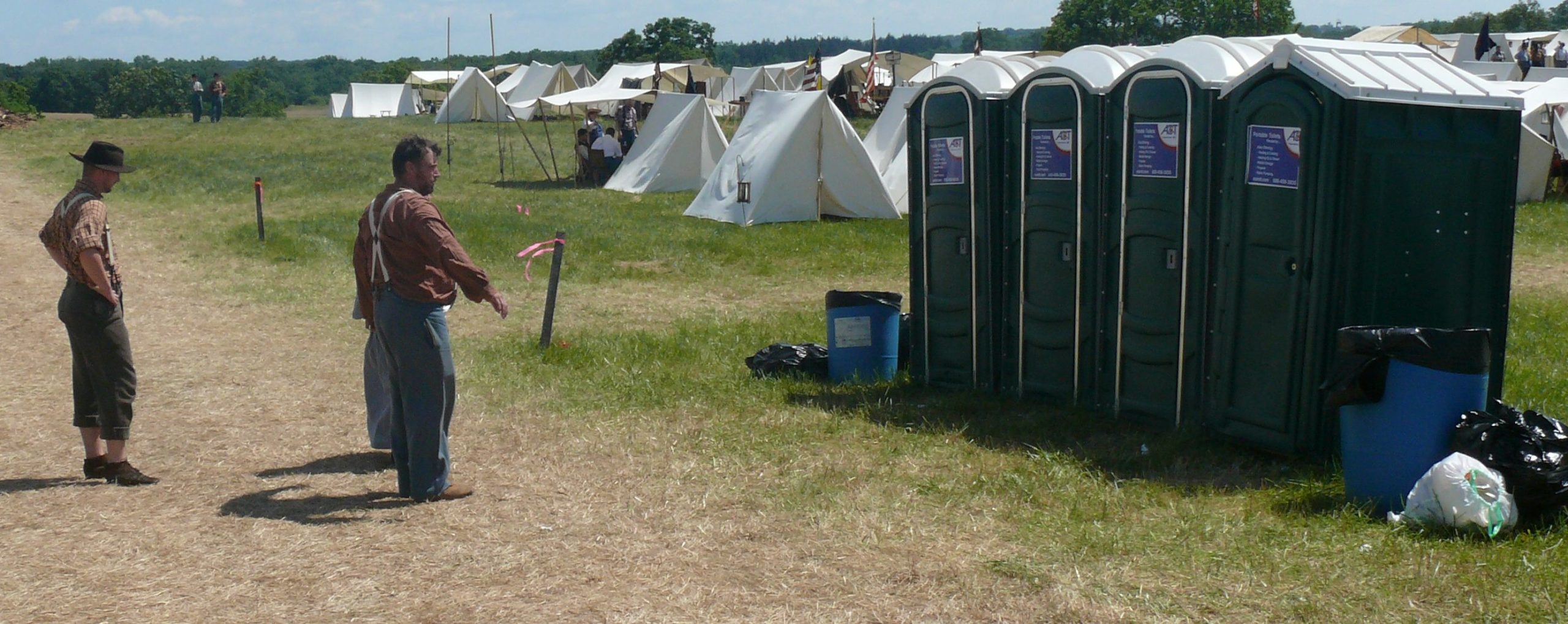
In diesem Sinne ist in Reenactment zumindest partiell als eine symbolische Suspendierung der Retrospektive und retrospektiver Sinnbildung zugunsten einer suggestiv-immersiven Wiederinkraftsetzung der Offenheit zu erkennen. Dies erzeugt natürlich eine unauflösbare Spannung, denn aus der Retrospektive können Aktive natürlich nicht wirklich austreten. Zudem kann keineswegs vorausgesetzt werden, dass die imaginierten Vergangenheiten zwischen den einzelnen Aktiven wirklich kompatibel wären. Das eine gemeinsame Agieren hat dabei eine besondere Bedeutung der Authentifizierung.
Der Gleichzeitigkeit unterschiedlicher individueller sowie (teil-)gesellschaftlicher und politischer Bedürfnisse und Motive entprechend dürften bei Reenactment-Ereignissen ganz unterschiedliche Kombinationen narrativer Formen historischer Sinnbildung nebeneinander und ineinander verschränkt im Spiel sein — und zwar sowohl zwischen Beteiligten (Organisator:innen, Akteur:innen, Zuschauer:innen und Außenstehenden) als auch im Denken und Handeln (aller?) einzelner. Letzteres deutet keineswegs auf eine Art historiographischer bzw. historisch denkender Inkonsequenz oder ‚Schizophrenie‘ hin, sondern ist durchaus ein Merkmal allen historischen Denkens.
Historische Darstellungen und Aussagen, folgen selten einem einzigen Sinnbildungsmuster, sondern kombinieren zumeist mehrere, wie schon bei der Entwicklung der Typologie Jörn Rüsen festgestellt hat.6 Es kommt daher sowohl für eine Charakterisierung und Interpretation weniger auf eine „Reinheit“ der Erzähl- und Sinnbildungsmuster an als auf die narrative Triftigkeit gerade auch der Kombinationen. Diese können etwa sequentiell miteinander verknüpft werden.7
Ebenso ist aber auch eine Parallelisierung denkbar. Gerade in den eher nach innen gerichteten Facetten der nacherlebenden Qualität von Reenactments ist zuweilen eine solche Verschränkung zweier Sinnbildungsmuster zu einer charakteristischen Kombination zu erkennen. Zusammengefasst kann man sie auch als „nostalgische Sinnbildung“ bezeichnen: Dem ‚immersiven‘ Nacherleben einer vergangenen Situation oder Lebensweise wird die Qualität eines Ausstiegs aus einer als belastend empfundenen Gegenwart zugeschrieben. Die Vergangenheit wird dieser Gegenwart positiv gegenübergestellt. So verbindet sich im Wunsch der Fortgeltung damaliger Lebensverhältnisse eine ins normativ-optativ verschobene traditionale Sinnbildung mit einer desktiptiv-genetischen in der Anerkennung ihrer seitherigen (negativen) Veränderung.
Ob hinsichtlich der ersteren von einer ‚Verschiebung‘ der Sinnbildung gesprochen werden sollte, muss weiter diskutiert werden. Man kann auch grundsätzlich postulieren, dass alle Sinnbildungen nicht nur in positiv-affirmativer Form und zwei kritischen Varianten vorkommen 8, sondern auch jeweils in deskriptivem und normativem bzw. optativem Modus. Eine solche Erweiterung des Sinnbildungsmodells passt insofern zur theoretischen Begründung historischen Denkens als Orientierungsleistung, als der deskriptive Modus zur Domäne der ‚Naturzeit‘ und der normative/optative/hypothetische Modus hingegen zu derjenigen der ‚Humanzeit‘ gehört.9
Historisches Denken und Erzählen charakterisiert sich dann keineswegs allein durch die Kombination und Verschränkung von Erzählmustern unterschiedlichen Typs im rein deskrptivem Modus, nicht nur als eine Sinnbildung über manifeste und geahnte Zeiterfahrung, sondern insbesondere aus als ein Modus der sinnbildenden Verbindung zeitbezogenen Erkennens und Verarbeitens mit entsprechendem Wünschen, Phantasieren etc. Dies scheint sich gerade an solchen Geschichtssorten (also geschichtskultureller Verarbeitungsformen) zu zeigen, die ein hypothetisches Agieren in einer symbolisch ‚wiedereingesetzten‘ Vergangenheit ermöglicht.
Das allerdings legt es nahe, die nicht nur kognitive, sondern körperlich-räumliche Facette dieser Geschichtssorten eher als ‚enaktiv‘ denn als ‚performativ‘ zu bezeichnen. Das ist durchaus konsistent mit Matthias Meilers linguistischer Herleitung des Wortpartikels „enact“ im Begriff „Reenactment“ aus der angelsächsischen Verwaltungssprache.10 Demnach geht die Bezeichnung „to enact“ auf die Bezeichnung für einen Rechtsakt zurück, in dem ein Beschluss, ein Gesetz o.ä. „in Kraft gesetzt“ wurde. „Re-enact-ing“ ist demnach das Wiederinkraftsetzen der Offenheit der Situation — und im Fall von Schlachten-Reenactments vielleicht auch mit der Hoffnung auf die Möglichkeit einer (ebenso symbolischen) Neuschaffung von Tatsachen.11.
Damit wäre zudem der Tatsache Rechnung getragen, dass sich diese Qualität ja gar nicht so sehr auf eine nach außen — auf ein wie auch immer geartetes oder vorgestelltes Publikum — richtet, sondern als wesentliche Facette der Qualifizierung der Situation und ihres Sinns auf die Agierenden selbst. Komplementär zur oben zitierten linguistischen Herleitung aus der englischen Verwaltungssprache wäre damit die Bedeutung des Agierens für die Konstruktion historischen Sinns angesprochen, wie etwa im Konzept des „Enaktivismus“ der konstruktivistischen Kognitionswissenschaft (etwa nach Francisco Varela) die spielerische „Koinszenierung von Wahrnehmenden und Wahrgenommenem“ begriffen wird, die gerade nicht eine reine autopoietische Erzeugung einer Vorstellung ohne jeglichen Bezug auf eine Wirklichkeit meint, sondern den kreative Entwurf derselben als Bild.12
Das ist durchaus kompatibel mit historischem Denken als Re-Konstruktion einer zwar als gegeben vorausgesetzten, nie aber beobachterunabhängig erkennbaren Vergangenheit. Insofern ist Re-Enactment eine Form re-konstruktiven historischen Denkens. Das unterscheidet sie etwa von äußerlich und hinsichtlich einiger Organisationsformen vergleichbaren Events und Subkulturen wie LARP und auch Science-Fiction-LARP13, aber auch von „literarischem Reenactment“.14 Beiden kommt nur indirekt auch historische Qualität zu, insofern in ihnen a) an fiktionalen Beispielen auch außerhalb der Fiktion gültige Lebensverhältnisse und Denkweisen präsentiert werden (bei Inszenierungen von Romanszenen geht es dann nicht um die konkreten Figuren und ihre Geschichten, wohl aber stehen sie für bestimmte Zeittypiken) und b) mit ihnen Welt- und Gesellschaftsbilder (inklusive Zukunftsvorstellungen) vergangener Autor:innen wiederbelebt werden. Wer „Star Trek“ spielt, spielt ja nicht einfach Zukunft, sondern ggf. die Zukunftsvorstellungen der 1960er Jahre (allerdings ggf. mit den Aktualisierungen gem. der ja fortgesetzten Reihe).
Schütt, Marie-Luise; Ricken, Gabi; Paseka, Angelika; Körber, Andreas (2020): Universal Design for Learning als Baustein erziehungswissenschaftlicher Seminarkonzepte für eine inklusionsorientierte Lehrer*innenbildung an der Universität Hamburg. In: Sonderpädagogische Förderung heute 65 (1), S. 21–33.
gerade erschienen:
Schütt, Marie-Luise; Ricken, Gabi; Paseka, Angelika; Körber, Andreas (2020): Universal Design for Learning als Baustein erziehungswissenschaftlicher Seminarkonzepte für eine inklusionsorientierte Lehrer*innenbildung an der Universität Hamburg. In: Sonderpädagogische Förderung heute 65 (1), S. 21–33.
In textbooks as well as in the classroom, there are always tasks that require the learners to put themselves in the shoes of a historical personality and to perform a certain mental effort „from their perspective“ – for example, to write a letter or the like.
The aim of such tasks is usually to determine the extent to which students are able to take this step of „taking“ or „adopting“ a perspective, i.e. to „put themselves in the shoes“ (or position) of a temporally and/or culturally „foreign“ person and to judge past situations not only from their present perspective, with modern concepts and values etc. In the background of such tasks there is thus a fundamental concept of fundamental (not only marginal) change extending over time, which requires us to judge each past epoch „from within“, in the horizon of contemporary thinking. According to Rüsen, this concept underlies genetic historical consciousness.1 In this respect it is (probably rightly) considered specifically modern (whereby the sequence of the types of meaning as forms of thought in dealing with the past that have emerged in the course of historiographical history is in turn based on the genetic concept. The typology itself is thus specifically modern). It is this way of thinking that makes the unconditional perception, thinking through and judging of a situation that is alien in time with the help of categories that are not contemporary but present, suspect under the concept of „presenteeism“. According to Sam Wineburg, this form of thinking is the natural, but un-historical one, its overcoming in favour of a perception and recognition of the fundamental otherness of the past that is the laborious core of historical learning against the presentist default.2
Even if historical thinking and learning is hardly absorbed in this overcoming of a quasi-natural presenteeism, but rather captures much more complex setups and operations, especially if one emphasizes the orientation function of history in the present (as Jörn Rüsen’s theory does and with it most of the concepts of German history didactics), the aspect emphasized by Wineburg certainly belongs to the core of the business.
But to what extent are tasks of the type mentioned suitable for this? Some doubts are in order. But this does not mean that these tasks are fundamentally useless. What is needed, however, is an intensive reflection on their logic, the performances and achievements demanded by them of the learners, as well as on the work required of the corresponding tasks (vulgo: student achievements – to what extent they are really „achievements“ remains to be reflected) and their significance in the learning process.
One aspect of this is that (like so many in history teaching) these tasks – at least in traditional teaching contexts – often mix up characteristics of learning and achievement tasks. Students must – at least without further clarification of the teaching function – gain the impression that the required adoption of perspectives is validly possible and can be assessed by the teacher. This makes the task a performance task. Even if it is not intended to question and check something that has already been practised before, but to present the students with a new challenge, such tasks do not in any way indicate what is to happen to the work done by the students other than that it is to be disclosed to the plenum or the teacher and assessed by them – but on the basis of which criteria?
Which teacher, which researcher of today could ever say when the adoption of a perspective has „succeeded“? None of us can think or assess a situation like a 10th century monk or a Japanese samurai. No one will have a „fully valid“ answer to a corresponding task – and no teacher can decide which achievement is „right“.
Nevertheless, such tasks are not nonsensical. After all, they are not at all concerned with (unfairly) demanding something more or less spontaneously from the students (namely the temporary understanding of past actions), which is still the subject and task of extensive research today. Rather, such tasks actually aim to make plausible the requirement of abstraction from the present perspective and the otherness of perception, interpretation and decision resulting from such attempts. The criterion for the success of such tasks therefore lies neither in actually having come close to the past person mimetically, nor in stripping off one’s own present positionality and perspective as completely as possible, so that one simply argues „as strangely as possible“ and then passes this off as proof of a successful adoption of perspective.
Rather, the aim of such tasks is that students should recognize from the attempt to adopt such a perspective that they have to abandon present self-understandings in order to somehow „do justice“ to a past perspective. Thus, it is not the coherence of the individual result that is important, but rather the recognition and significance of the claim of historical thinking: someone who judges and evaluates the (sufficiently complex) cognitively presented past situation as he/she would do from today’s present without any circumstances, shows just as little historical understanding as someone who presents and evaluates everything as differently as possible, but cannot say at all to what extent this should be appropriate to the concrete situation.
Only when talking and discussing about the respective (and preferably different) „solutions“ (better: treatments) it becomes clear what the individual students have already understood, but the potential for the actual learning process is actually only there.
The original processing of the task is therefore wrongly used as proof of the fulfilment of a requirement for a successful change of perspective for theoretical and didactic reasons. Such tasks must not be understood as achievement tasks, but must be learning tasks in so far as they generate the material for the actual process of historical thinking and learning.
In this way, however, they achieve a learning potential that is only slightly changed on the terminological level, but clearly changed in theoretical terms. From the ultimately unfulfillable and measurable or identifiable claim to a successful (or post festum: successful change of perspective), the possibility of not abandoning one’s own perspective, but rather expanding it by means of the required justified, i.e. cognitive consideration of factors that make up another perspective, would become possible. Broadening and reflection of perspective instead of a change of perspective.
In this respect, one could (also) borrow methodically from the foreign language didactic principle of „task-based learning“ in that the processing of a task by students is subject to reflection in a focus on (here:) history phase, in which historical thinking (and language) is made explicit, and precisely in this process newly acquired or differentiated concepts, terms, methods, etc., which are more abstract and provided with a reflexive index, are also made explicit. is thematized and progression is explicitly encouraged.
This in turn can be methodologically implemented by using cooperative learning methods3, for example by using the „Think-Pair-Share“ (or „Think – Exchange – Discuss“) scheme is implemented in such a way that the results of such a task, which were initially prepared in individual work („Think“ phase), are neither directly given to the teacher nor presented and discussed in the plenary session, but rather in partner work or also in small groups („Pair“ phase) of learners themselves, who first compare and analyse several such workings of the task from other points of view than only how „good“ or „successful“ they are.
As usual, such „Pair“-phases should not only be about presenting the individual results to the other students so that they all know them. Rather, such phases need their own work assignments. In the present case, these can consist of comparing the individual work assignments in a descriptive way: What have the authors done similarly, what differently? What effect do these decisions have on the processing of the task? Do insights and questions arise regarding the meaning and purpose of the task – now that different solutions are known?
Such a comparative analysis, which does not immediately consider the present works from the point of view of success, and even puts them in a one-dimensional series, but rather works out, on the basis of these adaptations, what could sometimes make everything different, contributes to the fact that the thought process, the requirement of historical thought, which the task addressed, comes into view as such. It may even be advisable that the small group carrying out the comparative work only looks at other pupils‘ texts, not at their own, and that they receive these anonymously (e.g. through computer writing). It may even be useful for the teacher herself to include one or two different works „anonymously“, which are to be discovered, compared with the others and assessed in terms of their potential and limitations.
The „Share“ phase of the discussion in the plenum then receives its own task, namely the discussion and negotiation of the insights gained in the groups (was this the case in all small groups? Do the insights complement each other or are they rather in tension with each other?) and questions not so much about individual treatments, but about the contrasts perceived between them.
It could be that…
The latter case in particular shows that such an approach makes it possible not to let such „errors“ in historical thinking become immediately (or even at all) effective as „errors“ (and demotivating their thematization), but to use them (qua anonymous comparison) productively to gain insight.
Such procedures of cooperative learning with its possibilities to let pupils think about their own products in a form that does not immediately hierarchise and evaluate them, can also be supported by digital instruments, namely those that make it possible to make the results of pupils‘ work visible (anonymously) next to each other on a large smart board or similar and to work on them in plenary, such as with „Etherpads“ (cf. https://de.wikipedia.org/wiki/Etherpad).4
Finally, such a processing and evaluation of such a task also enables non-separating differentiations by means of scaffolding. It is possible, for example, that in the individual processing phase students with difficulties in writing and formulating, with abstraction etc. are not required to write their own texts, but that they are enabled to decide on the basis of a series of prepared „text modules“ what would be conceivable and consistent in a solution. The given text modules must then of course in turn have quite different solutions and designs – up to and including incompatible and even contradictory parts. In this way, the constructive task would be turned into an assignment of given symbol building blocks to each other by „task reversal“. A task that is quite different on the „surface“ can thus – for the purpose of differentiation and scaffolding – address and require similar and comparable operations of historical thought and – in reflection – promote them. (Of course, such differentiation and underpinning by means of scaffolds also means that the anonymity that may have been chosen for further evaluations can no longer be fully maintained. But this can also be dealt with productively).
Gerade ist erschienen der Sammelband:

Mein Vortrag aus der Reihe „Andocken 18 – Hamburg-Mythen im 19. und 20. Jahrhundert“ des Forschungsverbunds zur Kulturgeschichte Hamburgs (FKGHH) von Anfang Dezember steht nun online. Leider ist die Tonqualität nicht wirklich gut. Es musste wohl ein Grundrauschen entfernt werden, was den Ton dumpf macht.
Körber, Andreas (3.12.2019). Der Mythos ‚Praxis‘ vs. ‚Wissenschaftliches Studium‘ und die Geschichte der Lehrerbildung an der Universität Hamburg (=ANDOCKEN 18). Hamburg. https://lecture2go.uni-hamburg.de/l2go/-/get/v/25478
(This is a text from last year’s discussion with Stéphane Lévesque and Gabriel Reich on narrative patterns‘ role in reflecting on monument and memorial policy. I never got round to finishing ist. Sorry for the delay.)
In their texts and in the earlier discussion (first on Public History Weekly: Lévesque, Stéphane (2018): Removing the Past?, then on Active History CA: A new approach to debates over Macdonald and other monuments in Canada, Part 1 and Part 2), Lévesque suggested a model of different levels of historical competencies following Jörn Rüsen’s typology of narrative patterns.
While I agree that there is a lot of plausibility in a sequential development of these types of narrating throughout (Western) history, and that the genetic type is the most complex and advanced one, I don’t find much plausibility in the idea that in the development of student‘ thinking within their lifetime, the traditional type should have any priority to the other ones. Instead, I think that students encounter full-fledged narratives as well as simple statements of all types simultaneously from the beginning, and will acquire them alongside each other — but only gradually learn to recognize them for what they are, grasping their logic.
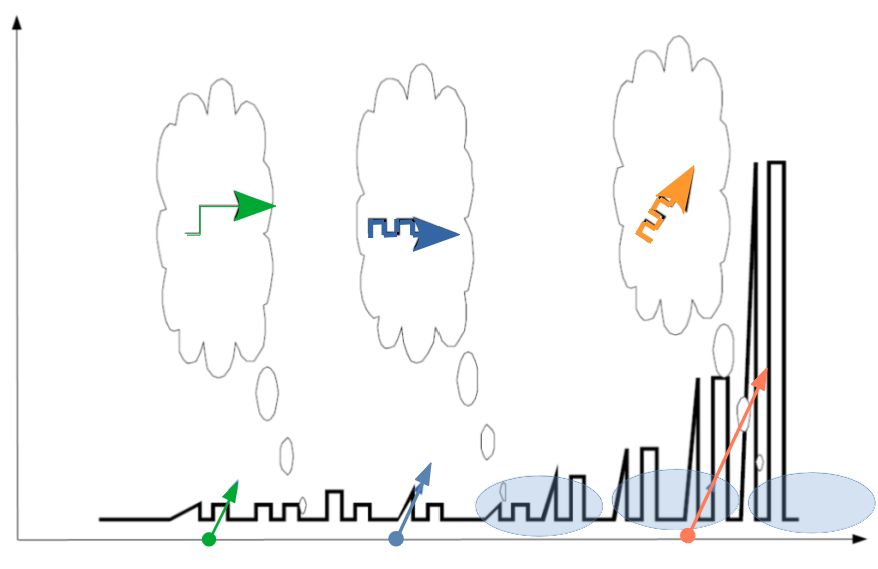
Consider the following graph:
(c) Andreas Körber 2018
It is to visualize the idea that increasing recognition of change in historic time (the x-axis) first leads to the development of the traditional type (asking for the origin of the currently valid, in cloud 1), then the experience that what has originated can also perish again and therefore asking for origins is not enough, lead to the development of the exemplaric type, asking for patterns and rules behind the change on the surface (cloud 2), and only modern experience of increased/accelerated change then led to the development of the genetic type, asking for the direction.
Each of these patterns leads to different expectations for the future. Initially (green perspective), the future may seem quite similar from the present. What is perceived as having begun, stays valid. Only from the (later) blue perspective, a pattern seems discernible, leading to the expectations that the future will also yield similar patterns of events as are detected in the past. From the (still later) orange perspective, an (additional?) increase in their „magniture“ can be perceived and its continuation be expected.
The graph also is to show that the rules and patterns as well as ideas of origins have not been rendered obsolete by each new type, but are superimposed or integrated into it.
I use this graph in my lecture. I now have added the small arrows. They are to indicate the learning-necessities of a person within a relatively short time-span of life or even youth. While in pre-modern times, they only encountered the then-developed patterns (if the model is valid), in modernity, they will have to use all patterns simultaneously, in order not make sense differentially.
The idea of a homology is problematic in another way, also. It might suggest that people in antiquity (or pre-modern-times) were developed rather like children or youths, not really grown-ups. This idea is not new, but is very problematic. As you might be aware of, Rudolf Steiner, founder of anthroposophy, suggested that the „ancient“ Greek had a mental age of about 7-years-olds. And there was a very influential German „didact“ of history in the 19th century (Friedrich Kohlrausch), who combined a similar idea of the homological development in the way people conceived „god“ with that of becoming of age. So only the modern man was really „grown up“ (and is was the Germans who did so — very nationalist).
Because of Rüsen’s idea of a „homology“ in the sequence of development of narrating types between mankind (phylogenesis) and individuals (ontogenesis), Bodo von Borries (and I as assistant to him) did a large-scale research in the early 1990s, were we presented students with items of different typological logic to dilemma-situations, like Rüsen himself has used for qualitative research and for explaining the narrative types. We did find a predominance of agreement to „traditional“ items with 6th-graders (abt. 11 yrs), but found no linear development. In fact, 9th-graders seemed even to regress. All this is published in German only, I fear.
I would strongly suggest to distinguish between the historical development and hierarchy of these patterns on the one hand and progression in learning on the other hand, for which I suggest the third dimension.
As for Lévesque’s revised table of competencies in a further comment in PHW and his evaluation that Gabriel Reich is correct in that the genetic type provides no solution to the question of whether to keep or get rid of monuments: Do these types really lead to specific political positions — especially if they are always combined? Or do they rather characterize part of their underlying understanding? I think there are different positions and solutions possible by each narrative. The value of the differentiation of types of meaning making and narration is rather analytical than prescriptive.
And that is also the pedagogical value: I think these typologies (your table and mine) can be used for classifying and discussing statements of people in the political debate. It will enhance students ability to recognize the logics behind specific political stances. And it may well show that both suggestions of keeping and of getting rid of can be underpinned by different types of narrative, but that would generate maybe different policies:
Take an example from Gabriel Reich’s patch, again: civil war monuments in Richmond.
One could argue for keeping the statutes on Monument Avenue on grounds of purely traditional thinking: to mark the origins of the specific state of things. This is both possible in partisan ways (only „our“ heroes), but also in a more „inclusive“ form, asking for such monument of both sides to be presented, to mark the origin of the countries „division“. Equally in traditional mode (but with different political background), one might call for their removal. If you hold that the division they mark is no longer given, they might be removed.
In exemplaric mode (as I opined earlier), one could speak out for the preservation of the monuments on the grounds that they exemplify a certain time and culture which we can still consider as „overcome“, but one can also argue for their removal because they represented outdated or politically non-supportable relations to the past, and that our time needs to find new ones, not „progressed“ ones, but such which reflect the „characteristics of our time“.
I do agree that to hold a specifically genetic view makes it hard to envision the whole question as one of keeping vs. removing, — but it doesn’t exclude it to the full extent.
If people are thinking predominantly in genetic mode, experiencing the country to having overcome that division, they object to a traditional logic they perceived the monuments to have. In this case, it would be the tension between one’s own genetic mode of thinking and that perceived in the monuments, which would generate a political position.
If the genetic perspective was upon how to improve commemoration, one might ask for making such commemorations „more inclusive“. This may have been behind erecting a monument for Arthur Ashe among the confederate generals – not a very consistent move, though, given that is merely additively combines monuments. In fact, it creates a „memorial landscape“ of a rather complex narrative structure, part of which is traditional („heroes“) and exemplary („each group“), but by doing so enforces a new kind of traditionality (keeping the racial groups apart, assigning each „their own“ tradition to hold up). So the intended „progress“ by inclusivity („An avenue for all people“) may in fact have created a multi-traditional narrative.1
But there are other possible solutions suggested by genetic thinking. The concept of past people being „children of their own time“ is as genetic as it can get, referring to a fundamental change in time, so that morals and actions might be considered incommensurable across times. This concept has been used for exonerating past peoples views and actions. On this ground, one might call it „useless“. But it isn’t. Genetic historical thinking entails both — to recognize the temporal change and moral and political contexts for past actions different from ours, AND to recognize that our own context is valid, too.
From this point of view, it may underpin a present position transgressing the „keep/remove“-divide, namely to find ways of memorializing civil war „heroes“ (and/or „villains“ that is) that do NOT inadvertently invite for traditional or exemplaric heroic reading, but specifically marks the distance of time.
It is imperative, this thinking goes, to keep these memorials, but not as heroic marks to the past or as ambivalent markers. One should not just remove them, for that would put into oblivion not only the past, but also the whole discussion and reflections, the uneasiness about its representation which sparked the discussion in the first place. Genetic thinking would not be content to just remove the heroism (especially that of the wrong, side) with the effect to have no memory at all, but would call for a memorialization which specifically marks the change between that time and ours today.
Again, take a Hamburg example. In an earlier contribution to this discussion I already hinted to counter-memorialisation. One of the best examples is here in Hamburg-Altona:
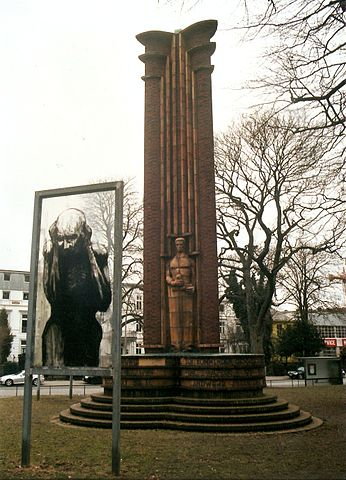
Next to Altona’s St. Johannis Church, a monument had been erected in 1925 for the members of the 31st Infantry Regiment in WW1, commissioned by survivors of that regiment. Each of the three sides of the column-like monument made of clinker features an oversized, half-naked figure, representing a warrior with some antique weapon.
The inscription below reads „To the fallen for a grateful memory, to the living for a reminder, to the coming generations for emulation.“3. Clearly a very traditional proto-narrative, both extending the own warriorship of the soldiers into antiquity and calling for its emulation, lacking any transcendence. The formula was coined by August Böckh for Friedrich Wilhelm III of Prussia, and was used on monuments remembering the „liberation wars“ against Napoleon, but also later on those for the „unification wars“ of 1870/71. After the losses of millions in WW1, its usage – especially of the third element – is remarkable, albeit not alltogether uncommon4.
In the mid-1990s, the church’s congregation commissioned a counter-memorial, created by Rainer Tiedje, consisting of three acryl-glass-plates, each directly confronting one of the warriors, depicting „dark, emaciated, fearful creatures“, as the explanation on the page „denkmalhamburg.de“ states (thus on http://denkmalhamburg.de/kriegerdenkmal-an-der-st-johanniskirche/, my translation). It concludes „In the center the heroism and the exaltation, in front of it it the horror of war. A successful mixture.“ (my translation).

To me, this countermemorial is not just a (exemplaric-mode) juxtaposition of (tradtional-mode) heroism and horror of war, but there is fundamentally genetic part in it: the counter-memorial does not merely point to timeless horrors of the consequences of warfare, but leans on a visual vocabulary established in Holocaust memorials: The „suffering men“ who wriggles with pain (and fear) on eye-level with the warriors, look like „muselmen“, the completely debilitated and immiserated inmates of the Nazi concentration camps. In its iconography, the counter-memorial belongs to the generation of monuments which coerce the viewer, the public to find and answer, not providing one themselves, either in being abstract or – as here – by visualizing death and disappearance in any but heroic form5. It is this feature, using a visual code depending not only abstractly on hindsight but on concrete knowledge about what such heroism-propaganda did help to bring about, together with the effective placing which renders impossible „commemoration ceremonies, at which the plaques are not noticed“, which indicate to a specific genetic thinking below it, trying to transgress the thinking of the time.
„History is the fiction we invent
to persuade ourselves
that events are knowable
and life has order and direction“
(( Watterson, Bill (2010): „Calvin and Hobbes“ 19.7.1993; In: The complete Calvin and Hobbes. Book 3. Kansas City: Andrews McMeel., p. 210 ))
The question of „facts“ does not let go of historiography, history didactics and history teaching. A few years ago it had been the subject of a public controversy about the teaching of history – also and especially in the context of the Hamburg Historians‘ Conference – on which I also commented here in the blog.1 And, — according to the reports of some participants* on Twitter — it has been raised again at the (still running) „histocamp 2019“ in Berlin.
Finally, it was also the subject of the 2018 issue of the Zeitschrift für Geschichtsdidaktik, which I edited, where it was contrasted with „fictions“. Since I did not elaborate on it the necessary form and clarity in my introduction, I would like to argue here that both the concept of „facts“ and the opposition to „fictions“ are part of the problem, but not part of the solution (the repetition of this question already points to the problem). So what is the problem?
There is much truth in the quotation given as the motto of this article – as much about the function of history (orientation) as about the desire to simply „know“ and „convey“ things (events).
Exactly this latter need is what caters to the idea of „facts“ as given entities only to be taken note of and considered as the basis for all efforts of higher historical thought processes. Even if the concept of historical knowledge — contrary to some ideas in the broader public — cannot be reduced to it (procedural knowledge about procedures of gaining knowledge, conceptual and also metacognitive knowledge are widely acknowledged), the idea of „knowledge“ of facts as the basis, the starting material of historical thinking and the gaining of historical insights is still often part of it. The article quoted in the controversy quoted at the beginning „Pupils must learn facts“ by my Berlin colleague Thomas Sandkühler is just one example.
The idea that the availability of such knowledge is a rather low level of historical learning also underlies the widespread taxonomy of learning objectives according to Benjamin Bloom – at least its modelling of the cognitive dimension. This distinguishes in ascending order in the image of a pyramid „knowledge“, „comprehension“, „application“, „analysis“, „synthesis“ and „evaluation“.
Similarly – and perhaps even more sharply – it is formulate in the revised version after Lorin Anderson and David Krathwol, in which the nouns are replaced by verbs indicating operations and where the order is slightly reversed and the last stage is changed: „remember“, „understand“, „apply“, „analyze“, „evaluate“ and „create“.
The idea of progression of learning underlying this gradation is – at least for the domain and discipline of history – highly problematic: US historian and history educator Sam Wineburg recently postulated that historical knowledge cannot be the basis and starting point of historical thought, but rather is to be regarded as its result. He calls for the taxonomy, according to Bloom, to be rotated by 180° in order to turn it from head to toe, so to speak.2 In the background of this position stands Wineburg’s well-known position that historical thinking is not something innate to man — an „unnatural act“. Without a process of learning that is quite strenuous, we would be able to understand all the phenomena of the past with the help of the information that is available to us from our present lives – „presentist“, that is.
Not only must we learn abstractly that the past was different, that people had different (and by no means inferior) perspectives, horizons of understanding, and worldviews, but we must (according to Wineburg) laboriously train ourselves to assume and recognize this otherness in dealing with questions of the past and materials from the past. This also applies to the identification of what was the case. „Knowledge“ about the past with regard to its actuality is thus the supreme result of historical thought – but by no means an easy prerequisite.3 By the way, this also fits in perfectly with a statement of the German colleague Karl Ernst Jeismann, according to which value judgements („evaluation“) are by no means at the end, but at the beginning of many historical thought processes – at least in the form of relevance decisions, which set the preoccupation with the past and its meaning in motion.4
I myself consider Wineburg’s criticism of the taxonomy of Bloom or Anderson/Krathwol to be justified, but his solution its 180° rotation is not a solution, for it overlooks the fact that „knowledge“ or „remembering“ – like most abilities and activities – never exist only in a quality or elaboration stage. It would also be wrong to locate knowledge only at the end of long learning processes. This applies equally to the operations of application, synthesis, evaluation – and of course also to understanding. For all these operations apply, however, that they not only occur in simple everyday forms as well as in highly elaborated studies by experts and researchers, but are explicitly addressed.
Keeping in line with Wineburg’s pictorial metaphor, I therefore suggest that the taxonomies not be rotated by 180° but rather by 90° and that their pyramid form be dissolved. This would yield a set of „columns“ for the individual abilities and operations, which then can be differentiated individually as to the quality of the operation resp. ability described. „Learning“, then, is not to be understood as the progress from one operation to the next after the first one has been „completed“, but as a process of elaboration both of the individual operations or abilities and their respective connections.5
But then „facts“ are neither simply prerequisites nor the sole final goal of historical thought and learning processes. Rather, they are mental summaries of facets of past life, action, suffering and being at different levels of abstraction and reflection for the purpose of naming and communicating them and including them in further argumentation. They are neither a prerequisite nor a result, but complexes of knowledge, distinctions and assignments of meaning gained in a (historical) thinking and judgement – and as such they are both a result and a prerequisite of historical thinking. But with that they are not simply „given“, but require reflection and understanding again and again. This is especially so because the demarcation of such „facets“ of the past from others is by no means predetermined, for the „differentiation of things as they were and of things as we see them“ is, with Peter von Moos, „from the outset ‚an empty gesture‘, because we are exclusively confronted with a selection of linguistically composed memorabilia (or ‚facts‘) from myriads of events, filtered by interpretation and to be interpreted“.6. What can be isolated as a „fact“ is not only a question of the accuracy of historical work, but also a question of perspective, of questioning, of interest, of the ability to distinguish (so to speak the „glasses“), which is shaped by the horizon of perception and perception.
Not only must we learn abstractly that the past was different, that people had different (and by no means inferior) perspectives, horizons of understanding, and worldviews, but we must (according to Wineburg) laboriously train ourselves to assume and recognize this otherness in dealing with questions of the past and materials from the past. This also applies to the identification of what was the case. „Knowledge“ about the past with regard to its actuality is thus the supreme result of historical thought – but by no means an easy prerequisite.3 By the way, this also fits in perfectly with a statement of the German colleague Karl-Ernst Jeismann, according to which value judgements („evaluation“) are by no means at the end, but at the beginning of many historical thought processes – at least in the form of relevance decisions, which set the preoccupation with the past and its meaning in motion.
I consider Wineburg’s criticism of the taxonomy of Bloom or Anderson/Krathwol to be justified, but his solution its 180° rotation is not a solution, for it overlooks the fact that „knowledge“ or „remembering“ – like most abilities and activities – never exist in one quality or elaboration stage only. It would also be wrong to locate knowledge only at the end of long learning processes. This applies equally to the operations of application, synthesis, evaluation – and of course also to understanding. For all these operations apply, however, that they not only occur in simple everyday forms as well as in highly elaborated studies by experts and researchers, but are explicitly addressed.
The taxonomies must rather (if one already follows Wineburg’s pictorial solution) not be rotated by 180°, but by 90° and their pyramid form dissolved, so that several „columns“ for the individual abilities and operations arise, which can be „stepped“ individually in each case. „Learning“ is then not to be understood as the progress from one operation to the next after the first one has been „completed“, but as a process of elaboration both of the individual operations or abilities and their respective connections.7
But then „facts“ are neither simply prerequisites nor the sole final goal of historical thought and learning processes. Rather, they are mental summaries of facets of past life, action, suffering and being at different levels of abstraction and reflection for the purpose of naming and communicating them and including them in further argumentation. They are neither a prerequisite nor a result, but complexes of knowledge, distinctions and assignments of meaning gained in a (historical) thinking and judgement — and as such they are both a result and a prerequisite of historical thinking. But with that they are not simply „given“, but require reflection and understanding again and again. This is especially so because the demarcation of such „facets“ of the past from others is by no means predetermined, for the „differentiation of things as they were and of things as we see them“ is, with Peter von Moos, „from the outset ‚an empty gesture‘, because we are exclusively confronted with a selection of linguistically composed memorabilia (or ‚facts‘) from myriads of events, filtered by interpretation and to be interpreted“.8. What can be isolated as a „fact“ is not only a question of the accuracy of historical work, but also a question of perspective, of questioning, of interest, of the ability to distinguish (so to speak the „glasses“), which is shaped by the horizon of perception.
Does this now lead to a relativism? Not at all, – or at the most with regard to the aspect of delimitation and identification of the „facts“ mentioned last, but not with regard to their actuality. Whoever rejects the concept of „facts“ by no means asserts arbitrariness and by no means necessarily speaks for (free) fiction, even if all names of facts and events always adhere to conjectural parts due to the particularity of tradition, selectivity and perspective. The problem with the „facts“ does not consist in their factuality, but in their presumed and maintained character as given units, which as such one can know and know, without considering the perspectivity and the interest that led to their differentiation. „Auschwitz“ (to take a very clear example) is not a „fact“. This sentence does not deny that there has been Auschwitz, but it recognizes that (1.) the term „Auschwitz“ designates more than a neutral, clearly delimitable and also not further decomposable unit of the past, which only in retrospect gains reference to and meaning for others. No, what we call „Auschwitz“ is gradually different for the people who suffered and were murdered there, for the survivors and their descendants who also suffered, but also for the perpetrators and their descendants, and finally for us today. There is not one Auschwitz, there were and there are many. But this does not mean that they had nothing to do with each other, that they existed separately, or even that Auschwitz was „only“ constructions.
What is at stake here, however, is not whether „Auschwitz“ is „a fact“, but rather the facticity of the events and experiences specifically described by the term „Auschwitz“. This is very well documented (in the vast majority of cases). The opposite of speaking of the „fact of Auschwitz“ is therefore not the assertion of its fictionality. Not „fact“ or „fiction“ is the correct opposition, but „presupposed fact“ or „insight into the past and its facticity gained by thinking“. Both, the respective concrete delimitation and summary as well as their property of „factuality“ can be gained in the mode of historical thinking, are the results of such thought processes. Otherwise „fake news“ and lies could not be identified and separated. The „memories“ of „Benjamin Wilkomirski“ (actually Bruno Dösseker) and the „Auschwitz“ figuring therein (only „identified“ outside the book), for example, could and had to be denied factuality, without this also applying to Auschwitz as a whole.
The fact that both the identification and delimitation of the respective event or occurrence and its factuality are results of thought processes does not prevent them from being addressed as facts in communication about the past and history. To let such „facts“ learn as „as such“ and to „convey“ them to schoolgirls as a prerequisite for interpretation and interpretation undermines the development of the competences that are necessary to be able to exist critically thinking in the diverse and problematic historical culture.
Not only order and sense („order and direction“), but also the „knowledgeability“ of events (and, add: circumstances)9 are thus result, but not condition of historical thinking – and should also figure as such in historical learning processes. And if it were not for the slightly ironic-fatalistic tone of Calvin’s wisdom (which serves him in the comic to want to write a „revisionist“ biography of himself), much of the quote would be quite seriously worth considering. One would, however, have to replace the terms „fiction“ and „invent“ not by their opposites („facts“ and „find out“), but by „narratives“ and „create“ — or even „construct“. „Stories are the narratives we construct to convince ourselves that we know something [about the past] that offers us order and orientation in our lives.“
That is what is meant by historical thinking being „contingency management“ („Kontingenzbewältigung“). The concept of „contingency“ here describes far more than „coincidence“. It refers to the uncertainty that arises between the two beliefs (a) that everything in the world and in life is clearly predetermined, and (b) that there are no connections between details of life whatsoever (both within and across times).
The first conviction would make historical thinking unnecessary, because we ourselves would have to judge ourselves as completely determined and thus without any possibility of decision, without any freedom of attention, perception, judgement and decision. „Orientation“ would not only be useless – we would not even come up with the idea of searching for it. The latter position in turn (complete coincidence) would have to lead us into an absolute aporia, because strictly speaking we could not expect anything with any degree of certainty. The fact that we also always have a connection of some kind between phenomena, circumstances and occurrences in life, even beyond time, is thus an essential element of contingency (con-tingere, lat.: to touch, to transfer), but also that this connection is not simply given and recognizable, but offers comprehensive (albeit not infinite) degrees of freedom. It is this area of contingency between presupposed, but not unquestionably and unambiguously determinable meaning of the past for the present and the future, for our expectations and plans, that makes historical thinking necessary – and with it „knowledge“ about the past, which, however, is not simply given. Knowledge of „facts“ can also be opened up historically thinking, in the form of conclusions about the factuality of details, namely, as such about synchronous and diachronic connections and, finally, also as conclusions and evaluations about significance and meanings for our own and all present and future.
What consequences could be drawn for history education and history lessons in schools? Does it mean that no more „facts“ are allowed to appear in teaching units and lessons, that it were no longer permissible or acceptable to no longer present facts (structures) and occurrences (events, event sequences, actions, etc.) in teacher lectures, timelines and tables, author texts in books, etc. — to make them available to students as material for their work? Not at all! Such references are not only instruments of school learning, but also part of social communication about history. And depending on the concrete question and task, it is not only helpful but also necessary to make them available to pupils or to let them work them out themselves. However, this does not mean that these occurrences and structures should not or even must not come into the focus of reflective, differentiating and evaluative thinking in the course of working with them. QUite to the contrary: it is almost part of the task of historical learning not only to consider, but also to examine and, if necessary, reformulate, differentiate or reject statements and assertions made in the materials (especially those in primary sources and accounts from different perspectives).
And more: The understanding of „facts“ (if one does not want to drop the term completely) not as givens, but as references to facets of history, „provisionally“ being formulated within the course of thought, research and communication not only renders it possible to differentiate and to interpret them, but also to compare culturally and linguistically different forms not only of their designation and interpretation, but also of their definition. This enables the explicit thematization and reflection of such different terms as „Seven Years‘ War“, „French and Indian War“, „3rd Silesian War“, „Great War for the Empire“, „Guerre de la Conquête“ and „Third Carnatic War“ as terms both for different, but also (more or less) connected events and – even more – for the political, cultural and temporal perspectives inherent in such terms (some of these terms only being possible retrospect). It is also possible to explicitly discuss designations in Simple and Easy Language with regard to their power (for the development of the facts and the participation in the learning processes and interpretations) and limitations, and the need for further explanations and additions.
The consequence of the problematization of the concept of „facts“ due to its possible connotation (especially in the case of learners) of them being – so to speak – „upstream“ of historical thinking and learning and thus also partially detracted from it, and from the alternative focus on „factuality“ as the actually intended and relevant characteristic, is, therefore, not relativism, but rather the necessary facilitation at all times of the thematization and reflection both of the constitution of the individual „facts“ and of their qualification as „factual“. The latter operations are represented by the concept of validity („Triftigkeit“) or plausibility, above all in empirical terms10, which renders it possible – in an elementaryized, or more precisely: graduated form – for students to arrive at their own conclusions on the factuality of asserted events. Finally, the focus on factuality instead of on „facts“ also opens up the construction of a learning progression in the recording and reflection of these dimensions of historical thought and historical communication that can be taught and learned „step by step“ so to speak.