Eine englischsprachige Fassung ist in Vorbereitung.
Gratulation den Autor*innen zur Publikation!
Das Dossier enthält folgende Beiträge:
Roers, Benjamin; Weise, Mara; Rentschler, Hannah; Bäumer, Marlon (2024): „Definitionen. Das Denkmal gibt es nicht.“ In: Benjamin Roers, Mara Weise (Eds.): Denkmälern begegnen. Zur Auseinandersetzung mit einer alltäglichen Geschichts-Sorte. Dossier (Zeitgeschichte Online). https://zeitgeschichte-online.de/node/70784.
Roers, Benjamin; Weise, Mara; Bäumer, Marlon; Rentschler, Hannah (2024): „(Be-)Deutungen. Die Geschichts-Sorte Denkmal ist vielfältig“. In: Benjamin Roers, Mara Weise (Eds.): Denkmälern begegnen. Zur Auseinandersetzung mit einer alltäglichen Geschichts-Sorte. Dossier (Zeitgeschichte Online). https://zeitgeschichte-online.de/node/70812.
Roers, Benjamin; Weise, Mara; Rentschler, Hannah; Bäumer, Marlon (2024): „Produktion: Denkmäler werden gesetzt.“ In: Benjamin Roers, Mara Weise (Eds.): Denkmälern begegnen. Zur Auseinandersetzung mit einer alltäglichen Geschichts-Sorte. Dossier (Zeitgeschichte Online). https://zeitgeschichte-online.de/node/70892.
Roers, Benjamin; Weise, Mara; Rentschler, Hannah; Bäumer, Marlon (2024): „Rezeption: Denkmäler werden gestürzt“. In: Benjamin Roers, Mara Weise (Eds.): Denkmälern begegnen. Zur Auseinandersetzung mit einer alltäglichen Geschichts-Sorte. Dossier (Zeitgeschichte Online). https://zeitgeschichte-online.de/node/70893.
Bäumer, Marlon; Rentschler, Hannah; Roers, Benjamin; Weise, Mara (2024): „Handreichung: Denkmäler verstehen. Version 2: November 2022.“ In: Benjamin Roers, Mara Weise (Eds.): Denkmälern begegnen. Zur Auseinandersetzung mit einer alltäglichen Geschichts-Sorte. Dossier (Zeitgeschichte Online). https://zeitgeschichte-online.de/node/70785.
Weise, Mara (2024): „Begegnung I: Deutungskämpfe – Der Kriegsklotz am Hamburger Dammtor“. In: Benjamin Roers, Mara Weise (Eds.): Denkmälern begegnen. Zur Auseinandersetzung mit einer alltäglichen Geschichts-Sorte. Dossier (Zeitgeschichte Online). https://zeitgeschichte-online.de/node/70811.
Roers, Benjamin (2024): „Begegnung II: Nationalismus in Rheinkultur – Die Germania in Rüdesheim.“ In: Benjamin Roers, Mara Weise (Eds.): Denkmälern begegnen. Zur Auseinandersetzung mit einer alltäglichen Geschichts-Sorte. Dossier (Zeitgeschichte Online). https://zeitgeschichte-online.de/node/70893.
Zur Thematik siehe auch meine kurz zuvor erschienene Arbeit:
Im Rahmen einer seit längerem laufenden kollegialen Diskussion über historisches Denken- Lernen an/mit und über Denkmäler habe ich heute einen Artikel auf pedocs veröffentlicht, der u.a. eine Antwort auf einen jüngeren Artikel von Stéphane Lévesque (Ottawa) darstellt. Der Artikel ist open access frei verfügbar.
As part of an ongoing collegial discussion about historical thinking – learning at/with and about monuments, I published an article on pedocs today that is, among other things, a response to a recent article by Stéphane Lévesque (Ottawa). The article is freely available open access:
Körber, Andreas (2023): Elaborating Historical Thinking on Monuments. Available online at https://www.pedocs.de/volltexte/2023/28266.
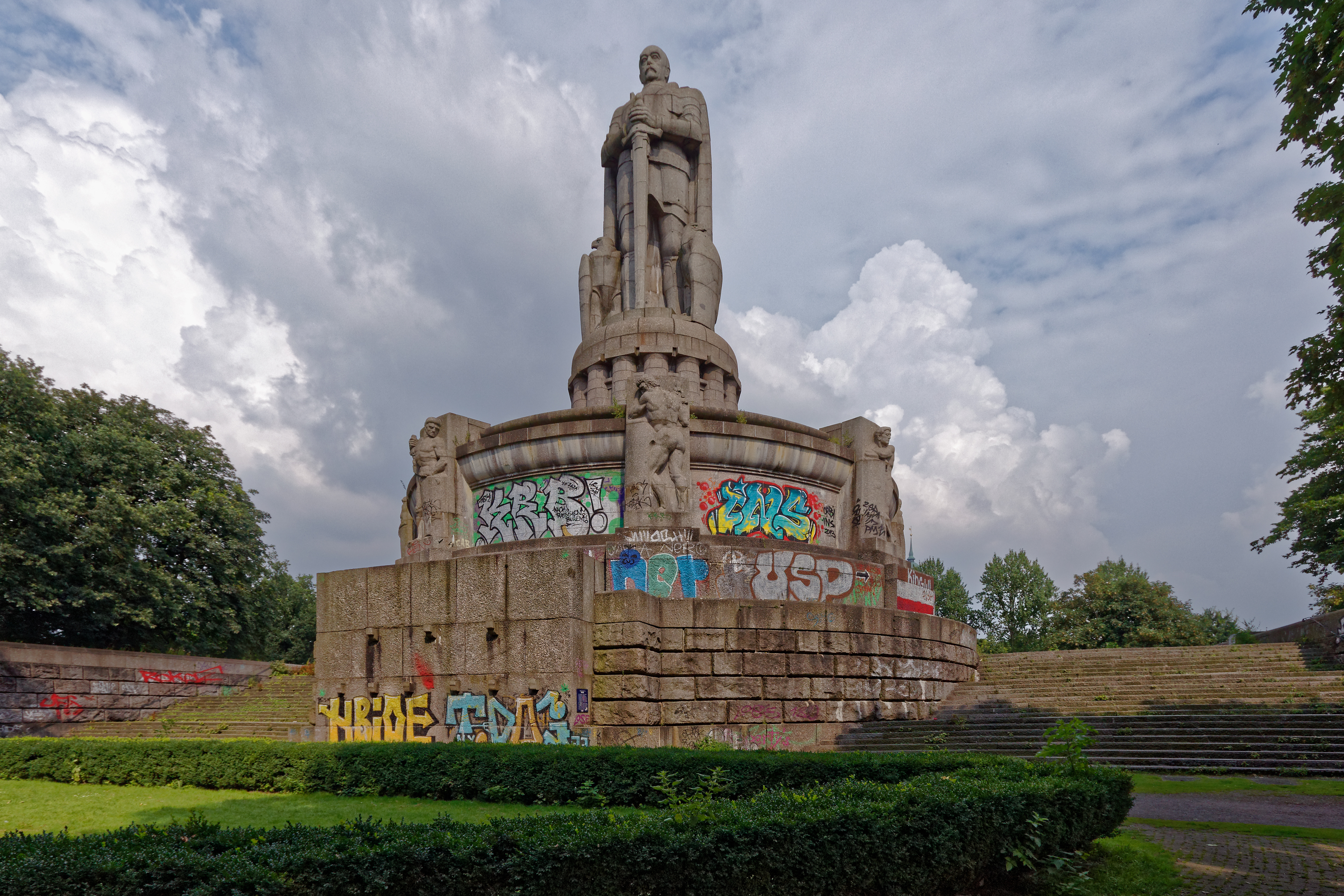
Heute erhielt ich von meiner Kollegin Dr. Myriam Richter die Ausschreibung zum für die Stiftung Historische Museen Hamburg vom Architekturbüro Luchterhandt organisierten „internationalen offenen Ideenwettbewerbs zur Kontextualisierung des Bismarck-Denkmals im Alten Elbpark“ über dem Hamburger Hafen unter dem Titel „Bismarck neu denken“ weitergeleitet.
Einen solchen Ideenwettbewerb als Teil des Projekts „Hamburg dekolonisieren“, einer „Initiative zur Aufarbeitung der kolonialen Geschichte“ der Stiftung in Kooperation mit der Behörde für Kultur und Medien Hamburg und gefördert von der Kulturstiftung des Bundes halte ich für unbedingt geboten. Zu wünschen ist, dass er tatsächlich „offen“ ist – nicht nur dahingehend dass über die in der Pressemitteilung erwähnten „Künstler*innen und Architekt*innen“ aus dem In- und Ausland anspricht, sondern in seiner ersten Phase durchaus auch Beiträge aus der breiteren Öffentlichkeit kommen, sondern auch durch einen zu wünschenden transparenten und offenen Prozess der Diskussion der verschiedensten Beiträge.
Drei Bilder des Bismarck-Denkmals vor und nach der Reinigung/EM>
Anlass für diesen Blog-Beitrag ist aber ein Detail der nun veröffentlichten Unterlagen und der zugehörigen Webseite des Büros Luchterhandt, nämlich die Bebilderung mit Fotos, die die im Vorfeld der bislang letzten Runde der durchaus kritischen öffentlichen Debatte oftmals angesprochene Reinigung des Denkmals nicht nur von Spuren von Verwitterung und industriellen Ablagerungen, sondern gerade auch von Graffiti — nicht alle, aber viele davon Ausdruck einer kritischen Haltung zu diesem Denkmal zeigen.1 und offenkundig von Mitarbeiter*innen der ausführenden Firma Kärcher selbst angefertigt wurden, bzw. deren Rechte zumindest bei dieser Firma liegen (der entsprechende Hinweis auf der Seite bei Luchterhandt lautet: „Bildrechte | Image copyrights: Alfred Kärcher SE & Co. KG“).
Das ist gerade auch deswegen interessant, weil die entsprechende Firma nicht nur mit ihrer Kompetenz in der Herstellung von Reinigungsgeräten und -materialien sowie offenkundig auch ihrer sach- und fachgerechten Anwendung wirbt, sondern auf ihren eigenen Webseiten (www.kaercher.com, www.kaercher.de) ihre Expertise und ihr eigenes Engagement in der Bewahrung der Denkmäler der Welt herausstellt:
— Moooment: „free of charge“ / „kostenlos“!? — Geht der Auftrag vielleicht gar nicht auf ein Bestangebot in einer Ausschreibung zurück, sondern auf eine Inanspruchnahme dieses hochherzigen und selbstlosen Engagements? — Nein, ausführendes Organ war offenkundig eine Hamburger Firma in Zusammenarbeit mit Kärcher (vgl. Fassadenreinigung Zywicki – mit weiteren Bildern der Ausführung)
Sei dem wie es sei: Die Nutzung der Bilder von Kärcher zur Bebilderung der Ausschreibung und der Weseite bedeutet zunächst einmal, dass — wenn auch ohne explizite Erwähnung im Text — die umstrittene Aktion Im Rahmen der Neugestaltung nicht völlig unter den Tisch gekehrt werden soll, sondern als Rahmen mitzudenken gewünscht ist.
Andererseits: Ob die „Neurahmung“ des „weithin sichtbaren“ Denkmals tatsächlich eine solche Reinigung erforderte, ja ob sie nicht selbst bereits einen Vorgriff auf diese Neurahmung darstellt, muss durchaus kritisch reflektiert werden. Einerseits kann man es ja verstehen, dass man die Ideen der Teilnehmer*innen nicht mit Altlasten belasten will (oder zumindest allenfalls mit derjenigen, die das Denkmal selbst für einige darstellt), sondern den Gegenstand gewissermaßen mehr als besenrein übergibt. Dass es bei solchen Reinigungen von Denkmälern keineswegs immer nur um die Befreiung von schädlichem Schmutz und Ermöglichung von Schadensaufnahme und Restauration geht, sondern dass die Denkmäler im Laufe der Zeit neben „biologischem Bewuchs oder schwarzen Krusten“ (Kärcher, s.o.) auch Lagen kultureller Bezugnahmen, der Auseinandersetzung mit ihnen, also neue Kontexte angelagert haben, die zu entfernen eben nicht nur Schadensbeseitigung oder -begrenzung ist, sondern auch (ob intendiert oder nicht) kulturelles „Whitewashing“ bedeutet, ist offenkundig weder im dargestellten Selbstverständnis der Firma Kärcher noch bei den Hamburger Verantwortlichen bedacht worden.
Zu bedenken ist dabei vor allem auch, dass diese — sowohl zeitlichen als auch sozialen — Schichten von Geschichts- und Erinnerungskultur, die Denkmäler „anlagern“ und zu ihrer Reflexion dazugehören, ja keineswegs nur aus Kritik bestehen, und keineswegs nur nicht-offiziellen („Protest“-)Charakter tragen, den man als „Schmiererei“ abtun könnte, sondern dass gerade auch „offizielle“, staatlich mandatierte Formen des (Um-)Gestaltung und des Gebrauchs dazugehören, die alles andere als konträre Positionen markieren, sondern (ebenso zeit- und positionsgebunden und somit der Reflexion bedürftig) auch affirmative Vereinnahmungen darunter sind, die aus je gegenwärtiger Sicht ihrerseits als „Missbrauch“ deklariert werden können. Am Hamburger Bismarck-Denkmal sind solche Spuren etwa in Form völkischer bis hin zu faschistischen/natonalsozialistischen Gestaltungen der Räumlichkeiten im Sockel zu erkennen ist.2
Der Firma Kärcher ist dabei wohl nicht wirklich ein Vorwurf zu machen, ist doch Reinigen ihr Geschäft und dessen extensive Bewerbung gewissermaßen der Logik der Wirtschaftsordnung geschuldet. Festzuhalten ist die in ihrer Darstellung zu findende enge Konnotation von „Erhaltung“ mit „Reinigung“ und gewissermaßen „Wiederherstellung in einen ursprünglichen Zustand“ aber sehr wohl, sind sie doch offenkundig weit verbreitete Charakteristika der geschichtskulturellen Mentalität unserer modernen Gesellschaften. Gerade in dem, was im Deutschen überwiegend als „Denkmalschutz“ bezeichnet und international als „heritage“ bezeichnet wird, spielen traditionale Geschichtsbezüge zwar keine Solo-, aber doch eine weitaus prominentere Rolle als in anderen Facetten der Geschichts- und Erinnerungskultur.
Muss das so sein? Ist es „natürlich“, also ein Zug menschlichen Umgangs mit Vergangenem, der selbst gattungsgeschichtlich nicht einmal auf einen Ursprung zurückgeführt werden kann, sondern quasi eine anthropologische Konstante darstellt? Das wäre wohl zu bezweifeln. Dass Menschen auf Veränderungen und insbesondere auf Verlust mit traditionalem Erinnern reagieren, hat wohl durchaus seinen Ursprung in einer frühen Erfahrung von Vergänglichkeit. Man kann darin auch den Ausdruck einer zeitübergreifend gleichbleibenden kulturellen Praxis sehen, also gewissermaßen exemplarisch Sinn bilden dazu: Gesellschaften aller Zeiten und Kulturen bilden Sinn, indem sie ihre Helden auch bildlich, plastisch darstellen und sie so zu verweigern versuchen („exegi monumentum are perennius“): Dann handelte es sich bei allen Beispielen politischer Denkmalsetzung samt der Auseinandersetzungen um sie um Beispiele für ein zeitübergreifend stabil bleibendes Verhalten, das man erlernen, aber kaum in seiner Grundlogik verändern könnte. — ist das plausibel?
Gerade die gegenwärtigen Auseinandersetzungen um das Stürzen, Verändern und Kommentieren öffentlicher Denkmaler in vielen Ländern (man denke an die vielen Staaten von US-Bürgerkriegs-Generälen in den Hauptstädten des Südens der USA, an Colston in Bristol, an MacDonald in Kanada, an Rhodes must Fall in Kapstadt und anderen Städten, bis nach Cambridge und Oxford; vgl. auch insbesondere Alex von Tunzelmanns Buch „Fallen Idols“) zeigen doch wohl, dass ein solcher Umgang, der an der Logik öffentlichen Erinnerns mittels Denkmälern festhält, die das Denken und Fühlen einer Zeit und Gesellschaft (und oftmals auch nur einer kleinen Gruppe darin) dem Rest ihrer Gesellschaft und der Nachwelt autoritativ und still stellend vorgebend und diese in die eigene Deutung vereinnahmt, indem es sie als Rezipient*innen anspricht, oder aber sie in die Sprecherposition ehrender Inschriften einbezieht, nicht nur der Komplexität, Heterogenität und Diversität heutiger Gesellschaften nicht gerecht wird, sondern auch Veränderungen in den Interessen und Fragen an, Perspektiven auf die jeweiligen Vergangenheiten und die aus ihnen erhofften Orientierungen wie die dabei formulierten Schlussfolgerungen ausblendet, welche die klassischen Denkmalsbotschaften wie auch die Form dysfunktional machen.
Das Hamburger Bismarck-Denkmal ist dafür ein besonders prominentes und gutes Beispiel, wird es doch in der gegenwärtigen Debatte in nicht völlig anderen, wohl aber anders konturierten Kontexten diskutiert — vornehmlich mit Bezug auf die koloniale Vergangenheit Deutschlands und Bismarcks Rolle darin.
Gerade auch in dieser Hinsicht ist das Motto des Wettbewerbs „Bismarck neu denken“ zu begrüßen und lediglich als teilweise schon erfolgt zu beurteilen. Mehr noch: Wenn die aktuellen Debatten und der Wettbewerb nur dazu führen, dass das Denkmal durch ein anderes oder verändertes ersetzt oder dazu weiter entwickelt werden, die dem gegenwärtigen Interessens-, Frage- und Problematisierungshorizont entsprechen, dann ist zwar einiges gewonnen, aber nur Begrenztes.
Wenn etwas nicht nur aus der Betrachtung der (oft nur mühsam errungenen) Veränderung Deutschlands und seiner Beziehungen zu anderen Ländern und Kulturen einerseits und der Geschichte von Zeit, Person und Politik Bismarcks zu lernen ist, sondern auch aus der Analyse des gesellschaftlichen Umgangs mit solchen und besonders dieser Ehrung, dann ist es doch, dass auch unsere gegenwärtigen Befindlichkeiten und Bedürfnisse, auch die sehr berechtigten danach, sich den problematischen Seiten der deutschen Geschichte zu stellen und ihrer Verherrlichung entgegen zu treten, sehr wohl ihren Wert haben, ja notwendig sind, aber keinesfalls einen Stand darstellen, den man in gleicher Zeit still stellender Weise künftigen Generationen und Gesellschaften vor-geben sollte.
Wenn etwa zu lernen ist aus der Geschichte der Denkmalskulturen der Moderne und auch der frühen Post-Moderne, dann ist es die Notwendigkeit, das herkömmliche „Denkmalen“ (Wippermann) zu überwinden und neue Formen nicht desselben zu entwickeln, sondern Formen eines zukunftsfähigeren, Komplexität und Spannungen nicht zugunsten einfacher Botschaften ausblendenden, sondern sie geradezu zur Sprache bringenden öffentlich-präsentierenden Umgangs mit Vergangenem.
Der Verzicht auf öffentliche Präsentation, ihre Entfernung aus dem Stadt- und Landschaftsbild und somit aus der Öffentlichkeit, scheint sämtlich ebenso keineswegs zielführend. So richtig es ist, Verherrlichungen von Gewalt, kolonialen Verhältnissen, Rassismus, Antisemitismus, gruppenbezogener Menschenfeindlichkeit, aber auch einfacher nationaler Selbstüberhöhung nicht noch Reproduzieren zu wollen, so falsch wäre es, sie als Tatsache der Vergangenheit mit Auswirkungen, Folgen und nicht nur Resten bis in die Gegenwart hinein einfach zu verschweigen. Es ist die Grundfigur der öffentlichen Kommunikation mittels Denkmälern und anderen Geschichtszeichen, dass ihre Sichtbarkeit die Themen überhaupt setzt. Das gilt letztlich auch für diejenigen — sehr raffinierten und intellektuell ansprechenden — Formen, die ihre Wirkung gerade aus der Übertretung, ja Außer-Kraft-Setzung dieser Grundfigur beziehen, wie etwa für die „Anti-Monuments“ James Young“ bzw, „unsichtbaren Monumente“ von Jochen Gerz, z.B.in Saarbrücken: Auch die Unsichtbarkeit bedarf einer Kommunikation, ansonsten löst sie keine Wirkung, kein Nachdenken aus.
Eine einfache Entfernung des Bismarck-Denkmals wäre also allenfalls eine halbe, seine Ersetzung durch ein „zeitgemäßes“ Denkmal für jemanden oder etwas anderes nur ein temporärer Gewinn und gleichzeitig ein Verlust. Aber die in der Auslobung und Aufgabenstellung des Wettbewerbs geforderte „Kontextualisierung“ garantiert wohl noch nicht ein Denken, das mehr als nur anders, mehr als nur aktualisiert ist, sondern das die veränderten gesellschaftlichen und medialen Bedingungen und die (wohl gar „beschleunigt“) zu erwartende fortgesetzte Veränderung berücksichtigt.
Wessen es bedarf, ist somit wohl eine Form, welche das öffentliche Erinnern weder einfach aufhebt noch durch ein anderes, ähnliches ersetzt oder mit ihm ergänzt, sondern sie in zwei Richtungen erweitert:
Zum einen in die einer Demokratisierung und Pluralisierung des Erinnerns. Nicht mehr (nur) eine kleine Gruppe sollte Gelegenheit haben, ihre Auffassung und Sicht der weitaus großen Mehrheit zu präsentieren und quasi-autoritativ vorzugeben — nicht einmal auf dem Wege des Gewinns einer parlamentarischen Mehrheit oder im Wege eines Referendums. Ganz wie es in gegenwärtigen Gesellschaften angesichts der Pluralität, Heterogenität und Diversität ihrer Mitglieder, der von ihnen miteinander und ihren Vergangenheiten und ihre gegenseitigen Umgangs damit gemachten Erfahrungen sowie den daraus resultierenden Interessen und Fragen an Vergangenes nicht (mehr?) um Vereinheitlichung und die Herstellung einer monolithischen, einheitlichen Geschichtsauffassung einer durch sie (wohl nur vermeintlich) beförderten Kohärenz gehen kann (auch nicht im Geschichtsunterricht), sondern vielmehr um die Beförderung gewaltfreier, aber durchaus kontroverser, nicht harmonisierender, wohl aber Kohäsion ermöglichender Kommunikation und die Befähigung dazu gehen muss, kann es auch nicht Aufgabe der öffentlichen Geschichts- und Erinnerungskultur sein, Einheitlichkeit herzustellen, sondern Kommunikation in der pluralen Diversität zu ermöglichen
Zum anderen in die einer Dynamisierung, welche das Stillstellen und Verewigen des klassischen Denkmals überschreitet, aber auch nicht völlig aufhebt. Es geht also nicht um die Herstellung gewissermaßen eine leeren Fläche, die einfach immer neu „bespielt“ und beschrieben werden kann, ohne dass ein gemeinsamer Bezug zur thematisierten Vergangenheit, aber auch zu den vorangegangenen Bezugnahmen erkennbare wäre. Gerade diese intertemporale Kommunikation zwischen der erinnerten Zeit und der Sukzession unterschiedlicher Bezugnahmen auf sie gilt es zu ermöglichen.
In diesem Sinne kann eine Beantwortung der Aufgabenstellung etwa darin bestehen, das Bismarck-Denkmal weder abzuräumen noch einfach um eine statische Komponente zu ergänzen. Mir schwebt eine Lösung vor, die sowohl den Bezug auf Person, Zeit und Politik Bismarcks als auch auf den ehrenden Gestus dieses von Hugo Lederer geschaffenen Denkmals von 1906 sichtbar erhält ohne sie zu zu verewigen oder zu reproduzieren, die sie aber auch nicht (über Gebühr, ein wenig schon) lächerlich macht und damit ernsthafter Reflexion über ihre Bedeutung und Wirkung entzieht, und es zugleich ermöglicht, dass nicht nur einmal, sondern immer wieder neu Bezug genommen wird auf Bismark, seine Zeit und Taten, seine Ehrung in Zeiten des Kaiserreichs, aber auch viele Schichten bisheriger Bezüge — auch und gerade protestierender.
Gerade in diesem Sinne ist die Beseitigung der jüngsten Schichten dieser Bezugnahmen zu bedauern. Aber sie sind ja offenkundig zumindest zuvor photographisch dokumentiert worden. Warum das nicht verlängern?
den (nun einmal gereinigten) Bismarck nicht stehen lassen, aber auch nicht auf dem Kopf stellen (die Ideen von Jürgen Zimmerer ist charmant,bliebe aber wohl etwas punktuell),sondern
hinlegen an einem nahen Ort, an dem er zugänglich ist, und wo sowohl Person und Politik, vor allem aber sehr viele unterschiedliche Facetten des Umgangs mit diesem Denkmal (und zwar nicht nur solche gegenwärtig-kritischer, sondern auch problematischer Formen der Verehrung von undemokratischen Positionen aus) ebenso dokumentiert und präsentiert werden können, wie
es ermöglichen, weitere anzufügen — etwa auf einer darum zu errichtenden beschreibbaren Milchglas-Hülle, die periodisch (wohl am besten rotierend-partiell) nach Dokumentation gereinigt und nur neuen Beschreibung freigegeben wird.
Post Views:133
Diese Entfernung von Graffiti ist selbst auch keineswegs die erste, wie ein Vergleich von Bildern unterschiedlicher Aufnahmedaten etwa auf Wikimedia zeigt. Da gibt es solche mit gut erkennbaren Tags und Graffiti vor allem am Sockel und solche ohne. [↩]
Vgl. die interessanten Foto-Aufnahmen und Erläuterungen auf einer Webseite des Vereins „Unter Hamburg“: https://www.unter-hamburg.de/bunker/bismarck-denkmal/. Vgl. auch dessen „zentrale Kriterien“ der Bewertung historischer Bedeutung unter https://www.unter-hamburg.de/der-verein/der-verein/: „Nicht das Bauwerk an sich ist wichtig, sondern dessen politisch-historische Bedeutung. Diese ergibt sich aus der Einordnung des Gebäudes in seinen historischen Kontext. Historischer Kontext bedeutet dabei: 1. die konkreten Arbeitsbedingungen, unter denen das Bauwerk entstanden ist sowie die spätere und heutige Nutzung, 2. die politisch-sozialen Verhältnisse, die zum Zeitpunkt der Entstehung des Bauwerkes herrschten, 3. die politischen, wirtschaftlichen, militärischen, propagandistischen oder sozialen Ziele, die von den Erbauern und späteren Nutzern verfolgt wurden, 4. die politische Interpretation des Bauwerkes in unterschiedlichen Zeiten (Interpretation und Rezeption in der Vergangenheit und heute). „ [↩]
(This is a text from last year’s discussion with Stéphane Lévesque and Gabriel Reich on narrative patterns‘ role in reflecting on monument and memorial policy. I never got round to finishing ist. Sorry for the delay.)
While I agree that there is a lot of plausibility in a sequential development of these types of narrating throughout (Western) history, and that the genetic type is the most complex and advanced one, I don’t find much plausibility in the idea that in the development of student‘ thinking within their lifetime, the traditional type should have any priority to the other ones. Instead, I think that students encounter full-fledged narratives as well as simple statements of all types simultaneously from the beginning, and will acquire them alongside each other — but only gradually learn to recognize them for what they are, grasping their logic.
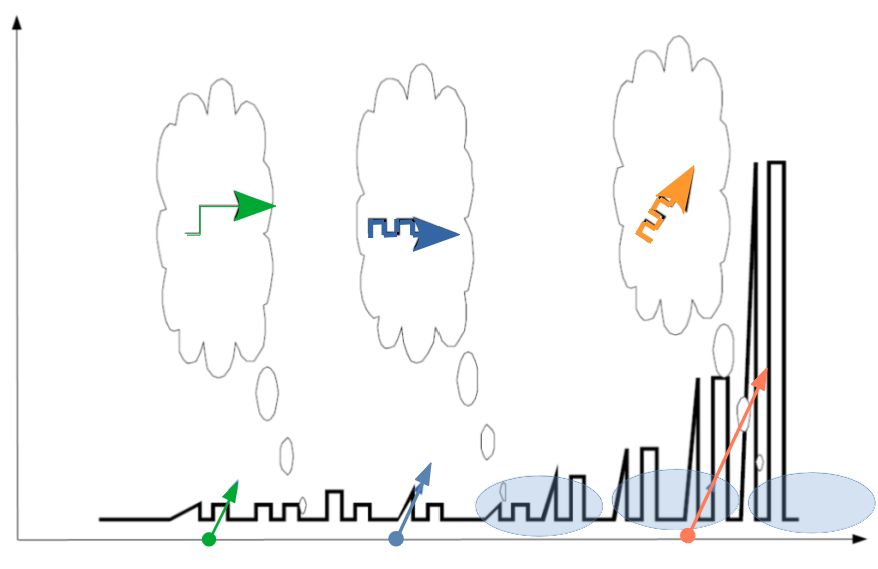
Consider the following graph:
(c) Andreas Körber 2018
It is to visualize the idea that increasing recognition of change in historic time (the x-axis) first leads to the development of the traditional type (asking for the origin of the currently valid, in cloud 1), then the experience that what has originated can also perish again and therefore asking for origins is not enough, lead to the development of the exemplaric type, asking for patterns and rules behind the change on the surface (cloud 2), and only modern experience of increased/accelerated change then led to the development of the genetic type, asking for the direction.
Each of these patterns leads to different expectations for the future. Initially (green perspective), the future may seem quite similar from the present. What is perceived as having begun, stays valid. Only from the (later) blue perspective, a pattern seems discernible, leading to the expectations that the future will also yield similar patterns of events as are detected in the past. From the (still later) orange perspective, an (additional?) increase in their „magniture“ can be perceived and its continuation be expected. The graph also is to show that the rules and patterns as well as ideas of origins have not been rendered obsolete by each new type, but are superimposed or integrated into it.
I use this graph in my lecture. I now have added the small arrows. They are to indicate the learning-necessities of a person within a relatively short time-span of life or even youth. While in pre-modern times, they only encountered the then-developed patterns (if the model is valid), in modernity, they will have to use all patterns simultaneously, in order not make sense differentially.
The idea of a homology is problematic in another way, also. It might suggest that people in antiquity (or pre-modern-times) were developed rather like children or youths, not really grown-ups. This idea is not new, but is very problematic. As you might be aware of, Rudolf Steiner, founder of anthroposophy, suggested that the „ancient“ Greek had a mental age of about 7-years-olds. And there was a very influential German „didact“ of history in the 19th century (Friedrich Kohlrausch), who combined a similar idea of the homological development in the way people conceived „god“ with that of becoming of age. So only the modern man was really „grown up“ (and is was the Germans who did so — very nationalist).
Because of Rüsen’s idea of a „homology“ in the sequence of development of narrating types between mankind (phylogenesis) and individuals (ontogenesis), Bodo von Borries (and I as assistant to him) did a large-scale research in the early 1990s, were we presented students with items of different typological logic to dilemma-situations, like Rüsen himself has used for qualitative research and for explaining the narrative types. We did find a predominance of agreement to „traditional“ items with 6th-graders (abt. 11 yrs), but found no linear development. In fact, 9th-graders seemed even to regress. All this is published in German only, I fear.
I would strongly suggest to distinguish between the historical development and hierarchy of these patterns on the one hand and progression in learning on the other hand, for which I suggest the third dimension.
As for Lévesque’s revised table of competencies in a further comment in PHW and his evaluation that Gabriel Reich is correct in that the genetic type provides no solution to the question of whether to keep or get rid of monuments: Do these types really lead to specific political positions — especially if they are always combined? Or do they rather characterize part of their underlying understanding? I think there are different positions and solutions possible by each narrative. The value of the differentiation of types of meaning making and narration is rather analytical than prescriptive.
And that is also the pedagogical value: I think these typologies (your table and mine) can be used for classifying and discussing statements of people in the political debate. It will enhance students ability to recognize the logics behind specific political stances. And it may well show that both suggestions of keeping and of getting rid of can be underpinned by different types of narrative, but that would generate maybe different policies:
Take an example from Gabriel Reich’s patch, again: civil war monuments in Richmond.
One could argue for keeping the statutes on Monument Avenue on grounds of purely traditional thinking: to mark the origins of the specific state of things. This is both possible in partisan ways (only „our“ heroes), but also in a more „inclusive“ form, asking for such monument of both sides to be presented, to mark the origin of the countries „division“. Equally in traditional mode (but with different political background), one might call for their removal. If you hold that the division they mark is no longer given, they might be removed.
In exemplaric mode (as I opined earlier), one could speak out for the preservation of the monuments on the grounds that they exemplify a certain time and culture which we can still consider as „overcome“, but one can also argue for their removal because they represented outdated or politically non-supportable relations to the past, and that our time needs to find new ones, not „progressed“ ones, but such which reflect the „characteristics of our time“.
I do agree that to hold a specifically genetic view makes it hard to envision the whole question as one of keeping vs. removing, — but it doesn’t exclude it to the full extent.
If people are thinking predominantly in genetic mode, experiencing the country to having overcome that division, they object to a traditional logic they perceived the monuments to have. In this case, it would be the tension between one’s own genetic mode of thinking and that perceived in the monuments, which would generate a political position.
If the genetic perspective was upon how to improve commemoration, one might ask for making such commemorations „more inclusive“. This may have been behind erecting a monument for Arthur Ashe among the confederate generals – not a very consistent move, though, given that is merely additively combines monuments. In fact, it creates a „memorial landscape“ of a rather complex narrative structure, part of which is traditional („heroes“) and exemplary („each group“), but by doing so enforces a new kind of traditionality (keeping the racial groups apart, assigning each „their own“ tradition to hold up). So the intended „progress“ by inclusivity („An avenue for all people“) may in fact have created a multi-traditional narrative.1
But there are other possible solutions suggested by genetic thinking. The concept of past people being „children of their own time“ is as genetic as it can get, referring to a fundamental change in time, so that morals and actions might be considered incommensurable across times. This concept has been used for exonerating past peoples views and actions. On this ground, one might call it „useless“. But it isn’t. Genetic historical thinking entails both — to recognize the temporal change and moral and political contexts for past actions different from ours, AND to recognize that our own context is valid, too.
From this point of view, it may underpin a present position transgressing the „keep/remove“-divide, namely to find ways of memorializing civil war „heroes“ (and/or „villains“ that is) that do NOT inadvertently invite for traditional or exemplaric heroic reading, but specifically marks the distance of time.
It is imperative, this thinking goes, to keep these memorials, but not as heroic marks to the past or as ambivalent markers. One should not just remove them, for that would put into oblivion not only the past, but also the whole discussion and reflections, the uneasiness about its representation which sparked the discussion in the first place. Genetic thinking would not be content to just remove the heroism (especially that of the wrong, side) with the effect to have no memory at all, but would call for a memorialization which specifically marks the change between that time and ours today.
Again, take a Hamburg example. In an earlier contribution to this discussion I already hinted to counter-memorialisation. One of the best examples is here in Hamburg-Altona:
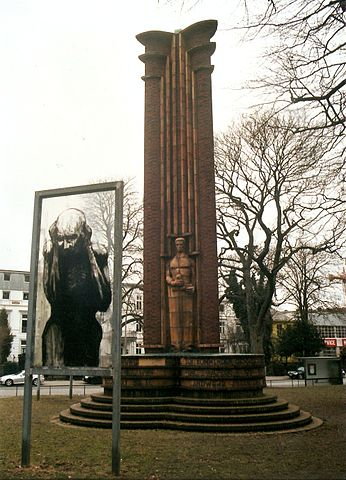
Monument and Counter-Monument next to at St. Johannis-Church in Hamburg-Altona2
Next to Altona’s St. Johannis Church, a monument had been erected in 1925 for the members of the 31st Infantry Regiment in WW1, commissioned by survivors of that regiment. Each of the three sides of the column-like monument made of clinker features an oversized, half-naked figure, representing a warrior with some antique weapon.
The inscription below reads „To the fallen for a grateful memory, to the living for a reminder, to the coming generations for emulation.“3. Clearly a very traditional proto-narrative, both extending the own warriorship of the soldiers into antiquity and calling for its emulation, lacking any transcendence. The formula was coined by August Böckh for Friedrich Wilhelm III of Prussia, and was used on monuments remembering the „liberation wars“ against Napoleon, but also later on those for the „unification wars“ of 1870/71. After the losses of millions in WW1, its usage – especially of the third element – is remarkable, albeit not alltogether uncommon4.
In the mid-1990s, the church’s congregation commissioned a counter-memorial, created by Rainer Tiedje, consisting of three acryl-glass-plates, each directly confronting one of the warriors, depicting „dark, emaciated, fearful creatures“, as the explanation on the page „denkmalhamburg.de“ states (thus on http://denkmalhamburg.de/kriegerdenkmal-an-der-st-johanniskirche/, my translation). It concludes „In the center the heroism and the exaltation, in front of it it the horror of war. A successful mixture.“ (my translation).
To me, this countermemorial is not just a (exemplaric-mode) juxtaposition of (tradtional-mode) heroism and horror of war, but there is fundamentally genetic part in it: the counter-memorial does not merely point to timeless horrors of the consequences of warfare, but leans on a visual vocabulary established in Holocaust memorials: The „suffering men“ who wriggles with pain (and fear) on eye-level with the warriors, look like „muselmen“, the completely debilitated and immiserated inmates of the Nazi concentration camps. In its iconography, the counter-memorial belongs to the generation of monuments which coerce the viewer, the public to find and answer, not providing one themselves, either in being abstract or – as here – by visualizing death and disappearance in any but heroic form5. It is this feature, using a visual code depending not only abstractly on hindsight but on concrete knowledge about what such heroism-propaganda did help to bring about, together with the effective placing which renders impossible „commemoration ceremonies, at which the plaques are not noticed“, which indicate to a specific genetic thinking below it, trying to transgress the thinking of the time.
Cf. Koselleck, Reinhart (1996): Kriegerdenkmäler als Identitätsstiftungen der Überlebenden. In: Odo Marquard und Karlheinz Stierle (Hg.): Identität. 2., unveränd. Aufl. München: Fink (Poetik und Hermeneutik, 8), S. 255–276; p. 261f [↩]
Cf. Koselleck, Reinhart (1994): Einleitung. In: Reinhart Koselleck und Michael Jeismann (Hg.): Der politische Totenkult. Kriegerdenkmäler in der Moderne. München: Fink (Bild und Text), S. 9–20, here p. 20 [↩]
==
Andreas Körber (Hamburg) How to Read a Monument as a Narrative in Class – a Suggestion [unfinished draft]
I.
The following suggestions for addressing monuments in history education are based on a conception of monuments as proto- or abbreviate narratives1 by a present actor about a certain past and its relevance. Even though in many discussions about the removal of monuments, people deplore the removal of their “past”,2 what is at stake, is not the past itself, but a specific and often privileged communication of a certain interpretation of some past context, personage or event.
As such, they also address someone (mostly a specific group) – sometimes explicitly, sometimes implicitly only. These “addressees” need, however, not be identical with those really exploring the monument. But these (the actual “audience”) will also feel addressed, and since they might (will) be diverse, in quite different ways. This communicative shift is far from being an exception – it might even be the rule in times of change and of increased diversity of our societies. Consider, e.g., a monument hailing some hero of an imperial war addressing its audience with a reference to “our empire” visited by an immigrant British citizen. This applies not only to monuments depicting a group’s (e.g. nation’s) “own pride and pain” but also to critical memorials addressing a group’s actions in the past which are considered as problematic (to say the least) in retrospect. Consider, e.g., Germany’s memorials at former places of concentration camps. In most cases, they are called “Gedenkstätten” – “sites of remembrance”. As such, already, they (have to) express their narrative logic in diverse from, given that the society they address is not only sociologically and culturally diverse but also with respect to the past they refer to. For survivors and dependants (of both survivors and fatal victims), they are (mainly) a place of commemoration their own loss and also victimhood. In many cases these places tell a story of “we have this place for remembering what they (the Germans) have done to us”. But even within this group, there are many who are and still consider themselves Germans. For them, the narrative is quite different. And of course there is a difference between mourning a loss and remembering a survival or even own resistance. An inscription on the 1965 monument at Neuengamme Concentration Camp Memorial in Hamburg, e.g., reading “Euer Leiden, Euer Kampf und Euer Tod sollen nicht vergebens sein” (“Your Suffering, Your Fight and Your Death Shall Not be in Vain”) does prominently address a group of prisoners who actively resisted. But what is more, most of these places respectively monuments there are also known as “Mahnmale”, i.e. “monument” in the literal sense of “admonishing” someone. Who can or should be admonished there? Referring to the Nazi Crimes, they can (and have to) do it in two different ways: Towards surviving victims and their dependants they may be read as “Never let that be done unto you again” – but addressing the German society as such they refer to “Remember” (publicly, that is) “what you have done” (both to “others” and to “some of your own”, that is) – “and make sure that this never happens again”. Germans among the victims of NS-crimes (Jewish Germans, Communists, Social Democrats Jehova’s Witnesses, and many others), then, will specifically have to select (not choose) how they are addressed.
Metaphorically, monuments don’t cease to “speak” if addressing a different audience from what was intended or supposed. Since all perception and analysis (“de-construction”1) of a narrative also requires and implies re-constructive mental processes, the resulting narratives in diverse publica will differ, partially by becoming more complex. Consider the 1925 war monument in front of Hamburg-Altona’s Johannis Church: It depicts three medieval warriors with bare chest and leaning on a long sword.2 The inscription reads: “Den Gefallenen zum dankbaren Gedächtnis, den Lebenden zur Mahnung, den kommenden Geschlechtern zur Nacheiferung” (“to the fallen in grateful memory, to the living as a reminder, to the coming generations for emulation”). Even though there surely are some youths on the right-wing of the political spectrum to whom this may appeal, both most of them will have to engage in twofold interpretation: “Ethnic” will have to differentiate between their own position and perspective and that of the youth in the Weimar Republic, in order to recognize the message and to make their own sense of it, Germans with what is often termed as “migratory background” will have even more aspects to combine.
All these considerations also hold true for the “speaker’s position” in a memorial or monument’s narrative: Let’s take the example of German Concentration Camp memorials again: Who is it, admonishing the victims not to be victimized again, and (more prominently) the Germans not to become perpetrators again? In fact, one can even detect another layer in such monuments. The fact that (belatedly enough) the German society today designates and supports these “Gedenkstätten” (or even hosts them institutionally) can also be considered a message to both the survivors, their dependants and to the world at large: “See and that we address this past” – possibly also with a call for support: “By witnessing this commitment of ours to remembering this past – help us to resist and even fight tendencies to abandon it and to return to a socio-centric way or commemoration” again.3 But is it “the German Society” speaking here – or some specific group (e.g. the government, a political faction, …) speaking “for” the German people or in lieu of? Just like the targeted audience of a monument seldomly is just the one really visiting it (and trying to make sense of it), the position of “authorship” needs to be differentiated.
Given all this, the conventional questions of (1) who erected a monument (2) to (remembering) whom, (3) for what purpose, (4) with whose money, and to what effect (e.g. of appraisal, critique), are still necessary, but need to be complemented.
As a result, a monument’s “message” or “meaning” is neither fixed nor arbitrary, but rather a spectrum of narrative relations between a range of perceived-“authors” or ”speakers” and a similar range of targeted and factual addressees.
Furthermore, their interrelation is of utmost interest and may strongly differ: Does (and if so: in what way) the monuments message imply the author and the addressee(s) to belong to the same group? It it “intransitive” in that it at least seemingly expresses the fact of “remembering” (“We both know that we have knowledge about this past and we express that it is of importance to us”), while in fact it serves either as a transitive reminder (“I know that you know, but you must not forget”) or even as a first-time introduction of the addressee into the subject at hand (which will be the mode in most cases of visiting monuments with students). So where “remembering” and even “commemoration” is suggested and meant, “telling” is the factual mode.
Furthermore, commemorative modes are manifold. Monuments can not only call for neutral “remembering”, but also for revering or condemning, for feelings (pride and pain) – and they can appeal for action, e.g. for following an example. In culturally diverse societies, the specific linguistic and artistic modes of expressing may not be clear to all students, possibly leading to misunderstandings, but possibly also to identifying alternative readings which are worth considering.
II.
Another aspect is crucial: In (post-)modern, diverse and heterogeneous societies (at least), it will not suffice that each individual is able to think about the past and its representations in the public sphere, to consider the messages and to relate to them individually. The common task of organizing a peaceful and democratic life together within society as well as in respect to foreign relations requires that the individual members of society do not only sport their own historical consciousness – possibly different from that of their neighbours, they will have to be able to relate to these other perceptions, conceptualisations, interpretations and evaluations of past and history and to the appeals they hold for them. In plural societies it is not enough to just know history yourself and to be able to think historically – its is paramount to have at least some insight into the historical thinking of others and to be able to communicate about it. This also refers to monuments. What is needed is not only knowledge and insight about some possible different interpretations (as e.g. exemplified by classical or representative ones taken from literature), but also an insight into the actual (ongoing, possibly still unsure, blurred, unfinished) interpretations of others in one’s one relevant contexts. Learning about history in inclusive societies, therefore, be they diverse with regard to cultural, social or other differentiations, requires a dimension of mutuality, of learning not only about history and the past, but also about the other members of society and their relations to it, the meanings it holds for them, their questions, their hypotheses, etc.4
III.
On the backdrop of all these considerations, the following guideline therefore does not venture to help students to perceive the “true” “meaning” of a monument, but rather to foster communication about what is perceived as its “message” and meaning by possibly different people. Some of these perceptions will be affirmed by being shared among several and possibly quite different users, while others might be different. This, however, does not necessarily render them wrong or nonsensical (which, they might be, however). Comparing different answers might both sharpen the individual’s perception and broaden it to perceive relevance and meanings of memorials to people with different background, interest, culture, interest, and so on. These forms of relevance might (often will) differ from that intended by those who erected the monument. What does that mean? Is a monument dysfunctional if people feel addressed by it in a way differing from that originally intended? Or does it keep relevance but change significance?
These questions do not replace but complement other approaches to analysing monuments. It might be sensible, though, to not apply them after more direct approaches, but to use them as a start, resulting in more specific (and possibly also more) of questions to explore.
The questions can be used in different ways. It will be rather tedious to just answer them one by one – especially including all bullet points. The latter are rather meant as suggestions for formulating an answer to the main questions above them.
To work individually is possible, but because of the concept explained above, it might be more fruitful to apply a “Think-Pair-Share” -system and first work independently, then compare suggestions in small groups in a way which does not only look for common solutions, but also explores and evaluates differences, and then share both insights and remaining or newly arisen questions with the whole group.
Task:
I. Respond to the questions 1-6, using the bullet points below as directions and suggestions. Try e.g. to complete the given sentences, but formulate your own answer to the main questions. If you are unsure or have additional ideas, formulate your questions (instead)!
II. Compare your nots with your partner(s). Don’t standardize them! Instead: Formulate (a) a new version of those aspects which were similar and (b) on your differences! In what way did/do you differ? Make a suggestion why that might be! Keep your original notes! They will be valuable in further discussions!
III. Report on your findings from II to your class! Compare with insights and questions of other groups!
=======================
Communicative Explicitness:
In how far does the monument (seem to) …
… present or suggest a specific person or group in a speaker position? (e.g. “We, <…> erected this monument”?)
… address a specific person/group or suggests to be directed towards a specific group? (“You, <…>…” / “to <…>”)5
… address a third-party as some kind of witness as to the fact of remembering?6
… refer to some third party as involved in the past which is narrated? (e.g. “what they have done to us”)
Narrative Explicitness:
In how far does the monument (seem to) …
… presuppose that the recipient/addressee has sufficient knowledge about the context referred to?
… explicitly construct a specific context (explicitly tell a story),
… rely on a certain amount of common knowledge of speaker and addressee?7
…introduce actors, contexts and events?
?
Transitive/Intransitive communication:
In how far does the monument (seem to) …
… embrace the recipient/addressee as a member of the same group (“we”) as the (purported) speaker?
… address the recipient/addressee as a member of a different group (“you”) as the (purported) speaker?
. “Mono-” or “Heterogloss” communication:
In how far does the monument (seem to) …
… embrace the recipient/addressee as undoubtedly having the same perspective/sharing the evaluation (“monogloss”)? e.g. by being implicit about it,
… address the recipient/addressee as not necessarily sharing the same perspective and evaluation (“heterogloss”)? e.g. by being explicit in statement, evaluation, etc.
Communicative Intent:
What is the relation of authors’/addressee(s)/third-party’s role in the (proto-)narrated story?, e.g.
Generic
“<…> want(s) <…> to <know/remember/acknowledge/accept/judge> as <…>”
Specific:
“’We’ <…> want ‘you’ <…> (and others) to know what ‘we’ <…> have achieved!” (as e.g. in “Stranger, tell the Spartans …“)
„’We’ <…>want ‘us’ <…> to not forget what ‘we’ <…> have achieved!” (as e.g. in Monuments to Unification)
„’We’ <…> want ‘us’ <…> to not forget what ‘we’ <…> have caused!” (as e.g. in German Concentration Camp Memorials)
“’We’ <…> want ‘you’ <…> to know that ‘we’ <…> submit ourselves to not forgetting/remembering!”
„’We’ <…> want ‘us’ <…> to not forget what ‘they’ <…> have done to ‘us’ <…>!”
„’’We’ <…> want ‘you’ <…> to know that ‘we’ <…> acknowledge what ‘you’ <…> have done to ‘us’ <…>!”
In how far does one (or several) of the following forms describe the communicative intention of the monument?
to inform, e.g. if it introduces and details the past incidents, contexts etc.;
to confirm, e.g. if it almost tacitly – without giving details – refers to a past context which both author and addressee share knowledge about; intending to secure acknowledgement of factuality;
to commemorate, e.g. if it almost tacitly – without giving details – refers to a past context which both author and addressee share knowledge about, intending to express a certain evaluation;
to mourn, e.g. if it refers to a past context which both author and addressee share knowledge about, intending to express a feeling of loss of someone/something valued);
to remind, e.g. if it refers to a past context which both author and addressee should share knowledge about, intending to
prevent forgetting;
secure a certain evaluation which is supposed to have been shared before?
appeal, e.g. if it asks (invites?/requests?/summons?) the recipient/addressee to feel/identify/act in a certain way, e.g. by
referring to (a) person(s) as responsible for something, admonishing the addressee to evaluate this/these persons in a certain way, but not to follow her/his example, either
heroizing: presenting (a) person(s) as responsible for a special achievement and therefore to be revered;
giving thanks: presenting (a) person(s) as responsible for a special achievement and expressing gratitude;
condemning: presenting (a) person(s) as responsible for a special achievement and therefore to be condemned;
to present examples / role models, e.g. if it by presents (a) person(s) as responsible for something and addresses the recipient/addressee as possibly being in a similar position and having similar capacities, urging her/him either
to follow the example (e.g. of taking action, of resisting);
to not follow the example (e.g. of going along …);
to express gratitude, e.g. if it presents the addressee and/or his group as responsible for something good, expressing gratitude;
to accuse, e.g. if it presents the addressee and/or his group as responsible for something bad, expressing contempt;
other (specify) …
====== References
„Gemütszustand eines total besiegten Volkes“. Höcke-Rede im Wortlaut. Nach dem Transkript von Konstantin Nowotny (2017). In Der Tagesspiegel, 1/19/2017. Available online at https://www.tagesspiegel.de/politik/hoecke-rede-im-wortlaut-gemuetszustand-eines-total-besiegten-volkes/19273518-all.html, checked on 3/14/2019.
Körber, Andreas (2014): Historical Thinking and Historical Competencies as Didactic Core Concepts. In Helle Bjerg, Andreas Körber, Claudia Lenz, Oliver von Wrochem (Eds.): Teaching historical memories in an intercultural perspective. Concepts and methods : experiences and results from the TeacMem project. 1st ed. Berlin: Metropol Verlag (Reihe Neuengammer Kolloquien, Bd. 4), pp. 69–96.
Körber, Andreas (2015): Historical consciousness, historical competencies – and beyond? Some conceptual development within German history didactics. Available online at http://www.pedocs.de/volltexte/2015/10811/pdf/Koerber_2015_Development_German_History_Didactics.pdf.
Körber, Andreas (2019; in print): Inklusive Geschichtskultur — Bestimmungsfaktoren und Ansprüche. In Sebastian Barsch, Bettina Degner, Christoph Kühberger, Martin Lücke (Eds.): Handbuch Diversität im Geschichtsunterricht. Zugänge einer inklusiven Geschichtsdidaktik. Frankfurt am Main: Wochenschau Verlag, pp. 250–258.
Körber, Andreas (2019; unpubl.): Geschichtslernen in der Migrationsgesellschaft. Sich in und durch Kontroversen zeitlich orientieren lernen. deutlich überarbeiteter Vortrag; unpubliziert. Geschichten in Bewegung“. Universität Paderborn. Paderborn, 6/14/2019.
Körber, Andreas; Schreiber, Waltraud; Schöner, Alexander (Eds.) (2007): Kompetenzen historischen Denkens. Ein Strukturmodell als Beitrag zur Kompetenzorientierung in der Geschichtsdidaktik. Neuried: Ars Una Verlags-Gesellschaft (Kompetenzen, 2).
Lévesque, Stéphane (2018): Removing the “Past”. Debates Over Official Sites of Memory. In Public History Weekly 2018 (29). DOI: 10.1515/phw-2018-12570.
Rüsen, Jörn; Fröhlich, Klaus; Horstkötter, Hubert; Schmidt, Hans Günther (1991): Untersuchungen zum Geschichtsbewußtsein von Abiturienten im Ruhrgebiet. Empirische Befunde einer quantitativen Pilotstudie. In Bodo von Borries (Ed.): Geschichtsbewusstsein empirisch. Pfaffenweiler: Centaurus (Geschichtsdidaktik : […], Studien, Materialien, [N.F.], Bd. 7), pp. 221–344.
Ziogas, Ioannis (2014): Sparse Spartan Verse. Filling Gaps in the Thermopylae Epigram. In Ramus 43 (2), pp. 115–133. DOI: 10.1017/rmu.2014.10.
Post Views:609
Cf. Rüsen et al. 1991, 230f. Cf. also my comment on Lévesque 2018, ibid. [↩]
That this danger is far from being hypothetical can be seen in the light of a speech by the right-wing (AFD)-politician Björn Höcke in Dresden on 18 January 2017, where he called for a “U-turn” in German memory culture, giving up the politics of “Vergangenheitsbewältigung”. In the same speech, he reproached to the Berlin Memorial to the Murdered Jews of Europe (the “Holocaust-Memorial”) as a “monument of shame”, which of course it is, but in a different sense: What Höcke meant is a “shameful” monument, but for the current German memorial culture he attacked, to address one’s own (in group’s) “crime and shame” is nothing shameful, but a necessity. Cf. the documentation of the speech in „Gemütszustand eines total besiegten Volkes“ 2017 (as of 28.8.2019). Any sense of pride, however, based on the development of this “critical” and even “negative” memory culture would be at least problematic – it would undermine the mind-set. The question remains of how to address this as an achievement without resorting to concepts of “pride”. [↩]
Cf. on the concept of inclusive history culture: Körber 2019; i. Dr.. Körber 2019. [↩]
As e.g. in a Hamburg monument commemorating the town’s dead of WW1: “Vierzig Tausend Söhne der Stadt ließen ihr Leben für Euch” (“Forty Thousand Sons of [our] Town Gave Their Lives for You”). [↩]
As e.g. in the verse of Simonides of Ceos (556–468 BCE) on the Spartan defenders at the Thermopylae, which Herodotus (VII, 228) reports to have been erected on the spot: “Oh stranger, tell the Lacedaemonians that we lie here, obedient to their words.” (transl. by Ioannis Ziogas). The original did not survive, but in 1955 a modern plate was erected bearing the Greek text again. For this and different translations of the inscription see the English Wikipedia-article: https://en.wikipedia.org/wiki/Battle_of_Thermopylae#Epitaph_of_Simonides (as of 27/8/2019). For a discussion of the wording see Ziogas 2014. [↩]
A monument in Oslo, on the premises of Åkershus Slot, near the Norwegian museum of resistance against German Occupation in WW2 (the Museum), e.g. states „de kjempet de falt – de gav oss alt“ (literally: „They fought, they fell – they gave us everything“), or rather: „they gave (sacrificed) everything for us.“ Even though the monument depicts tools and devices which can be used in resistance operations, the monument clearly requires knowledge of the whole context of Norwegian resistance. Körber 2014, p. 87. [↩]
Körber, Andreas „De-Constructing Memory Culture.“ In: Bjerg, Helle; Körber, Andreas; Lenz, Claudia; von Wrochem, Oliver (2014; Eds.): Teaching Historical Memories in an Intercultural Perspective. Concepts and Methods. Experiences and Results from the TeacMem Project. Berlin: Metropol (Neuengammer Kolloquien; 4); ISBN: 9783863311148, S. 145-150.
Ein Kriterienkatalog zur Analyse von Ausdrucksformen historischer Erinnerungen.
Körber, Andreas „De-Constructing Memory Culture.“ In: Bjerg, Helle; Körber, Andreas; Lenz, Claudia; von Wrochem, Oliver (2014; Eds.): Teaching Historical Memories in an Intercultural Perspective. Concepts and Methods. Experiences and Results from the TeacMem Project. Berlin: Metropol (Neuengammer Kolloquien; 4); ISBN: 9783863311148, S. 145-150.