Eine englischsprachige Fassung ist in Vorbereitung.
Gratulation den Autor*innen zur Publikation!
Das Dossier enthält folgende Beiträge:
Roers, Benjamin; Weise, Mara; Rentschler, Hannah; Bäumer, Marlon (2024): „Definitionen. Das Denkmal gibt es nicht.“ In: Benjamin Roers, Mara Weise (Eds.): Denkmälern begegnen. Zur Auseinandersetzung mit einer alltäglichen Geschichts-Sorte. Dossier (Zeitgeschichte Online). https://zeitgeschichte-online.de/node/70784.
Roers, Benjamin; Weise, Mara; Bäumer, Marlon; Rentschler, Hannah (2024): „(Be-)Deutungen. Die Geschichts-Sorte Denkmal ist vielfältig“. In: Benjamin Roers, Mara Weise (Eds.): Denkmälern begegnen. Zur Auseinandersetzung mit einer alltäglichen Geschichts-Sorte. Dossier (Zeitgeschichte Online). https://zeitgeschichte-online.de/node/70812.
Roers, Benjamin; Weise, Mara; Rentschler, Hannah; Bäumer, Marlon (2024): „Produktion: Denkmäler werden gesetzt.“ In: Benjamin Roers, Mara Weise (Eds.): Denkmälern begegnen. Zur Auseinandersetzung mit einer alltäglichen Geschichts-Sorte. Dossier (Zeitgeschichte Online). https://zeitgeschichte-online.de/node/70892.
Roers, Benjamin; Weise, Mara; Rentschler, Hannah; Bäumer, Marlon (2024): „Rezeption: Denkmäler werden gestürzt“. In: Benjamin Roers, Mara Weise (Eds.): Denkmälern begegnen. Zur Auseinandersetzung mit einer alltäglichen Geschichts-Sorte. Dossier (Zeitgeschichte Online). https://zeitgeschichte-online.de/node/70893.
Bäumer, Marlon; Rentschler, Hannah; Roers, Benjamin; Weise, Mara (2024): „Handreichung: Denkmäler verstehen. Version 2: November 2022.“ In: Benjamin Roers, Mara Weise (Eds.): Denkmälern begegnen. Zur Auseinandersetzung mit einer alltäglichen Geschichts-Sorte. Dossier (Zeitgeschichte Online). https://zeitgeschichte-online.de/node/70785.
Weise, Mara (2024): „Begegnung I: Deutungskämpfe – Der Kriegsklotz am Hamburger Dammtor“. In: Benjamin Roers, Mara Weise (Eds.): Denkmälern begegnen. Zur Auseinandersetzung mit einer alltäglichen Geschichts-Sorte. Dossier (Zeitgeschichte Online). https://zeitgeschichte-online.de/node/70811.
Roers, Benjamin (2024): „Begegnung II: Nationalismus in Rheinkultur – Die Germania in Rüdesheim.“ In: Benjamin Roers, Mara Weise (Eds.): Denkmälern begegnen. Zur Auseinandersetzung mit einer alltäglichen Geschichts-Sorte. Dossier (Zeitgeschichte Online). https://zeitgeschichte-online.de/node/70893.
Zur Thematik siehe auch meine kurz zuvor erschienene Arbeit:
Im Rahmen einer seit längerem laufenden kollegialen Diskussion über historisches Denken- Lernen an/mit und über Denkmäler habe ich heute einen Artikel auf pedocs veröffentlicht, der u.a. eine Antwort auf einen jüngeren Artikel von Stéphane Lévesque (Ottawa) darstellt. Der Artikel ist open access frei verfügbar.
As part of an ongoing collegial discussion about historical thinking – learning at/with and about monuments, I published an article on pedocs today that is, among other things, a response to a recent article by Stéphane Lévesque (Ottawa). The article is freely available open access:
Körber, Andreas (2023): Elaborating Historical Thinking on Monuments. Available online at https://www.pedocs.de/volltexte/2023/28266.
(This is a text from last year’s discussion with Stéphane Lévesque and Gabriel Reich on narrative patterns‘ role in reflecting on monument and memorial policy. I never got round to finishing ist. Sorry for the delay.)
While I agree that there is a lot of plausibility in a sequential development of these types of narrating throughout (Western) history, and that the genetic type is the most complex and advanced one, I don’t find much plausibility in the idea that in the development of student‘ thinking within their lifetime, the traditional type should have any priority to the other ones. Instead, I think that students encounter full-fledged narratives as well as simple statements of all types simultaneously from the beginning, and will acquire them alongside each other — but only gradually learn to recognize them for what they are, grasping their logic.
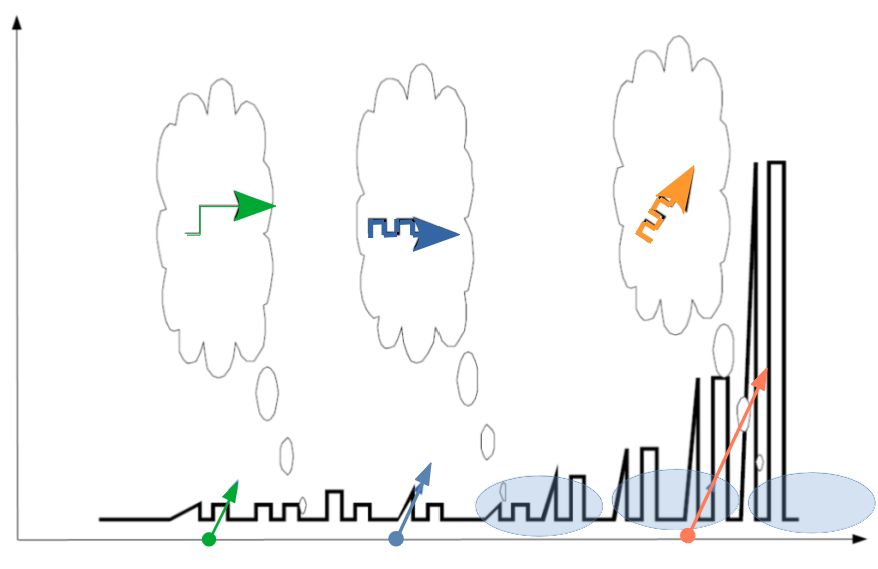
Consider the following graph:
(c) Andreas Körber 2018
It is to visualize the idea that increasing recognition of change in historic time (the x-axis) first leads to the development of the traditional type (asking for the origin of the currently valid, in cloud 1), then the experience that what has originated can also perish again and therefore asking for origins is not enough, lead to the development of the exemplaric type, asking for patterns and rules behind the change on the surface (cloud 2), and only modern experience of increased/accelerated change then led to the development of the genetic type, asking for the direction.
Each of these patterns leads to different expectations for the future. Initially (green perspective), the future may seem quite similar from the present. What is perceived as having begun, stays valid. Only from the (later) blue perspective, a pattern seems discernible, leading to the expectations that the future will also yield similar patterns of events as are detected in the past. From the (still later) orange perspective, an (additional?) increase in their „magniture“ can be perceived and its continuation be expected. The graph also is to show that the rules and patterns as well as ideas of origins have not been rendered obsolete by each new type, but are superimposed or integrated into it.
I use this graph in my lecture. I now have added the small arrows. They are to indicate the learning-necessities of a person within a relatively short time-span of life or even youth. While in pre-modern times, they only encountered the then-developed patterns (if the model is valid), in modernity, they will have to use all patterns simultaneously, in order not make sense differentially.
The idea of a homology is problematic in another way, also. It might suggest that people in antiquity (or pre-modern-times) were developed rather like children or youths, not really grown-ups. This idea is not new, but is very problematic. As you might be aware of, Rudolf Steiner, founder of anthroposophy, suggested that the „ancient“ Greek had a mental age of about 7-years-olds. And there was a very influential German „didact“ of history in the 19th century (Friedrich Kohlrausch), who combined a similar idea of the homological development in the way people conceived „god“ with that of becoming of age. So only the modern man was really „grown up“ (and is was the Germans who did so — very nationalist).
Because of Rüsen’s idea of a „homology“ in the sequence of development of narrating types between mankind (phylogenesis) and individuals (ontogenesis), Bodo von Borries (and I as assistant to him) did a large-scale research in the early 1990s, were we presented students with items of different typological logic to dilemma-situations, like Rüsen himself has used for qualitative research and for explaining the narrative types. We did find a predominance of agreement to „traditional“ items with 6th-graders (abt. 11 yrs), but found no linear development. In fact, 9th-graders seemed even to regress. All this is published in German only, I fear.
I would strongly suggest to distinguish between the historical development and hierarchy of these patterns on the one hand and progression in learning on the other hand, for which I suggest the third dimension.
As for Lévesque’s revised table of competencies in a further comment in PHW and his evaluation that Gabriel Reich is correct in that the genetic type provides no solution to the question of whether to keep or get rid of monuments: Do these types really lead to specific political positions — especially if they are always combined? Or do they rather characterize part of their underlying understanding? I think there are different positions and solutions possible by each narrative. The value of the differentiation of types of meaning making and narration is rather analytical than prescriptive.
And that is also the pedagogical value: I think these typologies (your table and mine) can be used for classifying and discussing statements of people in the political debate. It will enhance students ability to recognize the logics behind specific political stances. And it may well show that both suggestions of keeping and of getting rid of can be underpinned by different types of narrative, but that would generate maybe different policies:
Take an example from Gabriel Reich’s patch, again: civil war monuments in Richmond.
One could argue for keeping the statutes on Monument Avenue on grounds of purely traditional thinking: to mark the origins of the specific state of things. This is both possible in partisan ways (only „our“ heroes), but also in a more „inclusive“ form, asking for such monument of both sides to be presented, to mark the origin of the countries „division“. Equally in traditional mode (but with different political background), one might call for their removal. If you hold that the division they mark is no longer given, they might be removed.
In exemplaric mode (as I opined earlier), one could speak out for the preservation of the monuments on the grounds that they exemplify a certain time and culture which we can still consider as „overcome“, but one can also argue for their removal because they represented outdated or politically non-supportable relations to the past, and that our time needs to find new ones, not „progressed“ ones, but such which reflect the „characteristics of our time“.
I do agree that to hold a specifically genetic view makes it hard to envision the whole question as one of keeping vs. removing, — but it doesn’t exclude it to the full extent.
If people are thinking predominantly in genetic mode, experiencing the country to having overcome that division, they object to a traditional logic they perceived the monuments to have. In this case, it would be the tension between one’s own genetic mode of thinking and that perceived in the monuments, which would generate a political position.
If the genetic perspective was upon how to improve commemoration, one might ask for making such commemorations „more inclusive“. This may have been behind erecting a monument for Arthur Ashe among the confederate generals – not a very consistent move, though, given that is merely additively combines monuments. In fact, it creates a „memorial landscape“ of a rather complex narrative structure, part of which is traditional („heroes“) and exemplary („each group“), but by doing so enforces a new kind of traditionality (keeping the racial groups apart, assigning each „their own“ tradition to hold up). So the intended „progress“ by inclusivity („An avenue for all people“) may in fact have created a multi-traditional narrative.1
But there are other possible solutions suggested by genetic thinking. The concept of past people being „children of their own time“ is as genetic as it can get, referring to a fundamental change in time, so that morals and actions might be considered incommensurable across times. This concept has been used for exonerating past peoples views and actions. On this ground, one might call it „useless“. But it isn’t. Genetic historical thinking entails both — to recognize the temporal change and moral and political contexts for past actions different from ours, AND to recognize that our own context is valid, too.
From this point of view, it may underpin a present position transgressing the „keep/remove“-divide, namely to find ways of memorializing civil war „heroes“ (and/or „villains“ that is) that do NOT inadvertently invite for traditional or exemplaric heroic reading, but specifically marks the distance of time.
It is imperative, this thinking goes, to keep these memorials, but not as heroic marks to the past or as ambivalent markers. One should not just remove them, for that would put into oblivion not only the past, but also the whole discussion and reflections, the uneasiness about its representation which sparked the discussion in the first place. Genetic thinking would not be content to just remove the heroism (especially that of the wrong, side) with the effect to have no memory at all, but would call for a memorialization which specifically marks the change between that time and ours today.
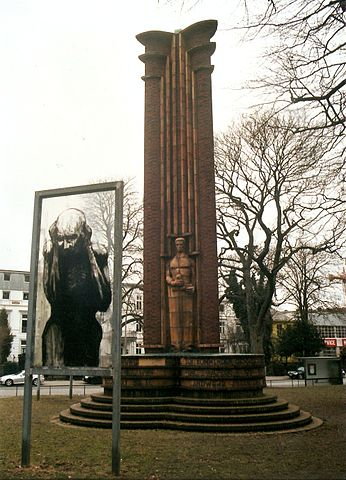
Again, take a Hamburg example. In an earlier contribution to this discussion I already hinted to counter-memorialisation. One of the best examples is here in Hamburg-Altona:
Monument and Counter-Monument next to at St. Johannis-Church in Hamburg-Altona2
Next to Altona’s St. Johannis Church, a monument had been erected in 1925 for the members of the 31st Infantry Regiment in WW1, commissioned by survivors of that regiment. Each of the three sides of the column-like monument made of clinker features an oversized, half-naked figure, representing a warrior with some antique weapon.
The inscription below reads „To the fallen for a grateful memory, to the living for a reminder, to the coming generations for emulation.“3. Clearly a very traditional proto-narrative, both extending the own warriorship of the soldiers into antiquity and calling for its emulation, lacking any transcendence. The formula was coined by August Böckh for Friedrich Wilhelm III of Prussia, and was used on monuments remembering the „liberation wars“ against Napoleon, but also later on those for the „unification wars“ of 1870/71. After the losses of millions in WW1, its usage – especially of the third element – is remarkable, albeit not alltogether uncommon4.
In the mid-1990s, the church’s congregation commissioned a counter-memorial, created by Rainer Tiedje, consisting of three acryl-glass-plates, each directly confronting one of the warriors, depicting „dark, emaciated, fearful creatures“, as the explanation on the page „denkmalhamburg.de“ states (thus on http://denkmalhamburg.de/kriegerdenkmal-an-der-st-johanniskirche/, my translation). It concludes „In the center the heroism and the exaltation, in front of it it the horror of war. A successful mixture.“ (my translation).
To me, this countermemorial is not just a (exemplaric-mode) juxtaposition of (tradtional-mode) heroism and horror of war, but there is fundamentally genetic part in it: the counter-memorial does not merely point to timeless horrors of the consequences of warfare, but leans on a visual vocabulary established in Holocaust memorials: The „suffering men“ who wriggles with pain (and fear) on eye-level with the warriors, look like „muselmen“, the completely debilitated and immiserated inmates of the Nazi concentration camps. In its iconography, the counter-memorial belongs to the generation of monuments which coerce the viewer, the public to find and answer, not providing one themselves, either in being abstract or – as here – by visualizing death and disappearance in any but heroic form5. It is this feature, using a visual code depending not only abstractly on hindsight but on concrete knowledge about what such heroism-propaganda did help to bring about, together with the effective placing which renders impossible „commemoration ceremonies, at which the plaques are not noticed“, which indicate to a specific genetic thinking below it, trying to transgress the thinking of the time.
Cf. Koselleck, Reinhart (1996): Kriegerdenkmäler als Identitätsstiftungen der Überlebenden. In: Odo Marquard und Karlheinz Stierle (Hg.): Identität. 2., unveränd. Aufl. München: Fink (Poetik und Hermeneutik, 8), S. 255–276; p. 261f [↩]
Cf. Koselleck, Reinhart (1994): Einleitung. In: Reinhart Koselleck und Michael Jeismann (Hg.): Der politische Totenkult. Kriegerdenkmäler in der Moderne. München: Fink (Bild und Text), S. 9–20, here p. 20 [↩]
==
Andreas Körber (Hamburg) How to Read a Monument as a Narrative in Class – a Suggestion [unfinished draft]
I.
The following suggestions for addressing monuments in history education are based on a conception of monuments as proto- or abbreviate narratives1 by a present actor about a certain past and its relevance. Even though in many discussions about the removal of monuments, people deplore the removal of their “past”,2 what is at stake, is not the past itself, but a specific and often privileged communication of a certain interpretation of some past context, personage or event.
As such, they also address someone (mostly a specific group) – sometimes explicitly, sometimes implicitly only. These “addressees” need, however, not be identical with those really exploring the monument. But these (the actual “audience”) will also feel addressed, and since they might (will) be diverse, in quite different ways. This communicative shift is far from being an exception – it might even be the rule in times of change and of increased diversity of our societies. Consider, e.g., a monument hailing some hero of an imperial war addressing its audience with a reference to “our empire” visited by an immigrant British citizen. This applies not only to monuments depicting a group’s (e.g. nation’s) “own pride and pain” but also to critical memorials addressing a group’s actions in the past which are considered as problematic (to say the least) in retrospect. Consider, e.g., Germany’s memorials at former places of concentration camps. In most cases, they are called “Gedenkstätten” – “sites of remembrance”. As such, already, they (have to) express their narrative logic in diverse from, given that the society they address is not only sociologically and culturally diverse but also with respect to the past they refer to. For survivors and dependants (of both survivors and fatal victims), they are (mainly) a place of commemoration their own loss and also victimhood. In many cases these places tell a story of “we have this place for remembering what they (the Germans) have done to us”. But even within this group, there are many who are and still consider themselves Germans. For them, the narrative is quite different. And of course there is a difference between mourning a loss and remembering a survival or even own resistance. An inscription on the 1965 monument at Neuengamme Concentration Camp Memorial in Hamburg, e.g., reading “Euer Leiden, Euer Kampf und Euer Tod sollen nicht vergebens sein” (“Your Suffering, Your Fight and Your Death Shall Not be in Vain”) does prominently address a group of prisoners who actively resisted. But what is more, most of these places respectively monuments there are also known as “Mahnmale”, i.e. “monument” in the literal sense of “admonishing” someone. Who can or should be admonished there? Referring to the Nazi Crimes, they can (and have to) do it in two different ways: Towards surviving victims and their dependants they may be read as “Never let that be done unto you again” – but addressing the German society as such they refer to “Remember” (publicly, that is) “what you have done” (both to “others” and to “some of your own”, that is) – “and make sure that this never happens again”. Germans among the victims of NS-crimes (Jewish Germans, Communists, Social Democrats Jehova’s Witnesses, and many others), then, will specifically have to select (not choose) how they are addressed.
Metaphorically, monuments don’t cease to “speak” if addressing a different audience from what was intended or supposed. Since all perception and analysis (“de-construction”1) of a narrative also requires and implies re-constructive mental processes, the resulting narratives in diverse publica will differ, partially by becoming more complex. Consider the 1925 war monument in front of Hamburg-Altona’s Johannis Church: It depicts three medieval warriors with bare chest and leaning on a long sword.2 The inscription reads: “Den Gefallenen zum dankbaren Gedächtnis, den Lebenden zur Mahnung, den kommenden Geschlechtern zur Nacheiferung” (“to the fallen in grateful memory, to the living as a reminder, to the coming generations for emulation”). Even though there surely are some youths on the right-wing of the political spectrum to whom this may appeal, both most of them will have to engage in twofold interpretation: “Ethnic” will have to differentiate between their own position and perspective and that of the youth in the Weimar Republic, in order to recognize the message and to make their own sense of it, Germans with what is often termed as “migratory background” will have even more aspects to combine.
All these considerations also hold true for the “speaker’s position” in a memorial or monument’s narrative: Let’s take the example of German Concentration Camp memorials again: Who is it, admonishing the victims not to be victimized again, and (more prominently) the Germans not to become perpetrators again? In fact, one can even detect another layer in such monuments. The fact that (belatedly enough) the German society today designates and supports these “Gedenkstätten” (or even hosts them institutionally) can also be considered a message to both the survivors, their dependants and to the world at large: “See and that we address this past” – possibly also with a call for support: “By witnessing this commitment of ours to remembering this past – help us to resist and even fight tendencies to abandon it and to return to a socio-centric way or commemoration” again.3 But is it “the German Society” speaking here – or some specific group (e.g. the government, a political faction, …) speaking “for” the German people or in lieu of? Just like the targeted audience of a monument seldomly is just the one really visiting it (and trying to make sense of it), the position of “authorship” needs to be differentiated.
Given all this, the conventional questions of (1) who erected a monument (2) to (remembering) whom, (3) for what purpose, (4) with whose money, and to what effect (e.g. of appraisal, critique), are still necessary, but need to be complemented.
As a result, a monument’s “message” or “meaning” is neither fixed nor arbitrary, but rather a spectrum of narrative relations between a range of perceived-“authors” or ”speakers” and a similar range of targeted and factual addressees.
Furthermore, their interrelation is of utmost interest and may strongly differ: Does (and if so: in what way) the monuments message imply the author and the addressee(s) to belong to the same group? It it “intransitive” in that it at least seemingly expresses the fact of “remembering” (“We both know that we have knowledge about this past and we express that it is of importance to us”), while in fact it serves either as a transitive reminder (“I know that you know, but you must not forget”) or even as a first-time introduction of the addressee into the subject at hand (which will be the mode in most cases of visiting monuments with students). So where “remembering” and even “commemoration” is suggested and meant, “telling” is the factual mode.
Furthermore, commemorative modes are manifold. Monuments can not only call for neutral “remembering”, but also for revering or condemning, for feelings (pride and pain) – and they can appeal for action, e.g. for following an example. In culturally diverse societies, the specific linguistic and artistic modes of expressing may not be clear to all students, possibly leading to misunderstandings, but possibly also to identifying alternative readings which are worth considering.
II.
Another aspect is crucial: In (post-)modern, diverse and heterogeneous societies (at least), it will not suffice that each individual is able to think about the past and its representations in the public sphere, to consider the messages and to relate to them individually. The common task of organizing a peaceful and democratic life together within society as well as in respect to foreign relations requires that the individual members of society do not only sport their own historical consciousness – possibly different from that of their neighbours, they will have to be able to relate to these other perceptions, conceptualisations, interpretations and evaluations of past and history and to the appeals they hold for them. In plural societies it is not enough to just know history yourself and to be able to think historically – its is paramount to have at least some insight into the historical thinking of others and to be able to communicate about it. This also refers to monuments. What is needed is not only knowledge and insight about some possible different interpretations (as e.g. exemplified by classical or representative ones taken from literature), but also an insight into the actual (ongoing, possibly still unsure, blurred, unfinished) interpretations of others in one’s one relevant contexts. Learning about history in inclusive societies, therefore, be they diverse with regard to cultural, social or other differentiations, requires a dimension of mutuality, of learning not only about history and the past, but also about the other members of society and their relations to it, the meanings it holds for them, their questions, their hypotheses, etc.4
III.
On the backdrop of all these considerations, the following guideline therefore does not venture to help students to perceive the “true” “meaning” of a monument, but rather to foster communication about what is perceived as its “message” and meaning by possibly different people. Some of these perceptions will be affirmed by being shared among several and possibly quite different users, while others might be different. This, however, does not necessarily render them wrong or nonsensical (which, they might be, however). Comparing different answers might both sharpen the individual’s perception and broaden it to perceive relevance and meanings of memorials to people with different background, interest, culture, interest, and so on. These forms of relevance might (often will) differ from that intended by those who erected the monument. What does that mean? Is a monument dysfunctional if people feel addressed by it in a way differing from that originally intended? Or does it keep relevance but change significance?
These questions do not replace but complement other approaches to analysing monuments. It might be sensible, though, to not apply them after more direct approaches, but to use them as a start, resulting in more specific (and possibly also more) of questions to explore.
The questions can be used in different ways. It will be rather tedious to just answer them one by one – especially including all bullet points. The latter are rather meant as suggestions for formulating an answer to the main questions above them.
To work individually is possible, but because of the concept explained above, it might be more fruitful to apply a “Think-Pair-Share” -system and first work independently, then compare suggestions in small groups in a way which does not only look for common solutions, but also explores and evaluates differences, and then share both insights and remaining or newly arisen questions with the whole group.
Task:
I. Respond to the questions 1-6, using the bullet points below as directions and suggestions. Try e.g. to complete the given sentences, but formulate your own answer to the main questions. If you are unsure or have additional ideas, formulate your questions (instead)!
II. Compare your nots with your partner(s). Don’t standardize them! Instead: Formulate (a) a new version of those aspects which were similar and (b) on your differences! In what way did/do you differ? Make a suggestion why that might be! Keep your original notes! They will be valuable in further discussions!
III. Report on your findings from II to your class! Compare with insights and questions of other groups!
=======================
Communicative Explicitness:
In how far does the monument (seem to) …
… present or suggest a specific person or group in a speaker position? (e.g. “We, <…> erected this monument”?)
… address a specific person/group or suggests to be directed towards a specific group? (“You, <…>…” / “to <…>”)5
… address a third-party as some kind of witness as to the fact of remembering?6
… refer to some third party as involved in the past which is narrated? (e.g. “what they have done to us”)
Narrative Explicitness:
In how far does the monument (seem to) …
… presuppose that the recipient/addressee has sufficient knowledge about the context referred to?
… explicitly construct a specific context (explicitly tell a story),
… rely on a certain amount of common knowledge of speaker and addressee?7
…introduce actors, contexts and events?
?
Transitive/Intransitive communication:
In how far does the monument (seem to) …
… embrace the recipient/addressee as a member of the same group (“we”) as the (purported) speaker?
… address the recipient/addressee as a member of a different group (“you”) as the (purported) speaker?
. “Mono-” or “Heterogloss” communication:
In how far does the monument (seem to) …
… embrace the recipient/addressee as undoubtedly having the same perspective/sharing the evaluation (“monogloss”)? e.g. by being implicit about it,
… address the recipient/addressee as not necessarily sharing the same perspective and evaluation (“heterogloss”)? e.g. by being explicit in statement, evaluation, etc.
Communicative Intent:
What is the relation of authors’/addressee(s)/third-party’s role in the (proto-)narrated story?, e.g.
Generic
“<…> want(s) <…> to <know/remember/acknowledge/accept/judge> as <…>”
Specific:
“’We’ <…> want ‘you’ <…> (and others) to know what ‘we’ <…> have achieved!” (as e.g. in “Stranger, tell the Spartans …“)
„’We’ <…>want ‘us’ <…> to not forget what ‘we’ <…> have achieved!” (as e.g. in Monuments to Unification)
„’We’ <…> want ‘us’ <…> to not forget what ‘we’ <…> have caused!” (as e.g. in German Concentration Camp Memorials)
“’We’ <…> want ‘you’ <…> to know that ‘we’ <…> submit ourselves to not forgetting/remembering!”
„’We’ <…> want ‘us’ <…> to not forget what ‘they’ <…> have done to ‘us’ <…>!”
„’’We’ <…> want ‘you’ <…> to know that ‘we’ <…> acknowledge what ‘you’ <…> have done to ‘us’ <…>!”
In how far does one (or several) of the following forms describe the communicative intention of the monument?
to inform, e.g. if it introduces and details the past incidents, contexts etc.;
to confirm, e.g. if it almost tacitly – without giving details – refers to a past context which both author and addressee share knowledge about; intending to secure acknowledgement of factuality;
to commemorate, e.g. if it almost tacitly – without giving details – refers to a past context which both author and addressee share knowledge about, intending to express a certain evaluation;
to mourn, e.g. if it refers to a past context which both author and addressee share knowledge about, intending to express a feeling of loss of someone/something valued);
to remind, e.g. if it refers to a past context which both author and addressee should share knowledge about, intending to
prevent forgetting;
secure a certain evaluation which is supposed to have been shared before?
appeal, e.g. if it asks (invites?/requests?/summons?) the recipient/addressee to feel/identify/act in a certain way, e.g. by
referring to (a) person(s) as responsible for something, admonishing the addressee to evaluate this/these persons in a certain way, but not to follow her/his example, either
heroizing: presenting (a) person(s) as responsible for a special achievement and therefore to be revered;
giving thanks: presenting (a) person(s) as responsible for a special achievement and expressing gratitude;
condemning: presenting (a) person(s) as responsible for a special achievement and therefore to be condemned;
to present examples / role models, e.g. if it by presents (a) person(s) as responsible for something and addresses the recipient/addressee as possibly being in a similar position and having similar capacities, urging her/him either
to follow the example (e.g. of taking action, of resisting);
to not follow the example (e.g. of going along …);
to express gratitude, e.g. if it presents the addressee and/or his group as responsible for something good, expressing gratitude;
to accuse, e.g. if it presents the addressee and/or his group as responsible for something bad, expressing contempt;
other (specify) …
====== References
„Gemütszustand eines total besiegten Volkes“. Höcke-Rede im Wortlaut. Nach dem Transkript von Konstantin Nowotny (2017). In Der Tagesspiegel, 1/19/2017. Available online at https://www.tagesspiegel.de/politik/hoecke-rede-im-wortlaut-gemuetszustand-eines-total-besiegten-volkes/19273518-all.html, checked on 3/14/2019.
Körber, Andreas (2014): Historical Thinking and Historical Competencies as Didactic Core Concepts. In Helle Bjerg, Andreas Körber, Claudia Lenz, Oliver von Wrochem (Eds.): Teaching historical memories in an intercultural perspective. Concepts and methods : experiences and results from the TeacMem project. 1st ed. Berlin: Metropol Verlag (Reihe Neuengammer Kolloquien, Bd. 4), pp. 69–96.
Körber, Andreas (2015): Historical consciousness, historical competencies – and beyond? Some conceptual development within German history didactics. Available online at http://www.pedocs.de/volltexte/2015/10811/pdf/Koerber_2015_Development_German_History_Didactics.pdf.
Körber, Andreas (2019; in print): Inklusive Geschichtskultur — Bestimmungsfaktoren und Ansprüche. In Sebastian Barsch, Bettina Degner, Christoph Kühberger, Martin Lücke (Eds.): Handbuch Diversität im Geschichtsunterricht. Zugänge einer inklusiven Geschichtsdidaktik. Frankfurt am Main: Wochenschau Verlag, pp. 250–258.
Körber, Andreas (2019; unpubl.): Geschichtslernen in der Migrationsgesellschaft. Sich in und durch Kontroversen zeitlich orientieren lernen. deutlich überarbeiteter Vortrag; unpubliziert. Geschichten in Bewegung“. Universität Paderborn. Paderborn, 6/14/2019.
Körber, Andreas; Schreiber, Waltraud; Schöner, Alexander (Eds.) (2007): Kompetenzen historischen Denkens. Ein Strukturmodell als Beitrag zur Kompetenzorientierung in der Geschichtsdidaktik. Neuried: Ars Una Verlags-Gesellschaft (Kompetenzen, 2).
Lévesque, Stéphane (2018): Removing the “Past”. Debates Over Official Sites of Memory. In Public History Weekly 2018 (29). DOI: 10.1515/phw-2018-12570.
Rüsen, Jörn; Fröhlich, Klaus; Horstkötter, Hubert; Schmidt, Hans Günther (1991): Untersuchungen zum Geschichtsbewußtsein von Abiturienten im Ruhrgebiet. Empirische Befunde einer quantitativen Pilotstudie. In Bodo von Borries (Ed.): Geschichtsbewusstsein empirisch. Pfaffenweiler: Centaurus (Geschichtsdidaktik : […], Studien, Materialien, [N.F.], Bd. 7), pp. 221–344.
Ziogas, Ioannis (2014): Sparse Spartan Verse. Filling Gaps in the Thermopylae Epigram. In Ramus 43 (2), pp. 115–133. DOI: 10.1017/rmu.2014.10.
Post Views:606
Cf. Rüsen et al. 1991, 230f. Cf. also my comment on Lévesque 2018, ibid. [↩]
That this danger is far from being hypothetical can be seen in the light of a speech by the right-wing (AFD)-politician Björn Höcke in Dresden on 18 January 2017, where he called for a “U-turn” in German memory culture, giving up the politics of “Vergangenheitsbewältigung”. In the same speech, he reproached to the Berlin Memorial to the Murdered Jews of Europe (the “Holocaust-Memorial”) as a “monument of shame”, which of course it is, but in a different sense: What Höcke meant is a “shameful” monument, but for the current German memorial culture he attacked, to address one’s own (in group’s) “crime and shame” is nothing shameful, but a necessity. Cf. the documentation of the speech in „Gemütszustand eines total besiegten Volkes“ 2017 (as of 28.8.2019). Any sense of pride, however, based on the development of this “critical” and even “negative” memory culture would be at least problematic – it would undermine the mind-set. The question remains of how to address this as an achievement without resorting to concepts of “pride”. [↩]
Cf. on the concept of inclusive history culture: Körber 2019; i. Dr.. Körber 2019. [↩]
As e.g. in a Hamburg monument commemorating the town’s dead of WW1: “Vierzig Tausend Söhne der Stadt ließen ihr Leben für Euch” (“Forty Thousand Sons of [our] Town Gave Their Lives for You”). [↩]
As e.g. in the verse of Simonides of Ceos (556–468 BCE) on the Spartan defenders at the Thermopylae, which Herodotus (VII, 228) reports to have been erected on the spot: “Oh stranger, tell the Lacedaemonians that we lie here, obedient to their words.” (transl. by Ioannis Ziogas). The original did not survive, but in 1955 a modern plate was erected bearing the Greek text again. For this and different translations of the inscription see the English Wikipedia-article: https://en.wikipedia.org/wiki/Battle_of_Thermopylae#Epitaph_of_Simonides (as of 27/8/2019). For a discussion of the wording see Ziogas 2014. [↩]
A monument in Oslo, on the premises of Åkershus Slot, near the Norwegian museum of resistance against German Occupation in WW2 (the Museum), e.g. states „de kjempet de falt – de gav oss alt“ (literally: „They fought, they fell – they gave us everything“), or rather: „they gave (sacrificed) everything for us.“ Even though the monument depicts tools and devices which can be used in resistance operations, the monument clearly requires knowledge of the whole context of Norwegian resistance. Körber 2014, p. 87. [↩]
A crosstabulation of competencies and patterns/logic of sensemaking as suggested by Stéphane Lévesque(( Another such crosstabulation has been suggested (in German) by Wolfgang Hasberg (Analytische Wege zu besserem Geschichtsunterricht. Historisches Denken im Handlungszusammenhang Geschichtsunterricht. In: Meyer-Hamme, Johannes / Thünemann, Holger / Zülsdorf-Kersting, Meik (Hrsg.): Was heißt guter Geschichtsunterricht? Perspektiven im Vergleich. Schwalbach/Ts. / Wochenschau, S. 137–160, p. 140). For my critique see Körber 2016 (in German). I also provided a table, including the different niveaus, but restricted to „Fragekompetenz“ (similar to Lévesque’s „inquiry competence“). )) is indeed useful for „reading“ individual monuments and making sense of their „message“, also. Lévesque’s filling of the table is a bit abstract, general for this, so the following would in part be my own understanding.
It also is based on Rüsen’s notion that while the different patterns were developed sequentially over time, to „older“ ones are not lost, but still available and indeed visible in modern day thinking, in fact most of the time in combinations. What characterizes modern-time historical thinking, then, is the presence and dominance of „genetic“ thinking, while pre-modern thought would not have this type at its disposal at all. But then, our examples here are all „modern“, so that it may be a question of dominance and relative weight.
Take a monument for a civil war general:
A spectator today may read it as a reminder to the origin of the current state of affairs, possibly the „losing of the cause“ (e.g. both the honoured general and the spectator being southeners) or to the liberation of the slaves (both northeners). In both cases, the monument would be seen as pointing to an origin of what is seen as valid today (the very definition of Rüsen’s „traditional“ type). This might explain why people adhering to the northern narrative would oppose to southern monuments, and vice versa, not believeing their story in the first place — and maybe fearing that keeping the monuments would signify that their version was to be seen as valid.
In an exemplaric mode, however, both may accept the „other side’s“ monuments, because what they point at would not be seen as the origin of affairs, but rather a general rule, e.g. honouring people „bravely fighting for their respective (!) cause“. The logic would be that each society would honor „their heroes“, who do not so much stand for the specific cause but for a general rule. What happens on the ground in Gettysburg, e.g., is something along this line: „Traditional“ commemorating attracts most people going there, but an exemplary „cover-narrative“ allows for common remembrance.
Ernst Barlach: Relief (1931; Re-Construction of 1948) on Hamburg Town Hall Square Monument . Photo from Wikimedia Commons (public domain): https://upload.wikimedia.org/wikipedia/commons/2/2c/Hamburg_Mahnmal_01_KMJ-adj.jpg
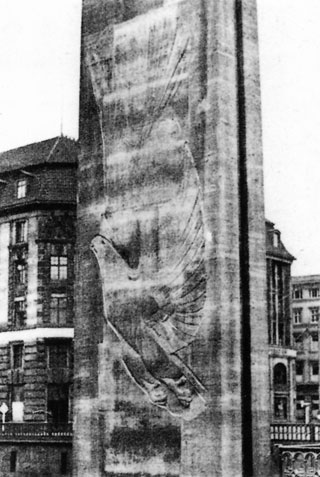
Hans-Martin Ruwoldt (1938): Phoenix on Hamburg Town Hall Square Monument. Photo by https://www.denk-mal-gegen-krieg.de/kriegerdenkmaeler/hamburg-lo-os/
In 1938, under Nazi rule, the relief was exchanged for a „phoenix“. Did it change the narrative and commemorative evaluation of the loss of the 40000 Hamburgians? To my view, it most certainly did.
The addition of the last part „FOR YOU“ to the inscription already before the initial installation of the monument was a concession to the right parties, changing (in Rüsen‘s terms) a more traditional message into a more exemplary one:
While the combination of the initial wording without the addition „FOR YOU“ and the mother-child-relief fit into a development of monument culture developed in WW1 which has been identified in retrospect, namely monuments which which do no longer provide an authoritative suggestion of the meaning of the protagonist‘s death, but rather question this meaning.(( On this type of monuments cf. Koselleck, Reinhart (1994): Einleitung. In: Reinhart Koselleck und Michael Jeismann (Hg.): Der politische Totenkult. Kriegerdenkmäler in der Moderne. München: Fink (Bild und Text), S. 9–20, here p. 18f. )) It did so because it expressed the continuous loss, referring to the dead soldiers rather as victims of a greater context of war, to be mourned, by pointing to their their death and loss as the rather tragic origins of the common grief.
Adding „FOR YOU“ to the inscription did not fully eradicate this negative-traditional narrative pattern, but added an additional layer of different narrative and evaluative character both to the deaths, which are ascribed a purpose, and to the conceptual framing of the dead, which are no longer only victims but also (self-)sacrifices for a common good. Interestingly, both concepts, that of victim and that of sacrifice, are present in the German term „Opfer“ explicitly used, but alluded to, here.
The exchange of the mourning mother/child-relief by a „phoenix“ in 1938, then, eradicated the thin layer of questioning the purpose and meaning of the loss, the notion of „victims“ and rendered the 40,000 Fathers, Brothers and „Sons of Town“ heroes – not only self-sacrifices for the wellbeing of their respective families, but role-models to be celebrated and emulated.(( According to Klingel, Kerstin (2006): Eichenkranz und Dornenkrone. Kriegerdenkmäler in Hamburg. Hamburg: Landeszentrale für Politische Bildung, p.71, the mourning-relief initially was to be replaced by „war symbols“ but all skteches handed in by artists (including a wrath with swords by Ruwoldt) were rejected, so that he was commissioned to create an eagle, which he did, but in a way which far more resembled a dove than an eagle. In how far this can be interpreted as a subversive rejection of the new martial character and even be evaluated as an act of defiance, is highly questionable, since the symbolism of the dove as the universial symbol for peace was created by Picasso only after WorldWar II. )) In 1948, then, the lost Barlach-relief, was restored, alas not by Barlach himself, who had meanwhile died.
I do have a hard time constructing a genetic understanding of such a monument, maybe because a modern, genetic way of thinking needs to have been informed by the „critical“ mode of at least partly de-legitimizing the orientating power of traditional and exemplaric thinking.
Maybe this is the background for modern monuments being quite different, either often non-figurative — as Peter Eisenman’s Memorial to the Murdered Jews in Berlin, or many works by Jochen Gerz(( Cf. e.g. his „Invisible Monument“ in Sarbrücken: https://en.wikipedia.org/wiki/Platz_des_Unsichtbaren_Mahnmals. )) — or taking on forms of counter-memorialization(( Cf. a.o. Wijsenbeek, Dinah: Denkmal und Gegendenkmal. Über den kritischen Umgang mit der Vergangenheit auf dem Gebiet der bildenden Kunst. München 2010. )), thus setting in motion a kind of change, not just re-present-ing a past, but encouraging or even enforcing critical reflection on it.
It is easier for the Hamburg monument: Genetic thinking would question whether not only this heroifying way of commemorating heroes (even if not individual), but also the concrete form of public acknowledging of tragic loss can be timely, after we experienced another war and an inhuman dictatorship and genocide which was not least based on feelings instigated by such commemorating.(( There’s a lot more to be reflected in commemorating: Who talks to whom, here? What do they say and expect? Who is the „you“? Is it “ us“ – still today? And if so: in how far is the message the same for all of us, those with Hamburg ancestors of the time, and those without, maybe immigrants? In how far can this aspect define our attitude? Can we force all recent immigrants into our own „national“ narrative (and even more so when it is not WW1, but Holocaust related)? But then, how can we not? (cf. also Körber 2014, and see below. ))
But there is something more to reflecting about narratives — and especially on how to relate to them. As I wrote above, Memorials are narratives. Rüsen calls them „narrative abbreviations“, pointing to them standing for a specific narrative, i.e. a specific relation between a past (under memory), the present (of the authors and erectors of the monument as well as the intended public), and with regard to a specific future, constructed only partly in verbal narrative form, but also with non-verbal and sequentially narrative elements (even though in some cases it is only the verbal inscriptions which really hint to any historical meaning).
Memorials are more than only proto-narratives. Their (often) prominent (albeit also often overlooked) positioning, their (proto-)narrative structure and their own quality for lasting a long time (cf. „monumentum exegi aere perennius), they do not only constitute a narrative relation from one temporal and social position towrds the past and the future, but also are meant to prolong the sense they make and to impose it on later generations. Monuments are about obligating their audience, the spectators with a certain narrative and interpretation. That qualifies them as parts of what we call „politics of history“, not only of commemoration, and what makes them political.
It therefore is paramount to read monuments as narratives, and not only in the de-constructive sense of „what did those erectors make of that past back then“, but also in the re-conctructive sense of „in how far or how does this narrative fit into my/our relation to that past). In other words: Standing before a monument and thinking about monuments, we all need to (and in fact do) think in a combination of understanding the others‘ and deliberating our own narrative meaning-making. Therefore we need to read them as narratives first, and become competent for it.
Monuments often take on the form of addressing people. Sometimes — as in the Hamburg case above — they address the spectator, reminding them of some kind of obligation to commemorate.(( My mother used to explain the German word „Denkmal“, literally referrring to a „mark(er)“ for initiating thinking, as an imperative: „Denk mal!“, referring to the other meaning of the word „mal“ as „for once“, resulting in „do think for once!“ )) But who is talking to whom? If the senate of Hamburg talkes to that to the Hamburg citizens of 1930-1932, can/will we accept that (a) the Hamburg Senate of today still admonishes us like that, and b) that we Hamburg citizens of today are still addressed in the same way?
In other cases, (inscriptions in) memorials might explicitly address the commemorated themselves, as e.g. in the confederate monument in Yanceyville, N.C., whose plaque reads „To the Sons of Caswell County who served in the War of 1861-1865 in answer to the Call of their County“, and continues in a „We-Voice“, signed by the Caswell Chapter of the United Daughters of the Confederacy“. So far so conventional. This might be rather unproblematic, since speaker-position and addressees are clearly marked. One might leave the monument even if one disagreed, not having to align with its narrative. Only if the presence of such commemorating in itself is inacceptable, action is immediately called for.
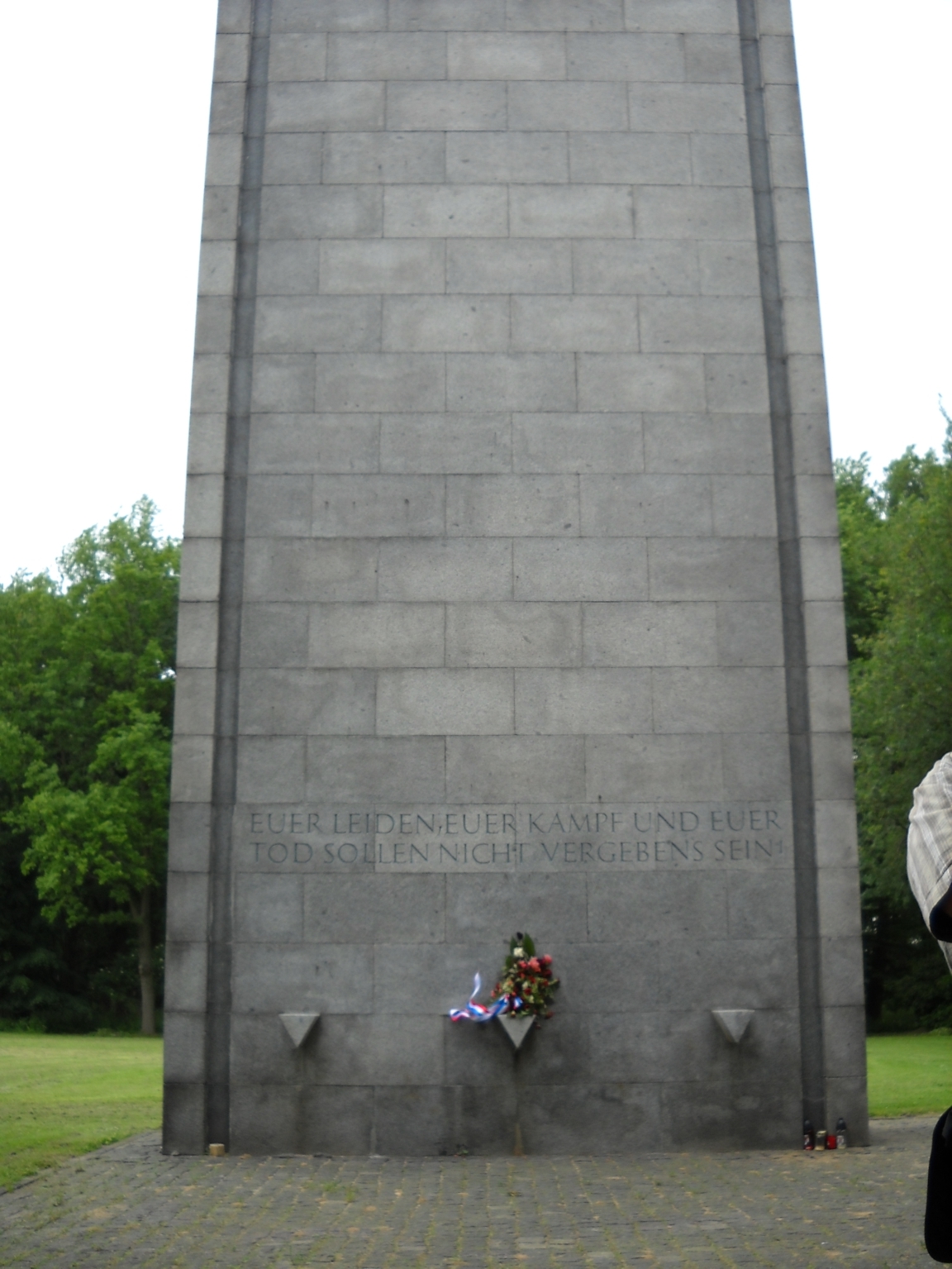
But there are other monuments which seem to talk from a neutral position, which in fact is that of the erectors, but by not being qualified, includes the spectator into the speaker position. The example I have ready at hand, is not from the US and not about war heroes, but again from Hamburg, this time from Neuengamme concentration camp memorial. In 1965, an „international monument“ stele(( Cf. https://upload.wikimedia.org/wikipedia/commons/thumb/1/15/Neuengamme_memorial.jpg/800px-Neuengamme_memorial.jpg, (photo by Hao Liu in the public domain) )) was erected there, together with a whole series of country-specific memorial plates. The inscription on the monument reads „Your suffering, your fighting and your death shall not be in vain“ (my translation). This now clearly is interesting in at least two respects: (1) it ascribes not only suffering and death, but also fighting to those commemorated and thereby possibly does not refer to those inmates who never had a chance or did not „fight“, who were pure victims, and (2) it speaks from a neutral voice which is not marked in time and social, political or event-related position. Whoever mourns at that place possibly silently co-signs the statement.
International Monument (1965) at Neuengamme Concentration Camp Memorial (partial photo; (c) 2006 Andreas Körber)
Consider an equal honouring of confederate generals in, say NC: „Your fighting shall not have been in vain.“ I would spark much more controversy and concers — and rightly so.
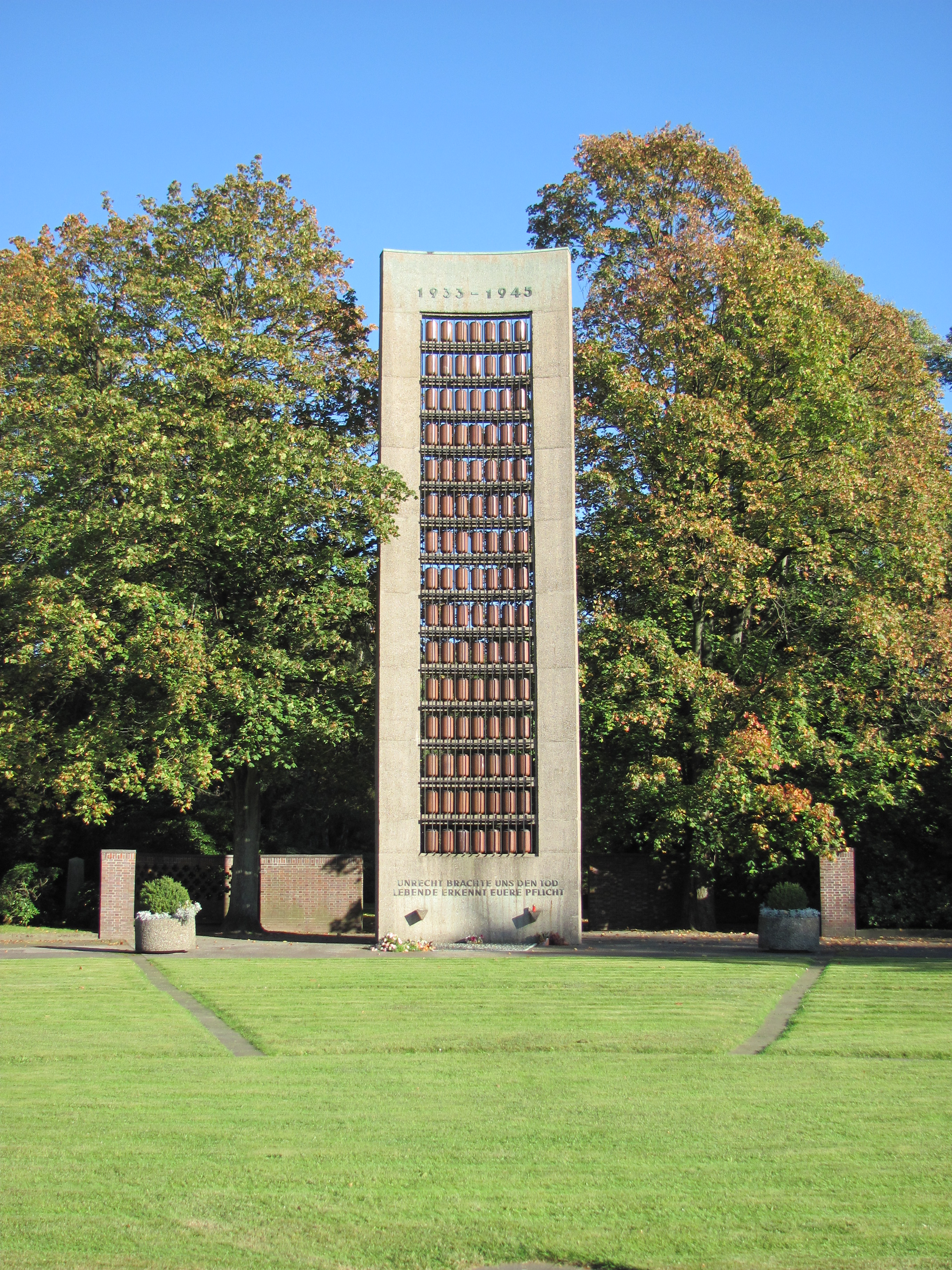
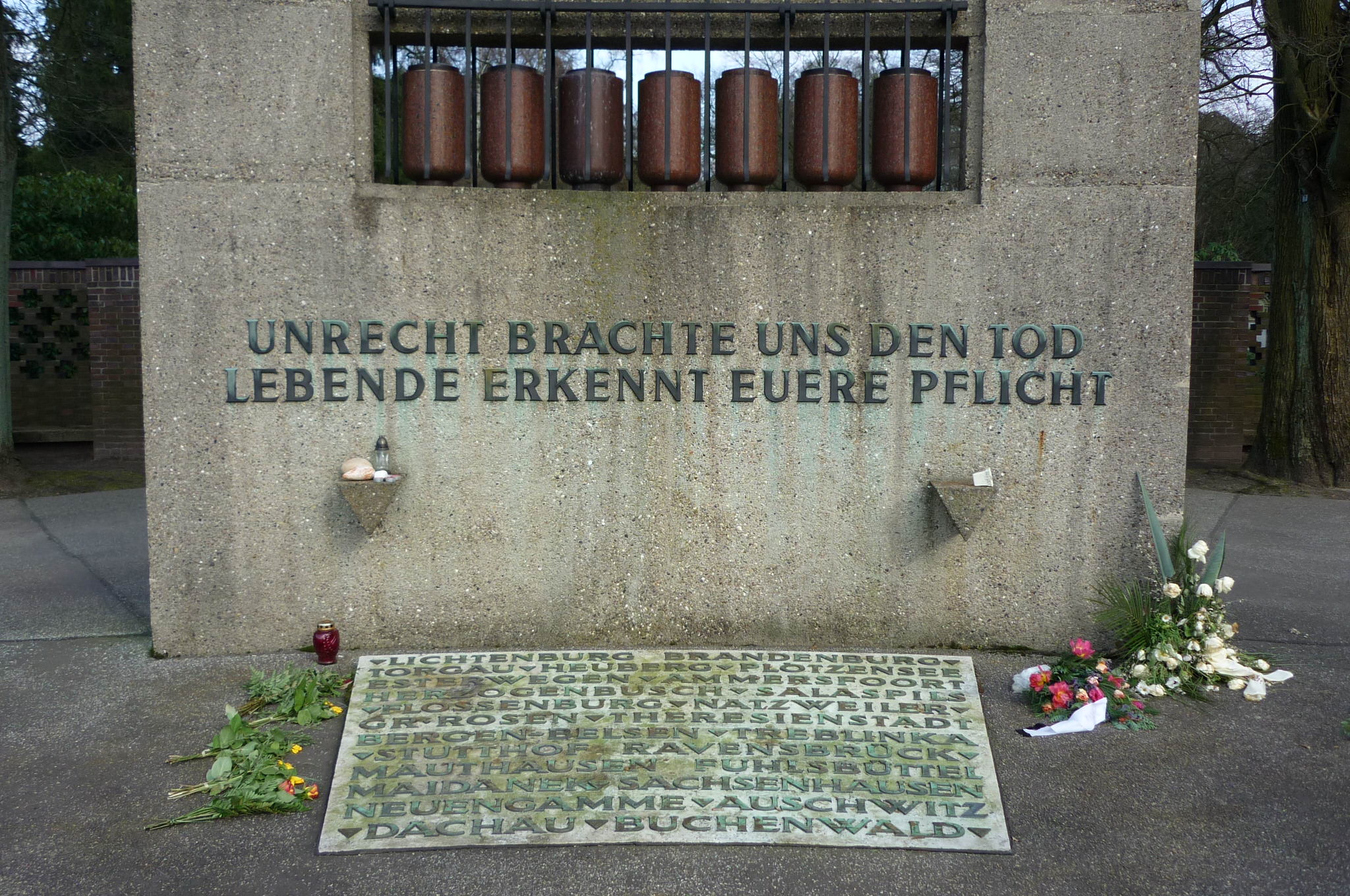
Still another example, the first Hamburg monument for the victims of National Socialism (from late 1945) on the Central Cemetry in Hamburg-Ohlsdorf, has an inscription „Injustice brought Us Death — Living: Recognize your Obligation“.
Erstes Hamburger Mahnmal für die Opfer des Nationalsozialismus von 11/1945 in Hamburg Ohlsdorf. Foto von NordNordWest/Wikipedia. Lizenz: CC-BY-SA 3.0; (https://creativecommons.org/licenses/by-sa/3.0/de/legalcode); Original: http://commons.wikimedia.org/wiki/File:Mahnmal_Opfer_der_NS-Verfolgung_Ohlsdorf.jpg
Erstes Hamburger Mahnmal für die Opfer des Nationalsozialismus von 11/1945 in Hamburg Ohlsdorf; Detail. Zustand 25.3.2010; Foto (c) Andreas Körber
Again, for analyzing and understanding, we need to recognize. The speaker position here, is clearly (metaphoricall) held by the victims to be commemorated. But whom do they speak to? Literally, it is the „living“. In a very broad understanding, the monument/memorial therefore addresses all humans, quite in a way what Rüsen has addressed as the highest level of normative plausibility: broadening the perspective to the level of humanity. This is not very problematic, since the inscription does talk of „duty“, not of „guilt“, it does not conflate the addressees with those who inflicted the injustice upon the victims. But it could have done. In 1945, the message would be clearly not merely universally humanistic, but at least also addressing the Germans as the society of the perpetrators. It does not condemn, but calls for recognizing the „duty“ and responsibility for commemorating and non-repeating as well as overcoming the structures of NS injustice, hinting at responsibility for not preventing them or even participating in them in the first place.
And today? In how far is the message the same for today’s society in Germany? The people living in Germany today do — apart from very few exceptions — not share any personal guilt or responsibility for what happened. In how far can or should they see themselves addressed?
Again, there is no question as to the very general, humanity-related address. This is directed at any audience. But would that mean that there is no difference between any other visitor to the memorial and Germans? Has the Nazi injustice (and similarly the Holocaust) become a matter of general, universal history only? Is there no special belonging to and message for German history? All these questions can and need to be addressed — and especially so, since a considerable part of German society consists not only of people born and raised (long) after the „Third Reich“, but also of many who immigrated from other countries, societies and cultures meanwhile. Are they simply counted into the perpetrators‘ society? — no, I think; but as people living in Germany, they also are adressed in a more specific way than any other visitor — and they are expected to feel addressed, also. While there may be (and often indeed is) not specific responsibility for what these memorials and monuments refer to, there surely is a specific responsibility from or out of this history — and these monuments therefore serve not only as general markers to a set past, but also as marks which have specific messages and different (but compatible) ones for different recipients. This is what also is a part of what is needed to be reflected and discussed with regard to monuments in public history culture and what history education needs to enable learners to partake in.
In order to make up our minds on monuments we have „inherited“ not only in political terms, we need to reflect their specific narrative message in a spectrum of time-relations. And we need to differentiate our terminology and enable our students to master a set of concepts related. We need, e.g., to distinguish honoring forms of commemoration from reminding and admonishing ones.
In Germany we have (not easliy) developed the notion of „Mahnmal“, admonishing, to be distinguished from a mere „Denkmal“ (literally a „thinking mark“). But even this distinction is insufficient. A Mahnmal (in fact the literal translation to „monument“, from Latin „admonere“) may admonish to remember our own suffering inflicted on us by ourselves, some tragic or by others, but also may admonish to not forget what we inflicted on others. This is the specific form „negative memory“ of German memorial culture.
Therefore, there’s a lot more to be reflected in commemorating:
Who „talks“? who authors the narrative — and is what capacity (e.g. in lieuf of „the people“, of a certain group, …)?
whom does the monument explicity address?
what is the relation of explicit addressees and factual spectators?
in how far is the message the same for us today as it was envisioned back then — and possibly realized? is it the same for all of us?
what kind of message is perceived?
(cf. Körber 2014)
References:
Hasberg, Wolfgang (2012): Analytische Wege zu besserem Geschichtsunterricht. Historisches Denken im Handlungszusammenhang Geschichtsunterricht. In: Meyer-Hamme, Johannes / Thünemann, Holger / Zülsdorf-Kersting, Meik (Hrsg.): Was heißt guter Geschichtsunterricht? Perspektiven im Vergleich. Schwalbach/Ts. / Wochenschau, S. 137–160, p. 140.
Klingel, Kerstin (2006): Eichenkranz und Dornenkrone. Kriegerdenkmäler in Hamburg. Hamburg: Landeszentrale für Politische Bildung.
Körber, Andreas (2014): De-Constructing Memory Culture. In: Teaching historical memories in an intercultural perspective. Concepts and methods : experiences and results from the TeacMem project. Hrsg. von Helle Bjerg, Andreas Körber, Claudia Lenz u. Oliver von Wrochem. Berlin 2014, 145-151.
Körber, Andreas (2016): Sinnbildungstypen als Graduierungen? Versuch einer Klärung am Beispiel der Historischen Fragekompetenz. In: Katja Lehmann, Michael Werner und Stefanie Zabold (Hg.): Historisches Denken jetzt und in Zukunft. Wege zu einem theoretisch fundierten und evidenzbasierten Umgang mit Geschichte. Festschrift für Waltraud Schreiber zum 60. Geburtstag. Berlin, Münster: Lit Verlag (Geschichtsdidaktik in Vergangenheit und Gegenwart, 10), S. 27–41.
Rüsen, Jörn (2017): Evidence and Meaning. A Theory of Historical Studies. Unter Mitarbeit von Diane Kerns und Katie Digan. New York, NY: Berghahn Books Incorporated (Making Sense of History Ser, v.28).
The graphic version of the model consists of four „competences“, visualized as smaller cogwheels arranged around and interacting with a central cogwheel titled with „historical consciousness“. For each of the four competencies, a short, monument-related definition is given.
Prompted by a commentary by Gabriel Reich of Virginia Commonwealth University, who also works extensively on monuments in memory culture, Stéphane Lévesque added a (more general) table version (a Spanish translation by Elizabeth Montanares Vargas has been presented on facebook, meanwhile) in an answering comment, further detailing the competencies in his model.2.
As much as I appreciate this new model of competencies in general, I have also added a few comments to it (and to one point of Gabriel Reich’s comment, which is not in focus, here). The space provided by Public history weekly for commenting is limited and graphs are (at least not easily) allowed. I therefore use this my own blog for repeating my comment to Lévesque’s model, and to detail it a bit further.
First of all, I strongly support the initiative to analyse monuments as an expression of and factor for historical consciousness. Indeed, we need both a) to analyse them as experts by using our repertoire of historiographic methods and concepts in order to stimulate and support informed public discussion about whether a particular monument is still desirable (or at least acceptable) or whether it needs to be changed (and how) or even removed, and b) to develop people’s competences to address these issues themselves, i.e. to reflect on the nature, meaning and message of a monument both at the time of its construction and today (e.g. through preservation, maintenance, alteration, commenting or removal).
For this reason, I greatly appreciate Stéphane’s proposal for a competency model, especially the table version from the commentary above. This does not mean that I fully support the concrete model, but it has enriched the debate. Three comments on this:
(1) I doubt that competence as such can be “traditional”, “exemplary”, “genetic”, “critical” or “genetic”. These patterns, both as I understand Rüsen and for myself, characterize the logic of narratives. I would therefore rather read the table as “the competence to query in the traditional mode” … “the competence to narrate in critical mode” etc.
(2) This again raises the question of whether the four patterns actually constitute a distinction of competence niveaus. While I agree that the genetic mode of narrating history is the historically most recent, complex and suitable for explaining changes, I doubt – this time against Rüsen (cf. Körber 2016) – that the typology can describe competence levels. The competence progression would need to be defined transversally: From (a) a basic level of non-distinctive (and thus unconsciously confusing) forms and patterns, via (b) the ability to perform all these forms of operations in the various patterns of Stéphane’s table (which would this describe a fully developed intermediate level), to (c) an elaborated level of (additional) ability to think about the nature of these distinctions, etc.
For this, the model is very useful, full of ideas. It can help to think about what it takes to describe monuments neither as “the past” nor as “simply old”, but to identify and “read” them as narratives (or narrative abbreviations) from a certain time, whose current treatment adds new narrative layers to them, so that their existence (or absence), form, and treatment of them can always be seen and evaluated as contemporary statements about the respective past. To recognize this and to deal with it in a socially responsible way requires these competences.
As far as Gabriel Reich’s commentary is concerned, I only ask whether his characterization of an attitude to the confederation monuments can really be addressed with Rüsen as “exemplary”, since this mode is not concerned with the maintenance and support of a conventional identity, but with the derivation of a supertemporal rule. I would refer to the example as “traditional”. An “exemplary” attitude towards retention would be more likely to be: “At all times, monuments of one’s own heroes have helped the losers of war to hold on to their cause. Then that must be possible for us too.” Or something along that line.
So far the comment already published in Public History Weekly.
That said, I might add, that I don’t mean that the „genetic“ way of sensemaking is not in some way superior to the others, and more apt for historical meaning-making, especially in its integration of a notion of directed change over time. My scepticism focuses on the idea that today’s people’s („ontogenetic“) competencies of historical thinking progresses along the same line as the cultural („phylogenetic“) development of Rüsen’s patterns of sensemaking throughout the history of historiography. Today’s youth simultaneously encounter manifestations of historical thinking using all three (rather than four)3 patterns of sensemaking. While there is a kind of „development“ of power of historical meaning-making and explanation from traditional via exemplaric to genetic, I doubt that people and students have to move from the former to the latter — or do so.
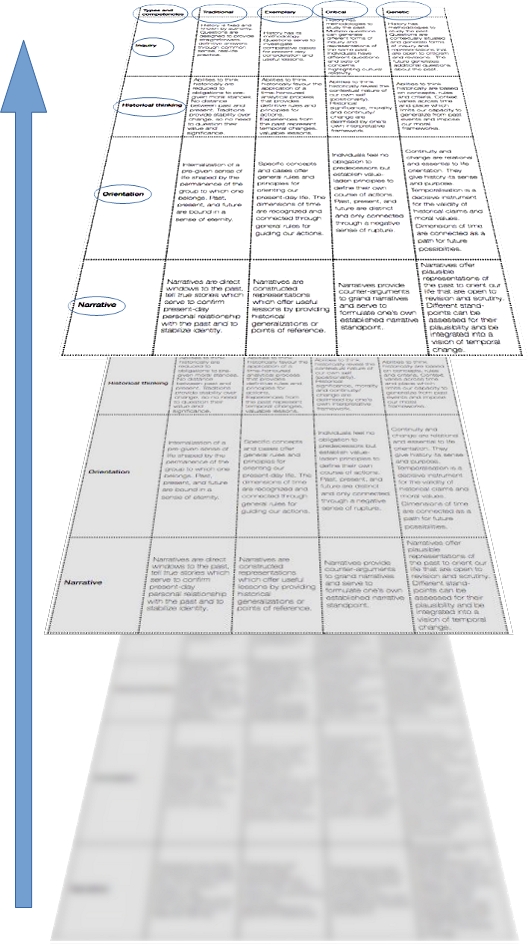
My own idea of development of competencies of historical thinking can rather be visualized as follows (adopting Lévesque’s table):
A „basic“ niveau (and possibly early stage) would be defined by the inability of distinguishing different modes of historical narrating in general and referring to monuments in this specific case. (Young) people on this niveau (at this stage) will relate to them. They will ask questions (and thus exercise their „inquiry competence“), think („historical thinking competence“), orientate themselves („orientation competence“), and narrate („narrative competence“). But this basic niveau will not be defined by being „traditional“, but by an uninformed mixing (possibly only half-understood) forms of all three patterns. This performance will be both instable and inconsistent. Half-baked traditional questions will stand next to unreflected exemplary statements, and so on. In the graph above, this is symbolized by the blurred table below.
The ability to apply the different patterns in a somewhat clarified way, to distinguish them and select one, to identify inconsistencies in their mixing, etc., then marks the intermediary niveau, and possible a major stage in the development of these competencies. On this niveau, at this stage, people will be able to discuss about the message a monument expresses and the meaning it has for us today, but they might disagree and even quarrel because they apply different patterns of meaning-making. In a way, Lévesque’s table describes this intermediate niveau, the different forms of historical inquiring, thinking, orientating, and narrating can take, depending from the general pattern of sensemaking. The table (the middle one in the graph above) clearly points at something, I have also tried to express in my German article challenging Rüsen’s own idea of the different patterns forming different nivueaus of competencies4: Each of the different operations (inquiring, narrating, orientating) will take on a specific stance of narrating. It is a difference whether I ask for a tradition or for a rule to be derived from past examples, or about a patterns of change across time. These questions are informed by more general stances and understandings of history (maybe coded in Lévesque’s central cogwheel of „historical consciousness“) and will generate different forms of orientation and narrating. This does not mean that the initial stance determines the outcome of the story, rendering historical thinking a matter of self-affirmation – not at all. A person inquiring in traditional will look for an origin for something valid and might — via historical thinking and research — learn of a quite different origin. The mode of meaning-making will still be traditional, but the concrete history will have changed. But people might also be forced to change their pattern in the process, e.g. learning of the limits of exemplary thinking when gaining insight into fundamental change, and thus „progress“ in a way from exemplary to genetic sensemaking.
The highest niveau, however, will be reached not by finally arriving at the genetic forms of thinking and the respective competencies, but by complementing the ability to recognize, distinguish and apply the different forma with a transgressing ability to reflect on the nature, value and limits of this (and other) typologies themselves. Only on this niveau (at this stage) are people fully at command of their historical reflection. They can address the limits societally accepted concepts and terminology pose and suggest new or amended ones, etc. In the graph above, this is symbolized by the additional focus to the rubrics of Lévesque’s table, marked by the blue rings.
Post Views:636
Lévesque, Stéphane: Removing the “Past”: Debates Over Official Sites of Memory. In: Public History Weekly 6 (2018) 29, DOI: dx.doi.org/10.1515/phw-2018-12570. There also is a German and a French version. [↩]
The table can be found under the same address as the original contribution, down the page [↩]
Rüsen’s „critical“ type of narrating does not really fit into the typology, presenting not a new logic of interconnecting temporal information, but merely de-elgitimizing others. In 1988 already, Bodo von Borries commented on this and presented a graphical concept of the interrelation of the different types, in which a „critical“ type was placed between both the traditional and the exemplary and the latter and the genetic, thus assigning it the function of a catalyst of development (Borries, Bodo von (1988): Geschichtslernen und Geschichtsbewusstsein. Empirische Erkundungen zu Erwerb und Gebrauch von Historie. 1. Aufl. Stuttgart: Klett, p. 61; cf. Körber, Andreas (2015): Historical consciousness, historical competencies – and beyond? Some conceptual development within German history didactics. Online verfügbar unter http://www.pedocs.de/volltexte/2015/10811/pdf/Koerber_2015_Development_German_History_Didactics.pdf, p. 14f.). In the new version of his „Historik“, Rüsen presents a similar version. Cf. Rüsen, Jörn (2013): Historik. Theorie der Geschichtswissenschaft. Köln: Böhlau, p. 260. English: Rüsen, Jörn (2017): Evidence and Meaning. A Theory of Historical Studies. Unter Mitarbeit von Diane Kerns und Katie Digan. New York, NY: Berghahn Books Incorporated (Making Sense of History Ser, v.28), p. 198. [↩]
Körber, Andreas (2016): Sinnbildungstypen als Graduierungen? Versuch einer Klärung am Beispiel der Historischen Fragekompetenz. In: Katja Lehmann, Michael Werner und Stefanie Zabold (Hg.): Historisches Denken jetzt und in Zukunft. Wege zu einem theoretisch fundierten und evidenzbasierten Umgang mit Geschichte. Festschrift für Waltraud Schreiber zum 60. Geburtstag. Berlin, Münster: Lit Verlag (Geschichtsdidaktik in Vergangenheit und Gegenwart, 10), S. 27–41. [↩]