
Counter-Democratic History Education Plans in the US under Trump?

Körber, Andreas (10.02.2025): „Counter-Democratic History Education Plans in the US under Trump?“ In. Historisch Denken Lernen. Blog des AB Geschichtsdidaktik.

The US government under Donald Trump wants to make history teaching – under the pretext of abolishing ideology via an Executive Order– once again an ideological celebration of its own greatness and the glory of its own, purely white nation:
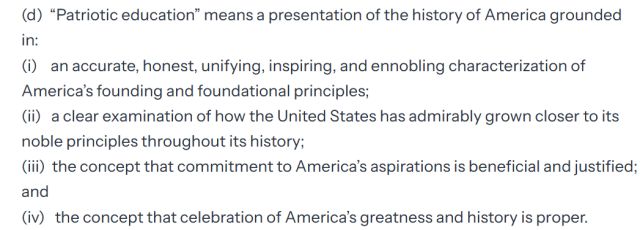
"(d) “Patriotic education” means a presentation of the history of America grounded in: (i) an accurate, honest, unifying, inspiring, and ennobling characterization of America’s founding and foundational principles; (ii) a clear examination of how the United States has admirably grown closer to its noble principles throughout its history; (iii) the concept that commitment to America’s aspirations is beneficial and justified; and (iv) the concept that celebration of America’s greatness and history is proper."
History-Education-related Excerpt of President Donald Trump’s Jan 29th, 2025 Executive Order on Patriotic Education. https://www.whitehouse.gov/presidential-actions/2025/01/ending-radical-indoctrination-in-k-12-schooling (Sec. 2; (d))

This not only means a politically motivated distortion of history itself and presumably a serious encroachment on the freedom of scientific historical research, but also a disregard for all the findings of historical didactic research and development. In particular, it may also be a state-prescribed renunciation of one of the central concepts of history teaching in recent decades, namely the ability to think independently – and necessarily critically – as the central goal of learning history at school.

That such independent critical thinking is necessary not only in the domain of history, in view of the alterity of past life-worlds and ways of thinking, but that it is also a core concern in view of the changed communication structures (“digitality”) and the associated contact of everyone with unfiltered assertions (to a certain extent as a “price” for improved access to the “market of opinions” with one’s own statements) is also necessary in general as a competence for members of modern societies has been the central topic of Sam Wineburg at Stanford in recent years.

But Trump’s executive order makes it clear that, when it comes to history, there is and must be more at stake than overcoming a tendency, real or imagined, that we all have to view the past through modern eyes (“presentism”). Historical thinking consists of more than taking the past seriously as belonging to a different time and culture and being able to recognize and think about it with the help of primary sources.

History is not (only) the exotic, strange and therefore incomprehensible, daunting or interesting past, but rather the access to this past that takes place out of a present interest and works with present questions and concepts, and the processing of its knowledge. The knowledge of its otherness and its connection to other times, the present and the possible future for the purpose of one’s own or someone else’s orientation. This insight only seemingly contradicts Wineburg’s quoted concern, namely only if in such access to the past, the present, the today’s as well as socially, culturally, and politically own conceptions would be set absolutely. But that would be precisely a non-critical historical thinking. Such historical thinking is critical, reflective and reflexive when it does not absolutize the past or its own and subordinates the other “pole” to it, but when the past is considered in the light of the present, but then in the light of the recognized past and its connections. This process is called sense-making (Jörn Rüsen). Historical thinking aims to make sense of the connections between human (and natural) conditions, states, actions, developments, etc., located at different times, in order to orient us today. Such enabling sense is neither found in the past as pre-formed nor imposed on it from the present. Rather, such meaning becomes capable of orientation when it is approached in the form of interests, questions, hypotheses, concepts, etc. to the data of the past, in contact with them, in the recognition of the past as the past, is changed and sharpened. This is the process of historical thinking in its synthetic, re-constructive mode. It results in historical narratives of very different kinds and media presence – from short statements in which the different points in time may only appear implicitly (“then it was like that” implies that today it is different or the same, but that both are worth mentioning and probably also open to some kind of explanation), in short reports, to extensive presentations. It is the nature of such historical statements that they – precisely as constructions of meaning over time – make a claim to validity, because unlike, for example, fictional stories, their very basis is that they refer to an actual past. Their relevance and concrete significance do not arise from the fact that what is narrated in them in a meaningful and orienting way seems plausible as a thought, but that it refers to an actual past.

Our world is full of such historical statements – statements and stories of very different quality. They are each told from specific, particular points of view and perspectives and with equally particular interests, but they are not necessarily bound to be orienting only for their authors – on the contrary: the vast majority of stories make a well-founded claim to validity that extends beyond the respective author’s own perspective. This is connected with assertions of relevance and significance that must be honored. And it is by no means a binary question of for whom such a story can be relevant and orienting – whether only for its author or for “everyone”. No, in such stories very different statements are made about who (which “we”) they are supposed to apply to and who the respective counterpart (an “you” or also a “they, the others”) is. Similarly, norms and values are incorporated into such stories, the validity of which can either only be asserted or justified. The same applies to a whole range of other elements of history – images of humanity and the world, explanatory models, etc.

Moreover, all these facets can be related to all temporal levels of history – and in no way uniformly. Whether and how, for example, a stable historical depth dimension is constructed to link authors and addressees to the present “we” (e.g. “our ancestors”), whether the two are opposed to each other (“then enemies – now together”), whether and to what extent present and past norms and values are presented as the same or as having changed, whether, for example, the past is narrated as fortunately overcome, as the basis of a positively evaluated development, as unfortunately lost or differently related to the present – meaning is always presented.

In addition to the ability to independently construct plausible (and recognized by others) orienting meaning in the sense of the above-mentioned synthetic re-construction, what is needed in today’s society (and actually for some time or even always), especially in democracies, is the ability of everyone to analyze the endless number of such “finished” narrated stories that they (all of us) encounter, to question them about what they specifically tell us, why and how they do it and how plausible it is (deconstruction).

In this sense, critical historical thinking is not reduced to distinguishing “good”, i.e. credible or trustworthy, from “bad” historical stories, and then ignoring the latter and trusting the former. Precisely because all stories, even the problematic ones, not only make claims to validity, but also offer validity and orientation, it requires the willingness and the ability to analyze them in terms of their construction logics and the elements incorporated into them – that is, “we”/they” conceptions, norms, world and human images, explanatory models, etc.

Against this background, the goal of democratic history teaching should not be to provide the members of a democratic society with a single narrative decreed from above, an interpretation of history that everyone must accept not out of an understanding of its orienting power in the face of current challenges, but by means of state decree and pedagogical measures (grades) – and certainly not a historical narrative that either excludes significant parts of society from the “we” or forcibly incorporates them into a particular “we” while disregarding their (also) specific positions, perspectives, identities and orientation needs.

As – in democracies – society and the state must acknowledge different political interests of their members which need to be both formed into a common interest still acknowlegding the different perspectives and safeguarding their very cores, so democratic history education must be history teaching that is not arbitrary, but does not deny the diversity and variety of positions, perspectives and orientation needs, but recognizes and takes them up for two purposes: (1.) to get to know and recognize not only one’s own (particular) position, perspective, world view and interpretation of history, but also those of others, even where one does not share them, and thus to broaden one’s own horizons, also to recognize one’s own particularity, and (2.) to piece together different stories and the experiences on which they are based in such a way that they do not merge into a single homogenized story, but into a spectrum of different stories that are recognized as such but compatible with each other from a superordinate perspective.

Furthermore, democratic history education should acknowledge that — as it is the normal state of democratic decision-making to acknowledge a diversity of interests — people’s historical perspectives and interpretations are different.

Consequently, historical judgments (both in the form of factual conclusions and value-based judgments) should not be imposed on students in the form of pre-formulated interpretations and evaluations, but rather be made possible for them as an independent achievement in the course of joint, guided considerations and discussions. Whether (or rather, to what extent) a story is “ennobling” and “admirable” should not be prescribed, but rather discussed, considered, and judged in a differentiated way – controversially if necessary.

But there is more at stake: in the way the executive order uses the term history, it is nothing more than an uncritical and irresponsible celebration of the self, and as such an instrument of indoctrination. The potential of history to not only affirm the existing (and also coercive), but to orient, is completely hidden. History always has the potential to question one’s own existence, a question that can yield both affirmative and transformative and reorienting results – and not as alternatives, but usually closely interwoven. If a nation’s history is so noble, this should not be difficult. Imposing such judgments from above is more a testament to the fear of independent judgments – especially when they are well-founded.

In this sense, Trump’s executive order is not only an expression of authoritarianism in a state under the authority of the law in terms of the politics of history, but also in pedagogical and historical-didactic terms.

Unschärfe und Überschärfe: Zur Fassung von Geschichtsrevisionismus – Part I: Revision als Prinzip der Geschichte

Bormuth, Heike (22.11.2023): „Unschärfe und Überschärfe: Zur Fassung von Geschichtsrevisionismus.“ In: Historisch Denken Lernen. Blog des AB Geschichtsdidaktik der Universität Hamburg. https://historischdenkenlernen.blogs.uni-hamburg.de/unschaerfe-und-ueberschaerfe-zur-fassung-von-geschichtsrevisionismus-part-i-revision-als-prinzip-der-geschichte/.

Geschichte ist überall und die Auseinandersetzung mit ihr findet schon lange nicht mehr ausschließlich oder überwiegend über die institutionell-formalen Geschichtsvermittler mit ihren Kontrollmechanismen, Qualitätsstandards und Publikationshürden statt. Insbesondere die sozialen Medien haben in den vergangenen Jahren an Einfluss und Bedeutung gewonnen.[1] Öffentlich wirksam finden Geschichtsdarstellungen zudem in Filmen, Roman, Computerspielen oder Festen einen Raum, um nur einige zu nennen. Auch Diejenigen, die nie eine historisch arbeitende Disziplin studiert haben, keinem Geschichtsverein angehören oder regelmäßig Gedenkstätten und Museen besuchen, werden so mit Geschichte konfrontiert, konsumieren, verarbeiten und interpretieren sie und tragen selbst zur gesamtgesellschaftlichen Geschichtskultur bei.[2] Grundsätzlich ist dies kein Problem, sondern ein sogar wünschenswerter Ist-Zustand. Nun befinden wir uns aber „[i]n einer Welt des hochvolatilen, unsicheren und vielfach ideologisierten (Internet-)Wissens und zweckorientierten Erzählens“,[3] in der Geschichte zunehmend eigen-nützig instrumentalisiert wird.

Den traditionellen Geschichtsvermittler:innen und ihrer wissenschaftlich begründeten Rationalität sind insbesondere „in bewegten Zeiten“[4] – und als solche lassen sich jüngste Ereignisse die Corona-Pandemie und politischen Unruhen der USA, aber auch länger andauernde Dimensionen, wie postmoderne Verunsicherung nach dem Ende der Nationalstaaten, Klimakatastrophe und wirtschaftliche Unsicherheit sicherlich fassen – Grenzen gesetzt. Vielmehr treten gerade dann Geschichtsrevisiotnist:innen bzw. geschichts:revisionistische Deutungen auf, die eigene Interessen durch eine bestimmte Sicht auf Geschichte legitimieren wollen.

Geschichtsrevisionismus ist dabei als Problem in vieler Munde, aber was genau damit gemeint ist, ist einerseits unscharf und kaum für sich genommen definiert oder von Revision als legitimem Bestandteil von Geschichtswissenschaft abgegrenzt. Gleichzeitig stellt sich der Begriff als inhaltliche überscharf dar, denn in Deutschland gilt Geschichtsrevisionismus als konstitutives Element und „zentrales Agitationsfeld des Rechtsextremismus“.[5]

Revision als Prinzip in der Geschichte

Geschichte als Wissenschaft folgt der historischen Methode, die der Versicherung dient, dass die Vergangenheit nicht der beliebigen Darstellung freigegeben wird. Dabei gilt, Geschichte ist die selektive Rekonstruktion einer unwiederbringlichen Vergangenheit anhand von übergebliebenen Vergangenheitspartikeln in Form einer Narration und unter Bedingungen des jeweiligen Standortes.[6] Mit faktischen Aussagen tun sich Geschichtsvermittler:innen entsprechend oftmals schwer. Dies verhindert zwar zu einem gewissen Grad Instrumentalisierung und Dogmatik, macht die Ergebnisse und Produkte der Akteur:innen aber auch verletzlich, da sie in der Außensicht als unsicher und damit frei uminterpretierbar erschienen können.

Ein weiteres Element wissenschaftsförmiger Geschichtsschreibung ist das Prinzip der stetigen Erneuerung und prinzipiellen Falsifizierbarkeit aller Ergebnisse. Historiker:innen der verschiedenen Disziplinen betreiben hierzu eine stetige Revision, im Sinne eines kritischen Rationalismus.[7] Dies meint die Überprüfung und gegebenenfalls Anpassung bestehender Erkenntnisse aufgrund neuer empirischer Beweise, die entweder die Plausibilität einer These zur Vergangenheit reduzieren und sie damit weniger glaubhaft erschienen lassen oder diese Plausibilität erhöhen und eine zuvor kaum oder nichtbeachtete These damit in den Stand von Wissen erheben. Diese neuen Beweise können die Resultate der Entdeckung oder Öffnung bis dahin unbearbeiteter Quellenbestände sein sowie der Erschließung einer neuen Art von Quellenmaterial, wie z.B. im Zuge des material turn der 1980er oder jünger in Bezug auf born digital Material. Neue Evidenzen können außerdem durch neue Forschungsmethoden-, fragen oder -ansätze, mit ihren jeweils eigenen Erkenntniswerten, entstehen, die zu einer Neubewertung historischer Gesamtzusammenhänge führen können. Dies betrifft sowohl genuin historische Methoden als auch interdisziplinäre Ansätze, wie beispielweise die soziologische Netzwerkforschung, oder junge Disziplinen, wie die Digital Humanities. Hier ist an eine Bearbeitung von Quellenmaterial in einem zuvor unmöglichen Umfang zu denken, die nun durch Mittel der automatischen Texterkennung und Schlagwortbildung sinnhaft wird. Ähnlich verhält es sich mit der Nutzbarmachung bekannter aber zuvor unleserlicher Quellen durch computergestützte Transkriptionsverfahren, wodurch in ein neuer Quellenbestand eröffnet wird.[8]

Neben neuen Quellen oder Methoden kann auch eine Veränderung des sozialen Werte- und Normenkontextes einer Gesellschaft, in der historische Forschung betrieben wird, die Neuevaluation bestehender Wissensschätze im Sinne einer Orientierungsfähigkeit notwendig machen. Vormals wenig beachtete Themen, etwa der Sozial- oder Geschlechtergeschichte, können in den Fokus rücken oder bestehende Bewertungen, beispielsweise von bzw. durch koloniale Begrifflichkeiten, kritisch hinterfragt werden. Verändern sich die Normen und Werte einer Gesellschaft verändert sich auch der Referenzrahmen, mittels dessen Historiker:innen Zustände, Prozesse, Personen und Ereignisse der Vergangenheit bewerten. Oftmals kommen mit diesen veränderten Perspektiven auch neue Fragen an die Vergangenheit auf, die überhaupt erstmalig bearbeitet werden können. Ähnliches Geschieht, wenn durch Ereignisse in der Gegenwart neue Orientierungsbedürfnisse durch Verunsicherungen entstehen, zu deren Befriedigung Vergangenheit befragt wird. Als Beispiel hierzu kann ein größeres Interesse an der Umweltgeschichte vor dem Hintergrund der Klimakatastrophe gesehen werden oder auch, wie Aviezer Tucker anführt, das Interesse an dem totalitären Experiment der Täufer im Münster des 16. Jahrhunderts vor dem Hintergrund des Aufkommens des Totalitarismus im 20. Jahrhundert. In gleichem Maße führen auch Prozesse, die erst kürzlich zu einem Abschluss gekommen sind zu neuen Bedürfnissen nach einer historischen Aufarbeitung, die im laufenden Entwicklungsprozess nicht möglich gewesen war. Exemplarisch könnte dies am Beispiel des Epochenjahres 1989 erörtert werden.[9]


Abb.: Kritischer Rationalismus in der Geschichtswissenschaft (eigene Darstellung).


Der Ansatz einer legitimen Revision im Kontext historisch arbeitender Disziplinen steht, wie die Formulierung bereits vermuten lässt, einem problematischen und illegitimen Geschichtsrevisionismus gegenüber. Allerdings ist revisionistisch durch die starke negative Besetzung und Verbindung zu illegitimer Revision kaum noch als Forschungsbegriff präsent.  Die Verwendung des Begriffs Geschichtsrevisionismus ist wiederum umstritten, da sie sowohl als Fremd- als auch als Selbstzuschreibung den Narrationen von illegitimen Geschichtsrevisionist:innen eine augenscheinliche Legitimität zugesteht. Einige Historiker:innen verwenden daher alternative Begriffe, wie den der Geschichtsleugnung, der allerdings nicht in gleichem Maße verbreitet ist. Insbesondere im anglo-amerikanischen Bereich findet revisionism hingegen weiterhin Anwendung im Sinne legitimer wissenschaftlicher Erneuerung[10] und in der französischen wie auch englischen Forschungslandschaft wird ein illegitimer Geschichtsrevisionismus unter starkem Bezug zur Leugnung von Holocaust und weiteren Völkermorden als negationism bzw. négationnisme[11] oder auch alt-histories[12] gefasst.

Zu Teil II


[1]     Siehe Burkhardt, Hannes: Mythosmaschine Twitter? Fakten und Fiktionen im Social Web zu Rudolf Heß und der Bombadierung Dresdens 1945. In: ZfGd (2019), 42-56:42f.

[2]     Siehe Hinz, Felix/Körber, Andreas: Warum ein neues Handbuch zu Geschichtskultur – Public History – Angewandter Geschichte? In: Dies. (Hrsg.): Geschichtskultur – Public History – angewandte Geschichte. Geschichte in der Gesellschaft. Medien, Praxen, Funktionen. Göttingen 2020, 9-36: 10f.

[3]     Geiss, Peter: Objektivität als Zumutung. Überlegungen zu einer postnarrativistischen Geschichtsdidaktik. In ZFGD (2019), 27-41: 38.

[4]     Siehe Jeismann, Karl-Ernst: „Geschichtsbewußtsein“ als zentrale Kategorie der Didaktik des Geschichtsunterrichts. In: Ders. / Wolfgang Jacobmeyer (Hrsg.): Geschichte und Bildung. Beiträge zur Geschichtsdidaktik und zur historischen Bildungsforschung. Paderborn 2000, S. 46-73: 49.

[5]     Bundesamt für Verfassungsschutz (Hrsg.): Kompendium des BfV. Darstellung ausgewählter Arbeitsbereiche und Beobachtungsobjekte. Köln 2018, 24.

[6]     Zum schwierigen Verhältnis von Geschichte und Faktizität bzw. Konstruktion siehe unter anderem  Koselleck, Reinhart: Fiktion und geschichtliche Wirklichkeit. In: Carsten Dutt (Hrsg.): Vom Sinn und Unsinn der Geschichte. Aufsätze und Vorträge aus vier Jahrzehnten. Berlin 2010, 80-95; Rausch, Gebhard: Konstruktivismus und die Tradition der Historik. In: ÖZG 8 (1997) H. 1, 45-75; und White, Hayden: Auch Klio dichtet oder die Fiktion des Faktischen. Studien zur Topologie des historischen Diskurses. Stuttgart 1991. Zur Subjektivität und Standortbindung siehe Koselleck, Reinhart: Vergangene Zukunft. Zur Semantik geschichtlicher Zeiten. Frankfurt aM 1979, 176-207.

[7]     Maßgeblich ist hierzu auf Karl Popper, den Verfechter einer empirisch-analytischen Wissenschaft, zu verweisen. Popper steht für eine logisch-planmäßige, dogmenfreie, nicht-positivistische und rationale Herangehensweise an wissenschaftliche Fragestellungen, die eine Induktionslogik ablehnt und entsprechend zwar eine Widerlegung, nie aber eine endgültige Verifikation von Aussagen als möglich ansieht. Intersubjektivität und Nachprüfbarkeit als zentrale Gütekriterien ermöglichen es, die gegenwärtige Gültigkeit einer Aussage zu beurteilen. Auf einer sozio-politischen Ebene tritt der Kritische Rationalismus für eine offene, pluralistische und sich allmählich reformierende Gesellschaft ein. Poppers zentrale Schriften hierzu sind seine Logik der Forschung. Zur Erkenntnistheorie der modernen Naturwissenschaft (1935) und Die beiden Grundprobleme der Erkenntnistheorie (Manuskripte 1930-1933, vollständig erschienen 1979) sowie, unter der sozialkritischen Prämisse, Die offene Gesellschaft und ihre Feinde (1945). Siehe hierzu Lamnek, Siegfried: Kritischer Rationalismus. In: Gerd Reinhold (Hrsg.): Soziologie-Lexikon. München/Wien 42000, 374. 122f; und Pehle, Heinrich/Brinkmann, Heinz-Ulrich: Kritischer Rationalismus. In: Everhard Holtmann (Hrsg.): Politik-Lexikon. München/Wien 32000, 329.

[8]     Tucker, Aviezer: Historiographic revision and revisionism. The evidential difference. In: Michael Kopeček (Hrsg.): Past in the making. Historical revisionism in Central Europe after 1989. Budapest/New York 2008, 1-14:1-2.

[9]     Ebd.

[10]   Ein willkürlicher Themenquerschnitt an Publikationen der jüngeren Zeit zeigt bei Artikeln und Monographien gleichermaßen Titel wie Black, Jeremy: Kings, nobles and commoners. States and societies in early modern Europe. A revisionist history. London 2004; Hagedorn, John: Race not space. A revisionist history of gangs in Chicago. In: The journal of African American History, 91 (2006) H. 2, 194-208; Keller, Robert: The Kennedy-Johnson Tax Cut. A revisionist history. In: The Journal of Economic History, 61 (2001) H. 2, 571-573; Ko, Dorothy: Cinderella’s sisters. A revisionist history of footbinding. Berkeley 2007; McGregor, Gaile: Domestic blitz. A revisionist history of the Fifties. In: American Studies. 34 (1993) H. 1, 5-33; Salemink, Oscar: Trading goods, prestige and power. A revisionist history of lowlander-highlander relations in Vietnam. In: Peter Boomgaard (Hrsg.): Linking destinies. Trade, towns and kin in Asian history. Leiden 2008, S. 51-70; Scot, Jamie: A revisionist history. How archives are used to reverse the erasure of Queer people in contemporary history. In: QED, 1 (2014) H. 2, 205-209; Sidney, Benjamin/Schwantes, Michael: The train and the telegraph. A revisionist history. Baltimore 2019; Sissoko, Carolyn: The Origins of the classical gold Standard. A revisionist history. In: International Political Economy. Monetary Relations eJournal, (2019), 1-23. DOI: http://dx.doi.org/10.2139/ssrn.3191289. Noch breiter wird die Auswahl, sobald die historische Perspektive innerhalb anderer Disziplinen wie Jura oder Medizin einbezogen wird, bei denen legitime revisionistische Rückblicke auf bestimmte Erkenntnisaspekte durchaus üblich sind.

[11]   Die Begriffsbildung geht zurück auf Henry Roussos 1987 erschienenes Buch Le Syndrome de Vichy. De 1944 à nos jours und bezog sich zunächst konkret auf Aspekte der Holocaustleugnung. Er wird seither aber auch weiter gefasst verwendet. Für eine weiterführende Auseinandersetzung siehe Igounet Valérie: Histoire du négationnisme en France. Paris 2000.

[12]   Alt-history bezeichnet mutwillige Falschdarstellung der Vergangenheit zur Entwicklung einer alternativen Geschichtserzählung, die zur alleinigen Autorität stilisiert wird. Hier reihen sich auch die Behauptungen alternativer Fakten und einer „Lügenpresse“ als vermeintliche Träger politisch erwünschter Weltsichten ein. Valencia-García, Louie Dean: Far-right revisionism and the end of history. In: Ders. (Hrsg.): Far-right Revisionism and the end of history. Alt/Histories. London 2020, 3-26: 7.

Zu Teil II