Reenactment: Nostalgische Sinnbildung per symbolisch-enaktiver „Wiedereinsetzung in den vorigen Stand“. Zur Logik und Typologie historischer Sinnbildung und ihrer (partiellen) Suspendierung im Reenactment.

Körber, Andreas (2020): Reenactment: Nostalgische Sinnbildung per symbolisch-enaktiver „Wiedereinsetzung in den vorigen Stand“. Zur Logik und Typologie historischer Sinnbildung und ihrer (partiellen) Suspendierung im Reenactment. In: Historisch denken lernen [Blog des AB Geschichtsdidaktik; Universität Hamburg], 17.08.2020. Online verfügbar unter https://historischdenkenlernen.blogs.uni-hamburg.de/reenactment-enaktive-wiedereinsetzung-in-den-vorigen-stand-zur-logik-historischer-sinnbildung-und-ihrer-partiellen-ausserkraftsetzung-im-reenactment/.

Einleitung

Über Reenactments als Geschichtssorte1 werden in letzter Zeit viele analytische Untersuchungen publiziert. Dazu gehört auch das (sehr empfehlenswerte) neue Buch von Ulrike Jureit, in welchem sie anhand unterschiedlicher Reenactments jeweils einen systematischen Aspekt der performativen Vergegenwärtigung von Vergangenheit erörtert.2 An einer Formulierung daraus möchte ich kurz einen Aspekt zum Charakter historischer Sinnbildung in Reenactments aufzeigen.

Narrative Begriffe

In Jureits Kapitel über Reenactments des Amerikanischen Bürgerkriegs heißt es:

„In der geschichtskulturellen Debatte über Ursachen und Ziele des Amerikanischen Bürgerkriegs verengt sich die Kontroverse gegenwärtig darauf, welche Rolle die Sklaverei und ihre Abschaffung beziehungsweise ihre von der Konföderation angestrebte Beibehaltung für den War between the States spielte. Die internationale Forschung hat dazu bereits zahlreiche Studien vorgelegt, die den Civil War in erster Linie als einen für das 19. Jahrhundert typichen Staats- und Nationsbildungskrieg kennzeichnen.“3

An der hier zitierten Charakterisierung des Krieges lässt sich gut eine Spezifik historischer Sinnbildung aufzeigen: Begriffe dieser Art, welche Ereignisse bzw. Ereigniskomplexe einer bestimmten Ausprägung einer Typologie zuordnen, sind alles andere als rein typologisch. Sie sind selbst narrativ, insofern sie in der Dichte eines einzelnen Terminus einen Verlauf verdichten, der über das Ereignis hinausreicht. Solche Begriffszuweisungen sind nur retrospektiv möglich, in hindsight. Zum einen lässt sich erst in diesem Rückblick das Ereignis „Amerikanischer Bürgerkrieg“ überhaupt gänzlich fassen.

Selbst wenn bereits zeitgenössisch eine Bezeichnung als ein Bürgerkrieg benutzt worden sein sollte, musste sie in der konkreten Abgrenzung wenig sicher und unklar bleiben. Zeitgenössisch sind denn — wie Jureit auch vermerkt —4 ganz andere Bezeichnungen verwendet worden, so „War between the States“ aus konföderierter Perspektive (die Sezession voraussetzend und die Normalität und Legitimität des Konflikts als zwischenstaatlich betonend) bzw. „Rebellion“ — nicht nur die Unrechtmäßigkeit, sondern auch die Innerstaatlichkeit, d.h. die eigentlich weiterbestehende Zusammengehörigkeit hervorkehrend.

Jeder dieser Begriffe erzählt somit eine andere Geschichte. „War between the States“ setzt zunächst eine tatsächliche Abspaltung an den Beginn, „Rebellion“ leugnet ihre Tatsächlichkeit. Aber der wissenschaftliche Begriff des „(typischen) Staats- und Nationsbildungskriegs“ rekurriert neben der abschließenden Abgrenzung des Ereigniskomplexes noch auf mindestens zwei weitere Elemente: Zum einen eine Regelhaftigkeit solcher Prozesse, wenn nicht über alle Zeiten, so doch innerhalb einer Zeitspanne (hier 19. Jh.), zum anderen aber auf die Kenntnis der Wirkung und des Nachlebens des Abgeschlossenen Konflikts. „Nationsbildungskrieg“ kann nur sein, was der Nationsbildung geholfen hat. Dem tun auch bereits im Krieg erkennbare Bestrebungen keinen Abbruch, genau eine solche Nationsbildung explizit anzustreben — wie etwa schon in Lincolns Gettysburg Address vom 19. November 1863 erkennbar.5

Im vollen Sinne aber setzt die Qualifikation des Krieges als „Staats- und Nationswerkungskrieg“ nicht nur die erkennbare Absicht, sondern die entsprechende Wirkung voraus. Für die Zeitgenoss:innen der Auseinandersetzung — sei es als Politiker, Soldaten, Angehörige — aber kann der Konflikt diese Qualität nicht gehabt haben. Für sie war es ein Konflikt nicht nur mit offenem Ausgang, sondern auch mit erhofften und befürchteten, nicht aber mit garantierten oder eingetretenen Wirkungen.

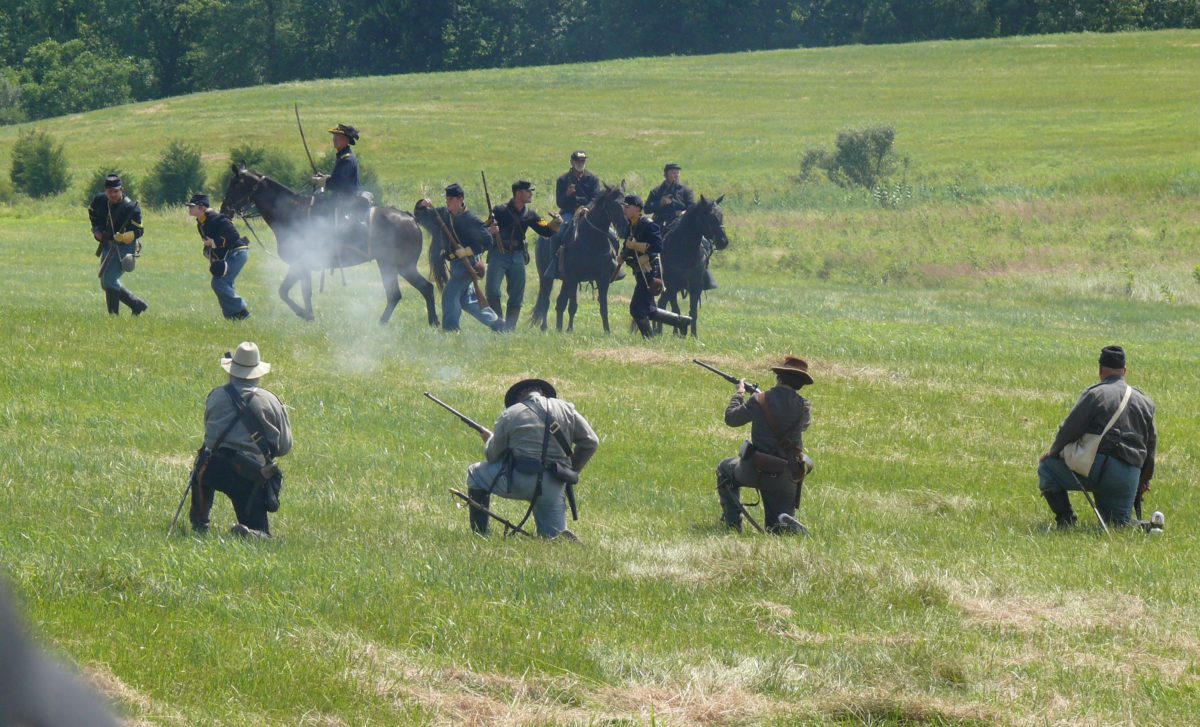
Bei den Reenactments von Schlachten dieses Bürgerkriegs nun mischen — nein: kombinieren und durchdringen — sich nun die unterschiedlichen Perspektiven und ihre Narrative — und sie tun es gewissermaßen „schief“: Auf kleinem Maßstab — also mit hohem Abstraktionsgrad — überwiegen Betonungen von Gemeinsamkeit und Versöhnung. Sie implizieren zudem die Anerkennung des tatsächlichen Ergebnisses, weshalb sie auf größerem Maßstab (also bei Betrachtung einzelner Gebiete, Schicksale, in einzelnen kleineren Erinnerungsformen) aus Unionsperspektive auch überwiegen dürfte, wogegen auf dieser selben Ebene Narrative des „Lost Cause“, der Verursachung des Krieges durch die Negation der „States‘ Rights“ etc. eher bei Anhängern konföderierter Sichtweisen vertreten sein dürften.

Reenactments: Spannung zwischen narrativer Retrospektive und ihrer Suspendierung

Gleiches findet sich im Reenactment. Es gibt Beispiele dafür, dass Darsteller*innen ihre zu spielenden Truppen nicht nach ihrer eigenen Interpretation des Krieges auswählen, sondern aus deutlich pragmatischeren Gründen — etwa Wohnortnähe. Das stützt die Interpretation, dass es um das Erinnern an die von Nord- und Südstaaten(soldaten und -bewohner:innen) gemeinsam durchlittene Prüfung geht. Es kommt der Interpretation des „Second Birth“ und der retrospektiv attestierten Nationsbildungswirkung am nächsten.

Gleichzeitig aber hat Reenactment auch eine zumindest partielle Facette der Aufhebung des retrospektiven Wissens und somit der aus hindsight erstellten oder bestätigten Charakterisierung des Krieges. Im Erleben des wiedervergegenwärtigten Kampfes — insbesondere bei den Tacticals, welche nicht einen realen Ablauf abbilden, sondern quasi ergebnisoffen ‚ausgefochten‘ werden, findet sich so etwas wie eine symbolische und psychische „Wiedereinsetzung in den vorigen Stand“ (um eine juristische Formulierung zu entlehnen).
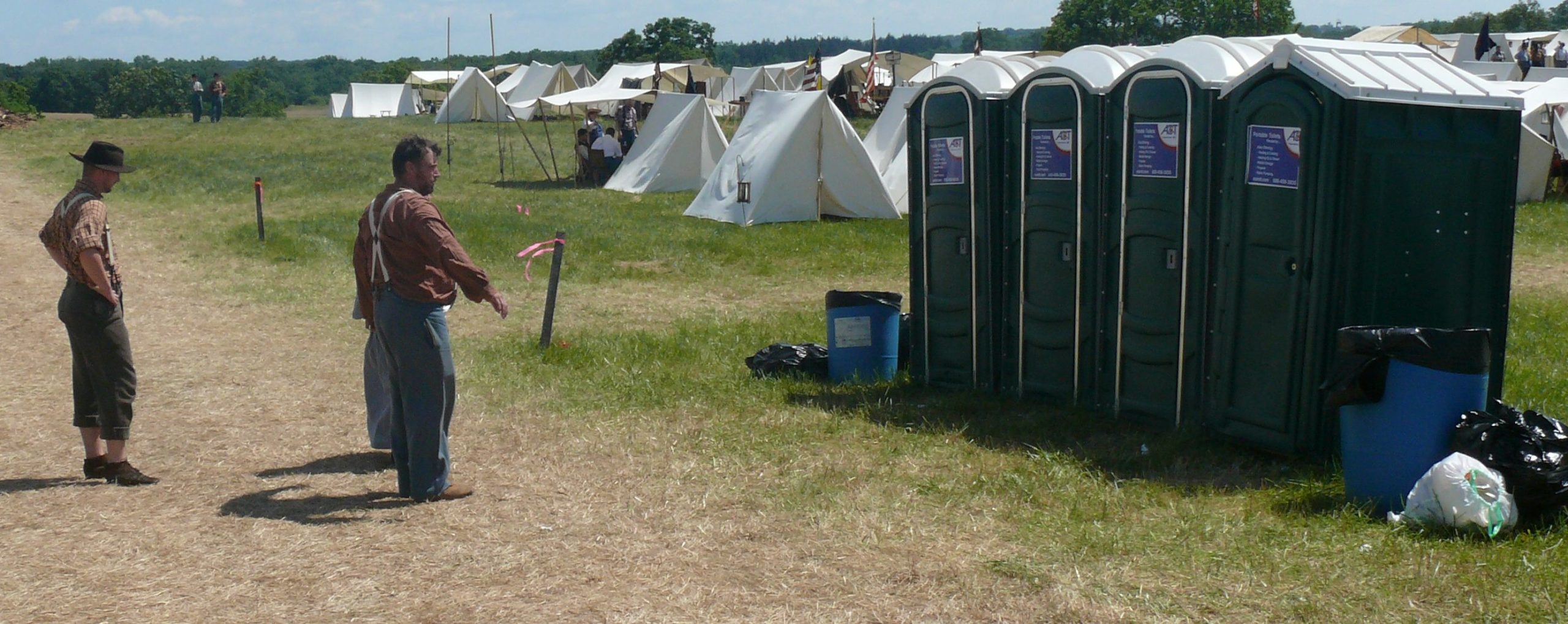
Einige in Uniformen des US-Bürgerkriegs gekleidete Männer stehen im Zeltlager vor einer Reihe Dixi-Toiletten. Gettysburg 7/2017. (c)A.Körber
„Nacherleben, wie es wirklich war (?). Einige in Uniformen des US-Bürgerkriegs gekleidete Männer stehen im Zeltlager vor einer Reihe Dixi-Toiletten. Gettysburg 7/2017. (c) A. Körber“

In diesem Sinne ist in Reenactment zumindest partiell als eine symbolische Suspendierung der Retrospektive und retrospektiver Sinnbildung zugunsten einer suggestiv-immersiven Wiederinkraftsetzung der Offenheit zu erkennen. Dies erzeugt natürlich eine unauflösbare Spannung, denn aus der Retrospektive können Aktive natürlich nicht wirklich austreten. Zudem kann keineswegs vorausgesetzt werden, dass die imaginierten Vergangenheiten zwischen den einzelnen Aktiven wirklich kompatibel wären. Das eine gemeinsame Agieren hat dabei eine besondere Bedeutung der Authentifizierung.

Der Gleichzeitigkeit unterschiedlicher individueller sowie (teil-)gesellschaftlicher und politischer Bedürfnisse und Motive entprechend dürften bei Reenactment-Ereignissen ganz unterschiedliche Kombinationen narrativer Formen historischer Sinnbildung nebeneinander und ineinander verschränkt im Spiel sein — und zwar sowohl zwischen Beteiligten (Organisator:innen, Akteur:innen, Zuschauer:innen und Außenstehenden) als auch im Denken und Handeln (aller?) einzelner. Letzteres deutet keineswegs auf eine Art historiographischer bzw. historisch denkender Inkonsequenz oder ‚Schizophrenie‘ hin, sondern ist durchaus ein Merkmal allen historischen Denkens.

Konsequenzen für die Sinnbildungstypologie?

Historische Darstellungen und Aussagen, folgen selten einem einzigen Sinnbildungsmuster, sondern kombinieren zumeist mehrere, wie schon bei der Entwicklung der Typologie Jörn Rüsen festgestellt hat.6 Es kommt daher sowohl für eine Charakterisierung und Interpretation weniger auf eine „Reinheit“ der Erzähl- und Sinnbildungsmuster an als auf die narrative Triftigkeit gerade auch der Kombinationen. Diese können etwa sequentiell miteinander verknüpft werden.7

Ebenso ist aber auch eine Parallelisierung denkbar. Gerade in den eher nach innen gerichteten Facetten der nacherlebenden Qualität von Reenactments ist zuweilen eine solche Verschränkung zweier Sinnbildungsmuster zu einer charakteristischen Kombination zu erkennen. Zusammengefasst kann man sie auch als „nostalgische Sinnbildung“ bezeichnen: Dem ‚immersiven‘ Nacherleben einer vergangenen Situation oder Lebensweise wird die Qualität eines Ausstiegs aus einer als belastend empfundenen Gegenwart zugeschrieben. Die Vergangenheit wird dieser Gegenwart positiv gegenübergestellt. So verbindet sich im Wunsch der Fortgeltung damaliger Lebensverhältnisse eine ins normativ-optativ verschobene traditionale Sinnbildung mit einer desktiptiv-genetischen in der Anerkennung ihrer seitherigen (negativen) Veränderung.

Ob hinsichtlich der ersteren von einer ‚Verschiebung‘ der Sinnbildung gesprochen werden sollte, muss weiter diskutiert werden. Man kann auch  grundsätzlich postulieren, dass alle Sinnbildungen nicht nur in positiv-affirmativer Form und zwei kritischen Varianten vorkommen 8, sondern auch jeweils in deskriptivem und normativem bzw. optativem Modus. Eine solche Erweiterung des Sinnbildungsmodells passt insofern zur theoretischen Begründung historischen Denkens als Orientierungsleistung, als der deskriptive Modus zur Domäne der ‚Naturzeit‘ und der normative/optative/hypothetische Modus hingegen zu derjenigen der ‚Humanzeit‘ gehört.9

Historisches Denken und Erzählen charakterisiert sich dann keineswegs allein durch die Kombination und Verschränkung von Erzählmustern unterschiedlichen Typs im rein deskrptivem Modus, nicht nur als eine Sinnbildung über manifeste und geahnte Zeiterfahrung, sondern insbesondere aus als ein Modus der sinnbildenden Verbindung zeitbezogenen Erkennens und Verarbeitens mit entsprechendem Wünschen, Phantasieren etc. Dies scheint sich gerade an solchen Geschichtssorten (also geschichtskultureller Verarbeitungsformen) zu zeigen, die ein hypothetisches Agieren in einer symbolisch ‚wiedereingesetzten‘ Vergangenheit ermöglicht.

Enaktivität als handelnde Suspendierung der narrativen Retrospektive

Das allerdings legt es nahe, die nicht nur kognitive, sondern körperlich-räumliche Facette dieser Geschichtssorten eher als ‚enaktiv‘ denn als ‚performativ‘ zu bezeichnen. Das ist durchaus konsistent mit Matthias Meilers linguistischer Herleitung des Wortpartikels „enact“ im Begriff „Reenactment“ aus der angelsächsischen Verwaltungssprache.10 Demnach geht die Bezeichnung „to enact“ auf die Bezeichnung für einen Rechtsakt zurück, in dem ein Beschluss, ein Gesetz o.ä. „in Kraft gesetzt“ wurde. „Re-enact-ing“ ist demnach das Wiederinkraftsetzen der Offenheit der Situation — und im Fall von Schlachten-Reenactments vielleicht auch mit der Hoffnung auf die Möglichkeit einer (ebenso symbolischen) Neuschaffung von Tatsachen.11.

Damit wäre zudem der Tatsache Rechnung getragen, dass sich diese Qualität ja gar nicht so sehr auf eine nach außen — auf ein wie auch immer geartetes oder vorgestelltes Publikum — richtet, sondern als wesentliche Facette der Qualifizierung der Situation und ihres Sinns auf die Agierenden selbst. Komplementär zur oben zitierten linguistischen Herleitung aus der englischen Verwaltungssprache wäre damit die Bedeutung des Agierens für die Konstruktion historischen Sinns angesprochen, wie etwa im Konzept des „Enaktivismus“ der konstruktivistischen Kognitionswissenschaft (etwa nach Francisco Varela) die spielerische „Koinszenierung von Wahrnehmenden und Wahrgenommenem“ begriffen wird, die gerade nicht eine reine autopoietische Erzeugung einer Vorstellung ohne jeglichen Bezug auf eine Wirklichkeit meint, sondern den kreative Entwurf derselben als Bild.12

Das ist durchaus kompatibel mit historischem Denken als Re-Konstruktion einer zwar als gegeben vorausgesetzten, nie aber beobachterunabhängig erkennbaren Vergangenheit. Insofern ist Re-Enactment eine Form re-konstruktiven historischen Denkens. Das unterscheidet sie etwa von äußerlich und hinsichtlich einiger Organisationsformen vergleichbaren Events und Subkulturen wie LARP und auch Science-Fiction-LARP13, aber auch von „literarischem Reenactment“.14 Beiden kommt nur indirekt auch historische Qualität zu, insofern in ihnen a) an fiktionalen Beispielen auch außerhalb der Fiktion gültige Lebensverhältnisse und Denkweisen präsentiert werden (bei Inszenierungen von Romanszenen geht es dann nicht um die konkreten Figuren und ihre Geschichten, wohl aber stehen sie für bestimmte Zeittypiken) und b) mit ihnen Welt- und Gesellschaftsbilder (inklusive Zukunftsvorstellungen) vergangener Autor:innen wiederbelebt werden. Wer „Star Trek“ spielt, spielt ja nicht einfach Zukunft, sondern ggf. die Zukunftsvorstellungen der 1960er Jahre (allerdings ggf. mit den Aktualisierungen gem. der ja fortgesetzten Reihe).

  1. Vgl. Logge, Thorsten: “History Types” and Public History. In: Public History Weekly 2018 (2018). []
  2. Jureit, Ulrike: Magie des Authentischen. Das Nachleben von Krieg und Gewalt im Reenactment. Göttingen 2020 (Wert der Vergangenheit). []
  3. Jureit 2020, S. 57, mit Verweisen auf McPherson, Sautter und Keegan. []
  4. Jureit 2020, S. 58, FN 57. []
  5. Auch dies reflektiert Jureit in einiger Ausführlichkeit wegen der dort erkennbaren Stiftung eines versöhnenden Sinns des Krieges als gemeinsam erlittene Herausforderung;  Jureit 2020, S. 53 u. 61ff). []
  6. Rüsen, Jörn: Lebendige Geschichte. Grundzüge einer Historik III: Formen und Funktionen des historischen Wissens. Göttingen 1989 (Kleine Vandenhoeck-Reihe 1489), S. 42, 57. []
  7. Ein Beispiel: Erzählungen eines gesellschaftlichen Fortschritts in technischer, wirtschaftlicher oder gesellschaftlicher Hinsicht sind oftmals keineswegs allein dem Typ genetischer Sinnbildung zuzuordnen. Sie kombinieren diesen vielmehr mit traditionaler Sinnbildung insofern, als der gerichteten Entwicklung ein Ursprung zugeschrieben wird, — etwa in den Entdeckungen der Renaissance und der Überwindung eines rein religiösen Weltbildes im Humanismus oder einer Erfindung als eher punktuelle Ursprünge für eine nachfolgende gerichtete Entwicklung. []
  8. Vgl. Körber, Andreas: Historische Sinnbildungstypen. Weitere Differenzierung. http://​www.pedocs.de​/​volltexte/​2013/​7264/​., nämlich einer auf Ersetzung der konkreten Erzählung durch eine gleichen Typs zielende ‚innere‘ Kritik und eine, welche die narrative Logik der Sinnbildung selbst kritisiert. []
  9. Vgl. Rüsen, Jörn: Historische Vernunft. Grundzüge einer Historik I: Die Grundlagen der Geschichtswissenschaft. Göttingen 1983 (Kleine Vandenhoeck-Reihe 1489), S. 51. []
  10. Meiler, Matthias: Über das -en- in Reenactment. In: Reenactments. Medienpraktiken zwischen Wiederholung und kreativer Aneignung. Hrsg. von Anja Dreschke, Ilham Huynh, Raphaela Knipp u. David Sittler. Bielefeld 2016 (Locating media 8). S. 25–42. []
  11. Dass zuweilen solche Reenactments auch mit dem Begriff des „Rematches“ verbunden und angekündigt werden, deutet darauf hin. Vgl. z.B. zur Schlacht von Hastings: Ungoed-Thomas, Jon (15.10.2006): „1066, the rematch: Harold loses again.“ In: The Times (15.10.2006). []
  12. Vgl. Weber, Andreas: Die wiedergefundene Welt. In: Schlüsselwerke des Konstruktivismus. Hrsg. von Bernhard Pörksen. Wiesbaden 2011. S. 300–318, S. 206. []
  13. Vgl. z.B. Engelhardt, Michael: To boldly go … – Star Trek-LARP in unendlichen Weiten. In: TeilzeitHelden. Magazin für gespielte und erlebte Phantastik (27.11.2015). []
  14. vgl. Knipp, Raphaela: Nacherlebte Fiktion. Literarische Ortsbegehungen als Reenactments textueller Verfahren. In: Reenactments. Medienpraktiken zwischen Wiederholung und kreativer Aneignung. Hrsg. von Anja Dreschke, Ilham Huynh, Raphaela Knipp u. David Sittler. Bielefeld 2016 (Locating media 8). S. 213–236. []

Ankündigung: Neuer Beitrag im Sammelband erschienen.

Körber, Andreas; Reder, Dirk (2020): Geschichtsagenturen. In: Felix Hinz und Andreas Körber (Hg.): Geschichtskultur – Public History – Angewandte Geschichte. Geschichte lernen in der Gesellschaft: Medien, Praxen, Funktionen. Göttingen: UTB; Vandenhoeck & Ruprecht (UTB 5464), S.411-424. ISBN: 9783825254643.

Körber, Andreas; Reder, Dirk (2020): Geschichtsagenturen. In: Felix Hinz und Andreas Körber (Hg.): Geschichtskultur – Public History – Angewandte Geschichte. Geschichte lernen in der Gesellschaft: Medien, Praxen, Funktionen. Göttingen: UTB; Vandenhoeck & Ruprecht (UTB 5464), S. 411-424. ISBN: 9783825254643.

Hinz, Felix; Körber, Andreas (Eds.) (2020): Geschichtskultur – Public History – Angewandte Geschichte. Geschichte lernen in der Gesellschaft: Medien, Praxen, Funktionen. Uni-Taschenbücher GmbH; Vandenhoeck & Ruprecht. Göttingen: UTB; Vandenhoeck & Ruprecht (UTB). - Umschlag
Hinz, Felix; Körber, Andreas (Eds.) (2020): Geschichtskultur – Public History – Angewandte Geschichte. Geschichte lernen in der Gesellschaft: Medien, Praxen, Funktionen. Uni-Taschenbücher GmbH; Vandenhoeck & Ruprecht. Göttingen: UTB; Vandenhoeck & Ruprecht (UTB), S. 411-424.

Beitrag zum Universal Design u.a. in der Geschichtslehrerbildung an der Universität Hamburg

Schütt, Marie-Luise; Ricken, Gabi; Paseka, Angelika; Körber, Andreas (2020): Universal Design for Learning als Baustein erziehungswissenschaftlicher Seminarkonzepte für eine inklusionsorientierte Lehrer*innenbildung an der Universität Hamburg. In: Sonderpädagogische Förderung heute 65 (1), S. 21–33.

gerade erschienen:
Schütt, Marie-Luise; Ricken, Gabi; Paseka, Angelika; Körber, Andreas (2020): Universal Design for Learning als Baustein erziehungswissenschaftlicher Seminarkonzepte für eine inklusionsorientierte Lehrer*innenbildung an der Universität Hamburg. In: Sonderpädagogische Förderung heute 65 (1), S. 21–33.

Successful Perspective-Taking? On the Problem and Potential of „Empathy“ (or simulative) Tasks in Historical Education (2nd, enhanced version)

Körber, Andreas (2020): Successful Perspective-Taking? On the Problem and Potential of „Empathy“ (or simulative) Tasks in Historical Education (2nd, enhanced version) (Blogbeitrag)

In textbooks as well as in the classroom, there are always tasks that require the learners to put themselves in the shoes of a historical personality and to perform a certain mental effort „from their perspective“ – for example, to write a letter or the like.

The aim of such tasks is usually to determine the extent to which students are able to take this step of „taking“ or „adopting“ a perspective, i.e. to „put themselves in the shoes“ (or position) of a temporally and/or culturally „foreign“ person and to judge past situations not only from their present perspective, with modern concepts and values etc. In the background of such tasks there is thus a fundamental concept of fundamental (not only marginal) change extending over time, which requires us to judge each past epoch „from within“, in the horizon of contemporary thinking. According to Rüsen, this concept underlies genetic historical consciousness.1 In this respect it is (probably rightly) considered specifically modern (whereby the sequence of the types of meaning as forms of thought in dealing with the past that have emerged in the course of historiographical history is in turn based on the genetic concept. The typology itself is thus specifically modern). It is this way of thinking that makes the unconditional perception, thinking through and judging of a situation that is alien in time with the help of categories that are not contemporary but present, suspect under the concept of „presenteeism“. According to Sam Wineburg, this form of thinking is the natural, but un-historical one, its overcoming in favour of a perception and recognition of the fundamental otherness of the past that is the laborious core of historical learning against the presentist default.2

Even if historical thinking and learning is hardly absorbed in this overcoming of a quasi-natural presenteeism, but rather captures much more complex setups and operations, especially if one emphasizes the orientation function of history in the present (as Jörn Rüsen’s theory does and with it most of the concepts of German history didactics), the aspect emphasized by Wineburg certainly belongs to the core of the business.

But to what extent are tasks of the type mentioned suitable for this? Some doubts are in order. But this does not mean that these tasks are fundamentally useless. What is needed, however, is an intensive reflection on their logic, the performances and achievements demanded by them of the learners, as well as on the work required of the corresponding tasks (vulgo: student achievements – to what extent they are really „achievements“ remains to be reflected) and their significance in the learning process.

One aspect of this is that (like so many in history teaching) these tasks – at least in traditional teaching contexts – often mix up characteristics of learning and achievement tasks. Students must – at least without further clarification of the teaching function – gain the impression that the required adoption of perspectives is validly possible and can be assessed by the teacher. This makes the task a performance task. Even if it is not intended to question and check something that has already been practised before, but to present the students with a new challenge, such tasks do not in any way indicate what is to happen to the work done by the students other than that it is to be disclosed to the plenum or the teacher and assessed by them – but on the basis of which criteria?
Which teacher, which researcher of today could ever say when the adoption of a perspective has „succeeded“? None of us can think or assess a situation like a 10th century monk or a Japanese samurai. No one will have a „fully valid“ answer to a corresponding task – and no teacher can decide which achievement is „right“.

Nevertheless, such tasks are not nonsensical. After all, they are not at all concerned with (unfairly) demanding something more or less spontaneously from the students (namely the temporary understanding of past actions), which is still the subject and task of extensive research today. Rather, such tasks actually aim to make plausible the requirement of abstraction from the present perspective and the otherness of perception, interpretation and decision resulting from such attempts. The criterion for the success of such tasks therefore lies neither in actually having come close to the past person mimetically, nor in stripping off one’s own present positionality and perspective as completely as possible, so that one simply argues „as strangely as possible“ and then passes this off as proof of a successful adoption of perspective.
Rather, the aim of such tasks is that students should recognize from the attempt to adopt such a perspective that they have to abandon present self-understandings in order to somehow „do justice“ to a past perspective. Thus, it is not the coherence of the individual result that is important, but rather the recognition and significance of the claim of historical thinking: someone who judges and evaluates the (sufficiently complex) cognitively presented past situation as he/she would do from today’s present without any circumstances, shows just as little historical understanding as someone who presents and evaluates everything as differently as possible, but cannot say at all to what extent this should be appropriate to the concrete situation.

Only when talking and discussing about the respective (and preferably different) „solutions“ (better: treatments) it becomes clear what the individual students have already understood, but the potential for the actual learning process is actually only there.
The original processing of the task is therefore wrongly used as proof of the fulfilment of a requirement for a successful change of perspective for theoretical and didactic reasons. Such tasks must not be understood as achievement tasks, but must be learning tasks in so far as they generate the material for the actual process of historical thinking and learning.

In this way, however, they achieve a learning potential that is only slightly changed on the terminological level, but clearly changed in theoretical terms. From the ultimately unfulfillable and measurable or identifiable claim to a successful (or post festum: successful change of perspective), the possibility of not abandoning one’s own perspective, but rather expanding it by means of the required justified, i.e. cognitive consideration of factors that make up another perspective, would become possible. Broadening and reflection of perspective instead of a change of perspective.

In this respect, one could (also) borrow methodically from the foreign language didactic principle of „task-based learning“ in that the processing of a task by students is subject to reflection in a focus on (here:) history phase, in which historical thinking (and language) is made explicit, and precisely in this process newly acquired or differentiated concepts, terms, methods, etc., which are more abstract and provided with a reflexive index, are also made explicit. is thematized and progression is explicitly encouraged.

This in turn can be methodologically implemented by using cooperative learning methods3, for example by using the „Think-Pair-Share“ (or „Think – Exchange – Discuss“) scheme is implemented in such a way that the results of such a task, which were initially prepared in individual work („Think“ phase), are neither directly given to the teacher nor presented and discussed in the plenary session, but rather in partner work or also in small groups („Pair“ phase) of learners themselves, who first compare and analyse several such workings of the task from other points of view than only how „good“ or „successful“ they are.
As usual, such „Pair“-phases should not only be about presenting the individual results to the other students so that they all know them. Rather, such phases need their own work assignments. In the present case, these can consist of comparing the individual work assignments in a descriptive way: What have the authors done similarly, what differently? What effect do these decisions have on the processing of the task? Do insights and questions arise regarding the meaning and purpose of the task – now that different solutions are known?
Such a comparative analysis, which does not immediately consider the present works from the point of view of success, and even puts them in a one-dimensional series, but rather works out, on the basis of these adaptations, what could sometimes make everything different, contributes to the fact that the thought process, the requirement of historical thought, which the task addressed, comes into view as such. It may even be advisable that the small group carrying out the comparative work only looks at other pupils‘ texts, not at their own, and that they receive these anonymously (e.g. through computer writing). It may even be useful for the teacher herself to include one or two different works „anonymously“, which are to be discovered, compared with the others and assessed in terms of their potential and limitations.
The „Share“ phase of the discussion in the plenum then receives its own task, namely the discussion and negotiation of the insights gained in the groups (was this the case in all small groups? Do the insights complement each other or are they rather in tension with each other?) and questions not so much about individual treatments, but about the contrasts perceived between them.
It could be that…

  • … Students have used very different words when writing their individual assignments and now realize that they cannot simply assume that their current terms can be used „in the situation“ without further ado.
  • … some pupils* discover the question to what extent it can be assumed that the person they are supposed to put themselves in the shoes of is not necessarily able to write. (Even a refusal of the task for such a reason can then be productively included as the result of a historical thought process).
  • … a comparison between two edits in the small group shows that the authors quite naturally (= without having given it much thought) started out from very different levels of information about „their“ person, so that the question arises: what could one know about … back then?
  • the comparison shows that some students may have included hindsight information in the process, while others did not.“

The latter case in particular shows that such an approach makes it possible not to let such „errors“ in historical thinking become immediately (or even at all) effective as „errors“ (and demotivating their thematization), but to use them (qua anonymous comparison) productively to gain insight.

Such procedures of cooperative learning with its possibilities to let pupils think about their own products in a form that does not immediately hierarchise and evaluate them, can also be supported by digital instruments, namely those that make it possible to make the results of pupils‘ work visible (anonymously) next to each other on a large smart board or similar and to work on them in plenary, such as with „Etherpads“ (cf. https://de.wikipedia.org/wiki/Etherpad).4

Finally, such a processing and evaluation of such a task also enables non-separating differentiations by means of scaffolding. It is possible, for example, that in the individual processing phase students with difficulties in writing and formulating, with abstraction etc. are not required to write their own texts, but that they are enabled to decide on the basis of a series of prepared „text modules“ what would be conceivable and consistent in a solution. The given text modules must then of course in turn have quite different solutions and designs – up to and including incompatible and even contradictory parts. In this way, the constructive task would be turned into an assignment of given symbol building blocks to each other by „task reversal“. A task that is quite different on the „surface“ can thus – for the purpose of differentiation and scaffolding – address and require similar and comparable operations of historical thought and – in reflection – promote them. (Of course, such differentiation and underpinning by means of scaffolds also means that the anonymity that may have been chosen for further evaluations can no longer be fully maintained. But this can also be dealt with productively).

  1. Rüsen, Jörn (1983): Historische Vernunft. Grundzüge einer Historik I: Die Grundlagen der Geschichtswissenschaft. Göttingen: Vandenhoeck & Ruprecht (Kleine Vandenhoeck-Reihe, 1489); Rüsen, Jörn (2013): Historik. Theorie der Geschichtswissenschaft. Köln: Böhlau. []
  2. See Wineburg, Sam (1999): Historical Thinking and Other Unnatural Acts. In: The Phi Delta Kappan 80 (7), S. 488-499; Wineburg, Sam (2001): Historical Thinking and Other Unnatural Acts. Charting the Future of Teaching the Past. Philadelphia: Temple University Press (Critical perspectives on the past). []
  3. e.g. according to Green, Norm; Green, Kathy (2007): Kooperatives Lernen im Klassenraum und im Kollegium. Seelze-Velber: Klett; Kallmeyer. []
  4. In contrast to some other instruments praised in the context of digitization, which ultimately do nothing else but implement conventional, small-step methods of a knowledge check with immediate right-wrong feedback electronically and often even worsen in so far that due to the electronic comparison of the students with a sample solution correct, but differently formulated answers are reported back as ‚wrong‘, just as half correct answers cannot be appreciated, etherpads enable the organization of a common consideration of a number of individual solutions. Due to the often typed-in and therefore given independence from handwriting, a certain anonymization can be achieved, which allows the focus to be on the text, not the author. Regarding the available space, font size etc. there are still limits, however, which may make it advisable to use „analogous“ methods with cards, posters etc. []

Gerade erschienen: Inklusive Diagnostik

Bormuth, Heike; Körber, Andreas; Seidl, Patrizia; Witt, Dirk (2020): Inklusive Diagnostik. Ein Werkzeug zur Planung inklusiven (Geschichts-)Unterrichts. In: Sebastian Barsch, Bettina Degner, Christoph Kühberger und Martin Lücke (Hg.): Handbuch Diversität im Geschichtsunterricht. Inklusive Geschichtsdidaktik. Frankfurt: Wochenschau Verlag (Wochenschau Wissenschaft), S. 338–349.

Bormuth, Heike; Körber, Andreas; Seidl, Patrizia; Witt, Dirk (2020): Inklusive Diagnostik. Ein Werkzeug zur Planung inklusiven (Geschichts-)Unterrichts. In: Sebastian Barsch, Bettina Degner, Christoph Kühberger und Martin Lücke (Hg.): Handbuch Diversität im Geschichtsunterricht. Inklusive Geschichtsdidaktik. Frankfurt: Wochenschau Verlag (Wochenschau Wissenschaft), S. 338–349.

Gerade erschienen: Inklusive Geschichtskultur

Körber, Andreas (2020): Inklusive Geschichtskultur – Bestimmungsfaktoren und Ansprüche. In: Sebastian Barsch, Bettina Degner, Christoph Kühberger und Martin Lücke (Hg.): Handbuch Diversität im Geschichtsunterricht. Inklusive Geschichtsdidaktik. Frankfurt: Wochenschau Verlag (Wochenschau Wissenschaft), S. 250–258.

Körber, Andreas (2020): Inklusive Geschichtskultur – Bestimmungsfaktoren und Ansprüche. In: Sebastian Barsch, Bettina Degner, Christoph Kühberger und Martin Lücke (Hg.): Handbuch Diversität im Geschichtsunterricht. Inklusive Geschichtsdidaktik. Frankfurt: Wochenschau Verlag (Wochenschau Wissenschaft), S. 250–258.

gerade erschienen: Literatur zu inklusivem Geschichtslernen

Körber, Andreas; Seidl, Patrizia; Witt, Dirk; Bormuth, Heike (2020): Inklusives Geschichtslernen via Scaffolding von Aufgaben. In: Sebastian Barsch, Bettina Degner, Christoph Kühberger und Martin Lücke (Hg.): Handbuch Diversität im Geschichtsunterricht. Inklusive Geschichtsdidaktik. Frankfurt: Wochenschau Verlag (Wochenschau Wissenschaft), S. 405–423.

Körber, Andreas; Seidl, Patrizia; Witt, Dirk; Bormuth, Heike (2020): Inklusives Geschichtslernen via Scaffolding von Aufgaben. In: Sebastian Barsch, Bettina Degner, Christoph Kühberger und Martin Lücke (Hg.): Handbuch Diversität im Geschichtsunterricht. Inklusive Geschichtsdidaktik. Frankfurt: Wochenschau Verlag (Wochenschau Wissenschaft), S. 405–423.

Gerade erschienen: Literatur zu inklusivem Geschichtslernen

Gerade ist erschienen der Sammelband:

Barsch, Sebastian; Degner, Bettina; Kühberger, Christoph; Lücke, Martin (Hg.) (2020): Handbuch Diversität im Geschichtsunterricht. Inklusive Geschichtsdidaktik. Frankfurt: Wochenschau Verlag (Wochenschau Wissenschaft).

  • Körber, Andreas (2020): Inklusive Geschichtskultur — Bestimmungsfaktoren und Ansprüche, S. 250–258.
  • Bormuth, Heike; Körber, Andreas; Seidl, Patrizia; Witt, Dirk (2020): Inklusive Diagnostik. Ein Werkzeug zur Planung inklusiven (Geschichts-)Unterrichts, S. 338–349.
  • Körber, Andreas; Seidl, Patrizia; Witt, Dirk; Bormuth, Heike (2020): Inklusives Geschichtslernen via Scaffolding von Aufgaben, S. 405–423.

Vortrag zur Lehrerbildung an der Universität Hamburg

Körber, Andreas (03.12.2019). Der Mythos ‚Praxis‘ vs. ‚Wissenschaftliches Studium‘ und die Geschichte der Lehrerbildung an der Universität Hamburg (=ANDOCKEN 18). Hamburg.

Mein Vortrag aus der Reihe „Andocken 18 – Hamburg-Mythen im 19. und 20. Jahrhundert“ des Forschungsverbunds zur Kulturgeschichte Hamburgs (FKGHH) von Anfang Dezember steht nun online. Leider ist die Tonqualität nicht wirklich gut. Es musste wohl ein Grundrauschen entfernt werden, was den Ton dumpf macht.

Körber, Andreas (3.12.2019). Der Mythos ‚Praxis‘ vs. ‚Wissenschaftliches Studium‘ und die Geschichte der Lehrerbildung an der Universität Hamburg (=ANDOCKEN 18). Hamburg. https://lecture2go.uni-hamburg.de/l2go/-/get/v/25478

Commemoration and Types or Patterns of Historical Meaning-Making (Narrating)

Körber, Andreas (2020): Commemoration and Types or Patterns of Historical Meaning-Making (Narrating) (Blogbeitrag)

(This is a text from last year’s discussion with Stéphane Lévesque and Gabriel Reich on narrative patterns‘ role in reflecting on monument and memorial policy. I never got round to finishing ist. Sorry for the delay.)

In their texts and in the earlier discussion (first on Public History Weekly: Lévesque, Stéphane (2018): Removing the Past?, then on Active History CA: A new approach to debates over Macdonald and other monuments in Canada, Part 1 and Part 2), Lévesque suggested a model of different levels of historical competencies following Jörn Rüsen’s typology of narrative patterns.

While I agree that there is a lot of plausibility in a sequential development of these types of narrating throughout (Western) history, and that the genetic type is the most complex and advanced one, I don’t find much plausibility in the idea that in the development of student‘ thinking within their lifetime, the traditional type should have any priority to the other ones. Instead, I think that students encounter full-fledged narratives as well as simple statements of all types simultaneously from the beginning, and will acquire them alongside each other — but only gradually learn to recognize them for what they are, grasping their logic.

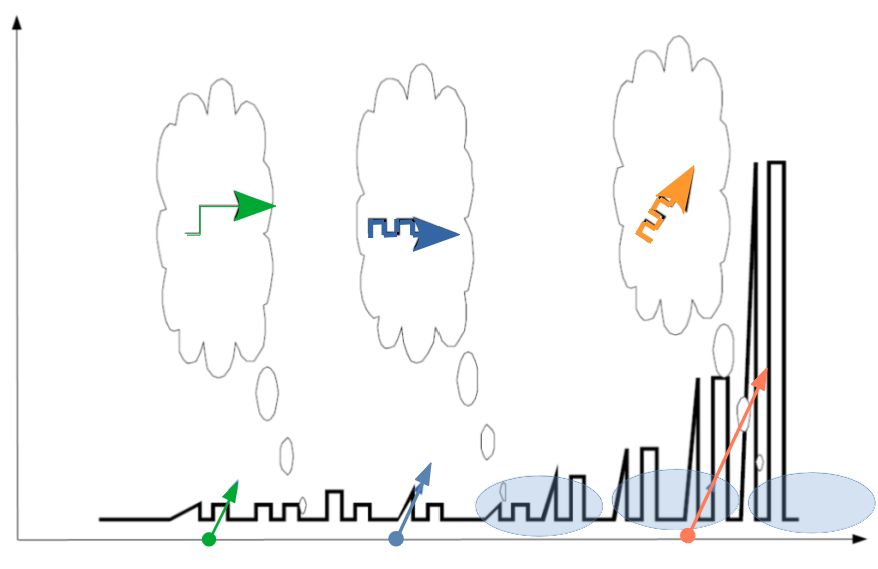
Consider the following graph:

(c) Andreas Körber 2018

It is to visualize the idea that increasing recognition of change in historic time (the x-axis) first leads to the development of the traditional type (asking for the origin of the currently valid, in cloud 1), then the experience that what has originated can also perish again and therefore asking for origins is not enough, lead to the development of the exemplaric type, asking for patterns and rules behind the change on the surface (cloud 2), and only modern experience of increased/accelerated change then led to the development of the genetic type, asking for the direction.

Each of these patterns leads to different expectations for the future. Initially (green perspective), the future may seem quite similar from the present. What is perceived as having begun, stays valid. Only from the (later) blue perspective, a pattern seems discernible, leading to the expectations that the future will also yield similar patterns of events as are detected in the past. From the (still later) orange perspective, an (additional?) increase in their „magniture“ can be perceived and its continuation be expected.
The graph also is to show that the rules and patterns as well as ideas of origins have not been rendered obsolete by each new type, but are superimposed or integrated into it.

I use this graph in my lecture. I now have added the small arrows. They are to indicate the learning-necessities of a person within a relatively short time-span of life or even youth. While in pre-modern times, they only encountered the then-developed patterns (if the model is valid), in modernity, they will have to use all patterns simultaneously, in order not make sense differentially.

The idea of a homology is problematic in another way, also. It might suggest that people in antiquity (or pre-modern-times) were developed rather like children or youths, not really grown-ups. This idea is not new, but is very problematic. As you might be aware of, Rudolf Steiner, founder of anthroposophy, suggested that the „ancient“ Greek had a mental age of about 7-years-olds. And there was a very influential German „didact“ of history in the 19th century (Friedrich Kohlrausch), who combined a similar idea of the homological development in the way people conceived „god“ with that of becoming of age. So only the modern man was really „grown up“ (and is was the Germans who did so — very nationalist).

Because of Rüsen’s idea of a „homology“ in the sequence of development of narrating types between mankind (phylogenesis) and individuals (ontogenesis), Bodo von Borries (and I as assistant to him) did a large-scale research in the early 1990s, were we presented students with items of different typological logic to dilemma-situations, like Rüsen himself has used for qualitative research and for explaining the narrative types. We did find a predominance of agreement to „traditional“ items with 6th-graders (abt. 11 yrs), but found no linear development. In fact, 9th-graders seemed even to regress. All this is published in German only, I fear.

I would strongly suggest to distinguish between the historical development and hierarchy of these patterns on the one hand and progression in learning on the other hand, for which I suggest the third dimension.

As for Lévesque’s revised table of competencies in a further comment in PHW and his evaluation that Gabriel Reich is correct in that the genetic type provides no solution to the question of whether to keep or get rid of monuments: Do these types really lead to specific political positions — especially if they are always combined? Or do they rather characterize part of their underlying understanding? I think there are different positions and solutions possible by each narrative. The value of the differentiation of types of meaning making and narration is rather analytical than prescriptive.

And that is also the pedagogical value: I think these typologies (your table and mine) can be used for classifying and discussing statements of people in the political debate. It will enhance students ability to recognize the logics behind specific political stances. And it may well show that both suggestions of keeping and of getting rid of can be underpinned by different types of narrative, but that would generate maybe different policies:

Take an example from Gabriel Reich’s patch, again: civil war monuments in Richmond.

One could argue for keeping the statutes on Monument Avenue on grounds of purely traditional thinking: to mark the origins of the specific state of things. This is both possible in partisan ways (only „our“ heroes), but also in a more „inclusive“ form, asking for such monument of both sides to be presented, to mark the origin of the countries „division“. Equally in traditional mode (but with different political background), one might call for their removal. If you hold that the division they mark is no longer given, they might be removed.

In exemplaric mode (as I opined earlier), one could speak out for the preservation of the monuments on the grounds that they exemplify a certain time and culture which we can still consider as „overcome“, but one can also argue for their removal because they represented outdated or politically non-supportable relations to the past, and that our time needs to find new ones, not „progressed“ ones, but such which reflect the „characteristics of our time“.

I do agree that to hold a specifically genetic view makes it hard to envision the whole question as one of keeping vs. removing, — but it doesn’t exclude it to the full extent.

If people are thinking predominantly in genetic mode, experiencing the country to having overcome that division, they object to a traditional logic they perceived the monuments to have. In this case, it would be the tension between one’s own genetic mode of thinking and that perceived in the monuments, which would generate a political position.

If the genetic perspective was upon how to improve commemoration, one might ask for making such commemorations „more inclusive“. This may have been behind erecting a monument for Arthur Ashe among the confederate generals – not a very consistent move, though, given that is merely additively combines monuments. In fact, it creates a „memorial landscape“ of a rather complex narrative structure, part of which is traditional („heroes“) and exemplary („each group“), but by doing so enforces a new kind of traditionality (keeping the racial groups apart, assigning each „their own“ tradition to hold up). So the intended „progress“ by inclusivity („An avenue for all people“) may in fact have created a multi-traditional narrative.1

But there are other possible solutions suggested by genetic thinking.  The concept of past people being „children of their own time“ is as genetic as it can get, referring to a fundamental change in time, so that morals and actions might be considered incommensurable across times. This concept has been used for exonerating past peoples views and actions. On this ground, one might call it „useless“. But it isn’t. Genetic historical thinking entails both — to recognize the temporal change and moral and political contexts for past actions different from ours, AND to recognize that our own context is valid, too.

From this point of view, it may underpin a present position transgressing the „keep/remove“-divide, namely to find ways of memorializing civil war „heroes“ (and/or „villains“ that is) that do NOT inadvertently invite for traditional or exemplaric heroic reading, but specifically marks the distance of time.

It is imperative, this thinking goes, to keep these memorials, but not as heroic marks to the past or as ambivalent markers. One should not just remove them, for that would put into oblivion not only the past, but also the whole discussion and reflections, the uneasiness about its representation which sparked the discussion in the first place. Genetic thinking would not be content to just remove the heroism (especially that of the wrong, side) with the effect to have no memory at all, but would call for a memorialization which specifically marks the change between that time and ours today.

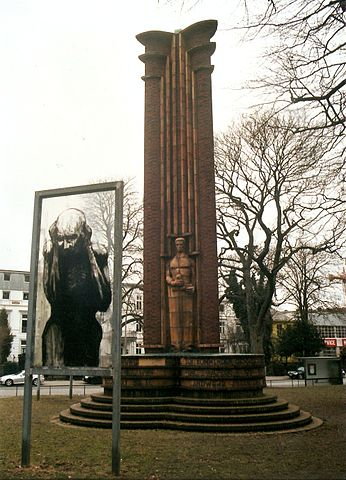
Again, take a Hamburg example. In an earlier contribution to this discussion I already hinted to counter-memorialisation. One of the best examples is here in Hamburg-Altona:

Monument and Counter-Monument next to at St. Johannis-Church in Hamburg-Altona2

Next to Altona’s St. Johannis Church, a monument had been erected in 1925 for the members of the 31st Infantry Regiment in WW1, commissioned by survivors of that regiment. Each of the three sides of the column-like monument made of clinker features an oversized, half-naked figure, representing a warrior with some antique weapon.

The inscription below reads „To the fallen for a grateful memory, to the living for a reminder, to the coming generations for emulation.“3. Clearly a very traditional proto-narrative, both extending the own warriorship of the soldiers into antiquity and calling for its emulation, lacking any transcendence. The formula was coined by August Böckh for Friedrich Wilhelm III of Prussia, and was used on monuments remembering the „liberation wars“ against Napoleon, but also later on those for the „unification wars“ of 1870/71. After the losses of millions in WW1, its usage – especially of the third element – is remarkable, albeit not alltogether uncommon4.


In the mid-1990s, the church’s congregation commissioned a counter-memorial, created by Rainer Tiedje, consisting of three acryl-glass-plates, each directly confronting one of the warriors, depicting „dark, emaciated, fearful creatures“, as the explanation on the page „denkmalhamburg.de“ states (thus on http://denkmalhamburg.de/kriegerdenkmal-an-der-st-johanniskirche/, my translation). It concludes „In the center the heroism and the exaltation, in front of it it the horror of war. A successful mixture.“ (my translation).


Gegendenkmal zum 31er Kriegerdenkmal (aus: Gedenkstätten in Hamburg. Wegweiser zu den Stätten der Erinnerung an die Jahre 1933-1945. https://www.gedenkstaetten-in-hamburg.de/gedenkstaetten/gedenkort/gegendenkmal-zum-31er-kriegerdenkmal/

To me, this countermemorial is not just a (exemplaric-mode) juxtaposition of (tradtional-mode) heroism and horror of war, but there is fundamentally genetic part in it: the counter-memorial does not merely point to timeless horrors of the consequences of warfare, but leans on a visual vocabulary established in Holocaust memorials: The „suffering men“ who wriggles with pain (and fear) on eye-level with the warriors, look like „muselmen“, the completely debilitated and immiserated inmates of the Nazi concentration camps. In its iconography, the counter-memorial belongs to the generation of monuments which coerce the viewer, the public to find and answer, not providing one themselves, either in being abstract or – as here – by visualizing death and disappearance in any but heroic form5. It is this feature, using a visual code depending not only abstractly on hindsight but on concrete knowledge about what such heroism-propaganda did help to bring about, together with the effective placing which renders impossible „commemoration ceremonies, at which the plaques are not noticed“, which indicate to a specific genetic thinking below it, trying to transgress the thinking of the time.

  1. Cf. https://onmonumentave.com/blog/2017/11/20/an-avenue-for-for-all-people-how-arthur-ashe-came-to-monument-avenue []
  2. Photo by 1970gemini in der Wikipedia auf Deutsch, CC BY-SA 3.0, https://commons.wikimedia.org/w/index.php?curid=19523318 []
  3. See http://denkmalhamburg.de/kriegerdenkmal-an-der-st-johanniskirche/  []
  4. Cf. Koselleck, Reinhart (1996): Kriegerdenkmäler als Identitätsstiftungen der Überlebenden. In: Odo Marquard und Karlheinz Stierle (Hg.): Identität. 2., unveränd. Aufl. München: Fink (Poetik und Hermeneutik, 8), S. 255–276; p. 261f []
  5. Cf. Koselleck, Reinhart (1994): Einleitung. In: Reinhart Koselleck und Michael Jeismann (Hg.): Der politische Totenkult. Kriegerdenkmäler in der Moderne. München: Fink (Bild und Text), S. 9–20, here p. 20 []