Neuer Titel erschienen

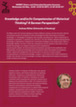
Borries, Bodo von (2021): Geschichtslernen, Geschichtsunterricht und Geschichtsdidaktik. Erinnerungen, Erfahrungsschätze, Erfordernisse. 1959/60–2020/21. Frankfurt am Main: Wochenschau (Wochenschau Wissenschaft).

Gerade ist ebenso erschienen:
Titelbild: Bodo von Borries (2021): Geschichtslernen, Geschichtsunterricht und Geschichtsdidaktik. Erinnerungen, Erfahrungsschätze, Erfordernisse. 1959/60–2020/21. Frankfurt am Main: Wochenschau (Wochenschau Wissenschaft)

Borries, Bodo von (2021): Geschichtslernen, Geschichtsunterricht und Geschichtsdidaktik. Erinnerungen, Erfahrungsschätze, Erfordernisse. 1959/60–2020/21. Frankfurt am Main: Wochenschau (Wochenschau Wissenschaft).

„Das Buch stellt 60 Jahre Geschichtsunterricht und Geschichtsdidaktik aus reflektierender Rückschau seines intensiv beteiligten Autors dar. Es quillt über von konkreten Beispielen, überraschenden Anekdoten, erhellenden Kontroversen, übertragbaren Fallanalysen und produktiven Anregungen. Der Band bietet nicht nur einen spannenden Einblick in die Geschichte der Disziplin, sondern gibt auch Impulse für ihre Zukunft.“

Inhaltsübersicht:

Vorbemerkung

1. Stichjahr 1959/60: Das „alte“ nationalkonservativ-politikgeschichtliche und stoffzentriert-lehrerdominierte System – Erfahrung eines Sek. II‑Schülers, dann Studenten und Einschätzung nach 60 Jahren

1.1 NS‑Verdrängung (und Bildungs-Expansion nach -Restauration)
1.1.1 Frühe Erfahrungen mit Geschichts-Unterricht und –Schulbuch
1.1.2 NS‑Verharmlosung in benutztem Schulbuch (1956) und Gesamtgesellschaft
1.1.3 Bescheidene Ansätze zur NS‑Durcharbeitung
1.1.4 Erste beachtliche Bildungsexpansion in verdeckter „Großer Koalition“ von SPD- und CDU/CSU-Ländern

1.2 Geschichtsdidaktisches Vakuum und unzureichende Lehrerausbildung
1.2.1 Unbedingte Stoff- und Lehrerdominanz
1.2.2 Ernstgenommene, aber „reifungstheoretisch“ verkürzte Entwicklungspsychologie
1.2.3 Vorgesehenes „politikgeschichtliches Schmalspurstudium“ und eigenes „Löcken wider den Stachel“
1.2.4 Keine hilfreiche Erziehungswissenschaft, Totalausfall von „Geschichtsdidaktik“ und „Schulpraktika“

2. Stichjahr 1971/72: Umbruch von Stoff- und Lehrerdominanz zu Problem- und Dialogorientierung – Erfahrung eines jungen Referendars und Einschätzung nach 48 Jahren

2.1 „Meilensteine“ und „Defizite“
2.1.1 Tiefe Existenzkrise des Faches Geschichte
2.1.2 Stoffüberfrachtung bei Abschaffungsrisiko (durch „Gesellschaftslehre“)
2.1.3 Erforderlicher „Schwenk vom Lehren zum Lernen“
2.1.4 Fachunterricht nur als Zweite Geige im Streichquartett des Geschichtslernens

2.2 „Eigenbeiträge“
2.2.1 Das persönliche Eintrittsbillett: Vorschlag präziser, lohnender Lernziele und intelligenter, gerechter Tests
2.2.2 „Sozialisation“ plus – keineswegs statt! – „Reifung“ des Geschichtsbewusstseins

3. Stichjahr 1983/84: Etablierung von „Geschichtsbewusstsein“ als Leitkategorie und Bedarf an „Empirie“ als Zugriff – Erfahrung eines aufstrebenden Hochschullehrers und Einschätzung nach 36 Jahren

3.1 „Meilensteine“ und „Hauptdefizite“
3.1.1 Leitkategorie „Geschichtsbewusstsein“, noch ohne vollen Konstruktivismus und Narrativismus
3.1.2 Kompromiss von „Identität“ und „Emanzipation“ – und beider bleibende Bedeutung
3.1.3 Konsequente Quellenorientierung und ständiger Arbeitsunterricht – Kluge Entscheidung?
3.1.4 „Sinnbildungsmuster“ als logisch differenzierte Formen des unvermeidlichen „Gegenwartsbezugs“

3.2 „Eigenbeiträge“
3.2.1 Besonderer Schwerpunkt I: Alternative Unterrichtsmodelle
3.2.1.1 „Frauengeschichte“ – gemäß Wissenschaftslogik und Verfassungsanspruch!
3.2.1.2 „Kolonialgeschichte“ und „Umweltgeschichte“ als Ausweitung des eng-nationalen Kanons
3.2.2 Beginn der Empirie-Einlösung: Geschichtsnutzungen, Lernarten und Unterrichtsprofile

4. Stichjahr 1995/96: Quantitative Evaluation des mechanischen Massenexperiments „Ost-West-Verhetzung“ und beginnende „Interkulturalität“ – Erfahrung eines altgedienten Professors und Einschätzung nach 24 Jahren

4.1 „Meilensteine“ und „Hauptdefizite“
4.1.1 Eine große Stunde internationaler Schulbucharbeit am „Georg-Eckert-Institut“
4.1.2 Nationale Verengung bei starkem Bedarf eines neuen „inklusiven“ Nation-Building
4.1.3 Langsames Wachstum von „Interkulturalität“ in Geschichtslernen und Fachdidaktik
4.1.4 „Historische Projektarbeit“ als „Größenwahn“ oder „Königsweg“ (bei neuer Computerbenutzung)?

4.2 „Eigenbeiträge“
4.2.1 Besonderer Schwerpunkt II: Quantitative Ost-West-Vergleiche
4.2.1.1 Jugendliches Geschichtsbewusstsein in Ost- und West-Deutschland (6., 9., 12. Klassenstufe)
4.2.1.2 Jugendliches Geschichtsbewusstsein in Ost- und West-Europa (9. Klassenstufe)
4.2.2 Neue Unterrichtsmodelle und qualitative Empirie (als nötiger mentaler „Ausgleich“)

5. Stichjahr 2007/08: Geschichts-Kompetenz (nicht-nur-kognitiv?) als „Historisch Denken Lernen“ und erneute Evaluierung der „Quellenorientierung“ – Erfahrung eines bald Zwangspensionierten und Einschätzung nach 12 Jahren

5.1 „Meilensteine“ und „Hauptdefizite“
5.1.1 Theoriegewinn FUER-Lernmodell und FUER-Kompetenzmodell, dazu Empirietauglichkeit und Praxishilfe (aber auch Grenzen)
5.1.2 Problematische Curriculumstruktur und ungeklärte Lernprogression
5.1.3 Verlust der Vorreiterposition an die „Kulturwissenschaft“, Kampf um Empirie-Leistungen?!
5.1.4 Durcharbeitung von NS‑Katastrophe und SED-Herrschaft

5.2 „Eigenbeiträge“
5.2.1 Besonderer Schwerpunkt III: Begriffsklärung „Geschichtslernen“ durch Theorieerweiterung, Normreflexion und Praxiserprobung
5.2.1.1 „Versöhnender Geschichtsaustausch“ als ideales Ziel und „Parasitäres Fehllernen“ als drohende Praxis
5.2.1.2 Abhilfe durch konstitutive Moralreflexion, Emotionsbearbeitung. Lebensweltbezug und Ästhetikanalyse
5.2.2 „Mixed-Method“-Studie zum „Schulbuchgebrauch“ mit enttäuschenden Befunden

6. Stichjahr 2019/20: „Rückschwenk vom Lernen zum Lehren“ und „offene Zukunftsfragen“ – Gegenwärtige Erfahrung und Einschätzung eines quasi-fossilen Rentners

6.1 „Meilensteine“ und „Hauptdefizite“
6.1.1 Bedauerlicher, aber verständlicher Rückschwenk vom „Lernen“ zum „Lehren“
6.1.2 E-Learning im Fach Geschichte und erneut intensivierte international-interkulturelle Zusammenarbeit
6.1.3 Nachdenkliche Fragenliste
6.1.4 Kompetenztest: Large-Scale-Assessment „HiTCH“

6.2 „Eigenbeiträge“
6.2.1 Weitere Systematisierung „nicht-nur-kognitiver“ Anteile des Geschichtslernens
6.2.2 Nagelprobe: „Gegenwartskrisen – Orientierungsbedürfnisse – Kompetenzgewinne“

7. Fazit: Versuch einer Zusammenfassung und „Synthese“ zu 60 Jahren

7.1 Historisierung und Phasierung
7.1.1 Transformation der Historie und Konstituierung der Disziplin Geschichtsdidaktik
7.1.2 Drei Phasen von Geschichtsschulbuch, Geschichtsunterricht und Geschichtsdidaktik
7.1.3 Offenkundige Verbesserungen und bleibende Sorgen
7.1.4 Anhaltendes Missverhältnis zur Psychologie

7.2 Geschichtsdidaktik und Bildungspolitik
7.2.1 Neue zwingende Aufgaben im Curriculum
7.1.2 Schwierige Rekrutierung von Geschichtsdidaktik-Personal
7.2.3 Negativ und folgenlos ausgehende Evaluation mechanischer Massenexperimente
7.2.4 Das Beispiel „NS im Rahmen der Welt- und Umweltkunde“ der 6. Klasse

Erwähnte Literatur I: Fremde Publikationen

Erwähnte Literatur II: Eigene Publikationen

Vortrag zum Verhältnis von Wissen und Kompetenzen beim Historischen Lernen

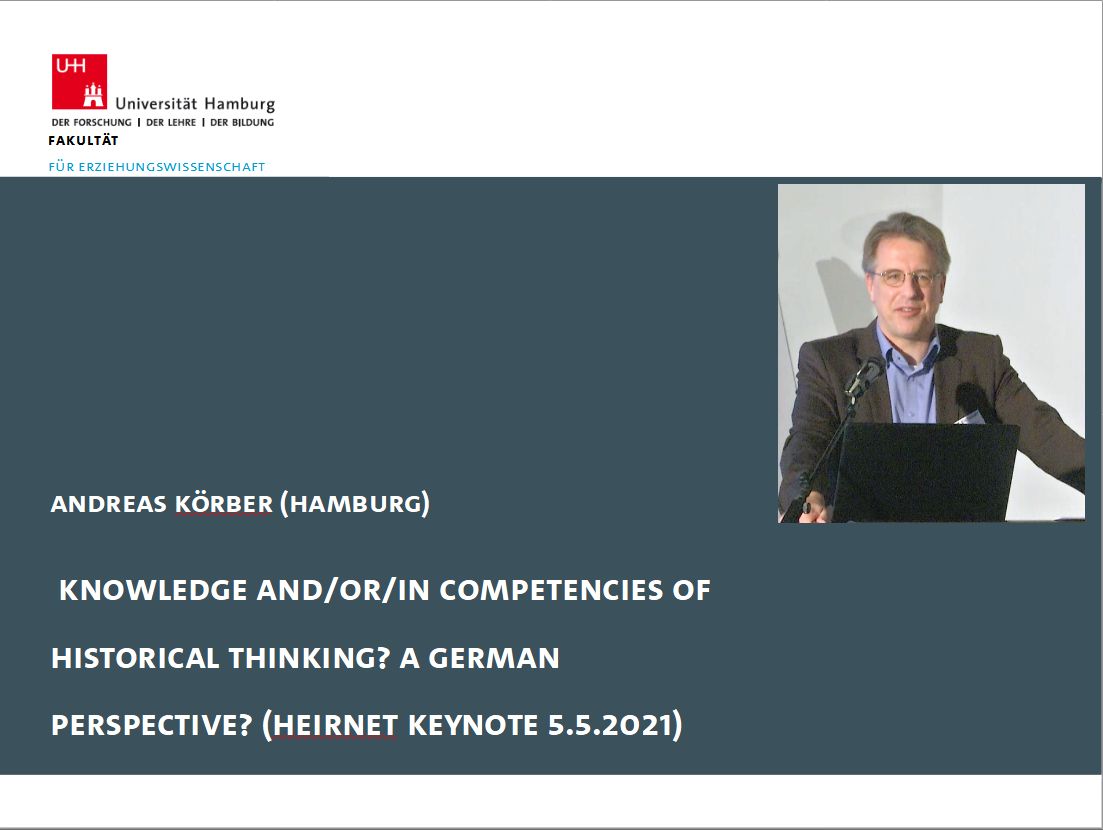
Körber, Andreas (5.5.2021): Knowledge and/or/in Competencies of Historical Thinking? A German Perspective. Online-Vortrag im Rahmen der Reihe HEIRNET Keynotes. HEIRNET, 5/5/2021. Available online at https://youtu.be/QD_egiBxycY.

Am 5. Mai werde ich im Rahmen der von Roland Bernhard (Wien) und Jon Nichol (Exeter) organisierten Vortragsserie „HEIRNET Keynotes“  des „History Education International Research Network HEIRNET)“ einen Online-Vortrag halten zum Thema „Knowledge and/or/in Competencies of Historical Thinking? A German Perspective„.

Der Vortrag findet als ZOOM-Sitzung statt und wird später auf dem Youtube-Kanal der HEIRNET-Keynotes verfügbar sein.

.

Die nächste HEIRNET Keynote wird stattfinden am 2.6.2021.

Die Vorträge der Reihe sind bisher:

  1. Chapman, Arthur (UCL London): „Powerful Knowledge in History Education“. HEIRNET Keynotes, 3/3/2021. https://www.youtube.com/watch?v=VqfWux9Udnw.
  2. van Boxtel, Carla (Universiteit Amsterdam): „Historical knowledge as a resource for understanding past, present and future“. HEIRNET Keynotes, 4/7/2021. https://www.youtube.com/watch?v=WtnPdHCnipE.
  3. Körber, Andreas (Hamburg): Knowledge and/or/in Competencies of Historical Thinking? A German Perspective. HEIRNET Keynotes. HEIRNET, 5/5/2021. https://www.youtube.com/channel/UC7eWJuWGeZVfw1S62y9UqfQ (Video in Vorbereitung).

Neuer Handbuchbeitrag

Körber, Andreas (2021): Kompetenzmodelle in der Geschichtsdidaktik. In: Georg Weißeno und Béatrice Ziegler (Hg.): Handbuch Geschichts- und Politikdidaktik. Wiesbaden: Springer VS, S. 1-4 (online-first). DOI: 10.1007/978-3-658-29673-5_1-1; Online verfügbar unter https://link.springer.com/content/pdf/10.1007%2F978-3-658-29673-5_1-1.pdf

gerade erschienen:

Körber, Andreas (2021): Kompetenzmodelle in der Geschichtsdidaktik. In: <a href=“https://link.springer.com/referencework/10.1007/978-3-658-29673-5#toc“>Georg Weißeno und Béatrice Ziegler (Hg.): Handbuch Geschichts- und Politikdidaktik. Wiesbaden: Springer VS</a>, S. 1-4 (online-first). DOI: 10.1007/978-3-658-29673-5_1-1; Online verfügbar unter <a href=“https://link.springer.com/content/pdf/10.1007%2F978-3-658-29673-5_1-1.pdf“>https://link.springer.com/content/pdf/10.1007%2F978-3-658-29673-5_1-1.pdf</a>

Monuments and Memorials – A tabular instrument for analysing (still incomplete)

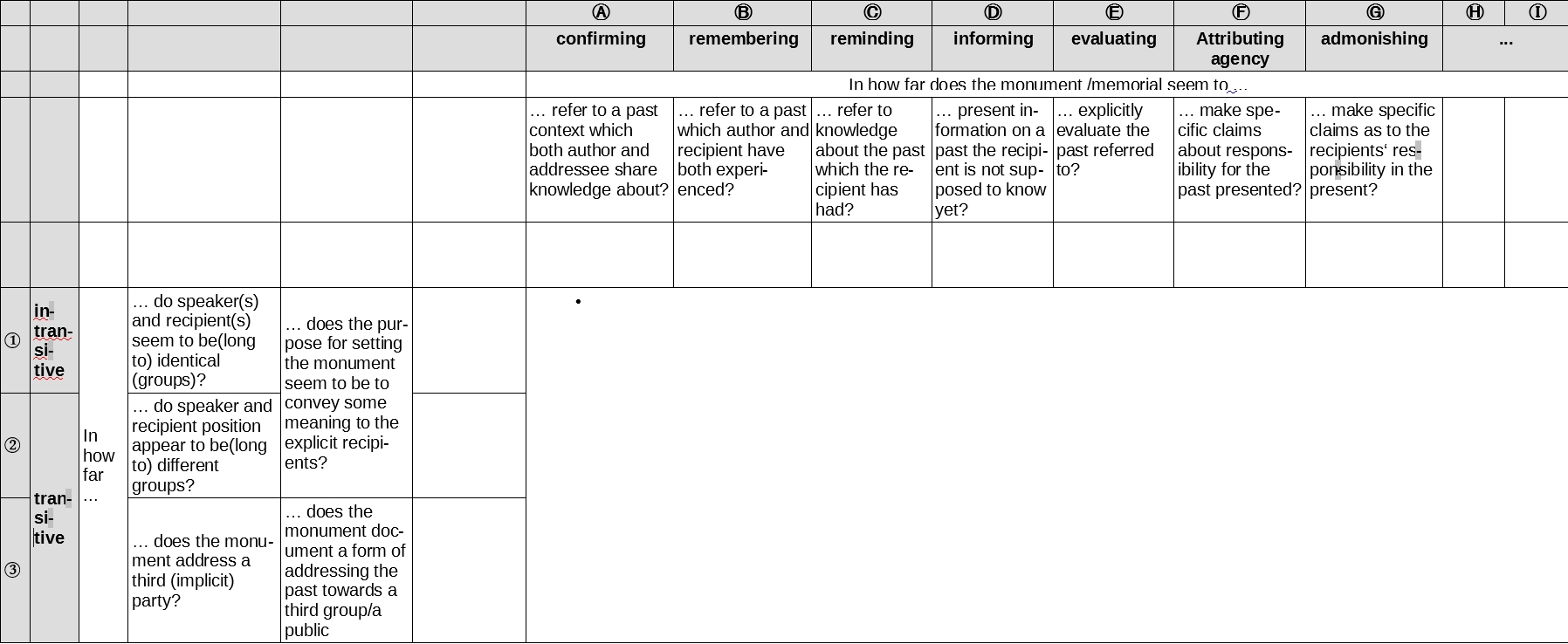
Körber, Andreas (2020): Monuments and Memorials – A tabular instrument for analysing (Blog Entry; still incomplete)

Introduction:

A table for analyzing narrative modes within monuments
Table for analyzing narrative functions in monuments.

Reference:
Körber, Andreas (2014): De-Constructing Memory Culture. In: Helle Bjerg, Andreas Körber, Claudia Lenz und Oliver von Wrochem (Hg.): Teaching historical memories in an intercultural perspective. Concepts and methods : experiences and results from the TeacMem project. 1. Aufl. Berlin: Metropol-Verlag (Reihe Neuengammer Kolloquien, Bd. 4), 145-151 + CD-File.

Successful Perspective-Taking? On the Problem and Potential of „Empathy“ (or simulative) Tasks in Historical Education (2nd, enhanced version)

Körber, Andreas (2020): Successful Perspective-Taking? On the Problem and Potential of „Empathy“ (or simulative) Tasks in Historical Education (2nd, enhanced version) (Blogbeitrag)

In textbooks as well as in the classroom, there are always tasks that require the learners to put themselves in the shoes of a historical personality and to perform a certain mental effort „from their perspective“ – for example, to write a letter or the like.

The aim of such tasks is usually to determine the extent to which students are able to take this step of „taking“ or „adopting“ a perspective, i.e. to „put themselves in the shoes“ (or position) of a temporally and/or culturally „foreign“ person and to judge past situations not only from their present perspective, with modern concepts and values etc. In the background of such tasks there is thus a fundamental concept of fundamental (not only marginal) change extending over time, which requires us to judge each past epoch „from within“, in the horizon of contemporary thinking. According to Rüsen, this concept underlies genetic historical consciousness.1 In this respect it is (probably rightly) considered specifically modern (whereby the sequence of the types of meaning as forms of thought in dealing with the past that have emerged in the course of historiographical history is in turn based on the genetic concept. The typology itself is thus specifically modern). It is this way of thinking that makes the unconditional perception, thinking through and judging of a situation that is alien in time with the help of categories that are not contemporary but present, suspect under the concept of „presenteeism“. According to Sam Wineburg, this form of thinking is the natural, but un-historical one, its overcoming in favour of a perception and recognition of the fundamental otherness of the past that is the laborious core of historical learning against the presentist default.2

Even if historical thinking and learning is hardly absorbed in this overcoming of a quasi-natural presenteeism, but rather captures much more complex setups and operations, especially if one emphasizes the orientation function of history in the present (as Jörn Rüsen’s theory does and with it most of the concepts of German history didactics), the aspect emphasized by Wineburg certainly belongs to the core of the business.

But to what extent are tasks of the type mentioned suitable for this? Some doubts are in order. But this does not mean that these tasks are fundamentally useless. What is needed, however, is an intensive reflection on their logic, the performances and achievements demanded by them of the learners, as well as on the work required of the corresponding tasks (vulgo: student achievements – to what extent they are really „achievements“ remains to be reflected) and their significance in the learning process.

One aspect of this is that (like so many in history teaching) these tasks – at least in traditional teaching contexts – often mix up characteristics of learning and achievement tasks. Students must – at least without further clarification of the teaching function – gain the impression that the required adoption of perspectives is validly possible and can be assessed by the teacher. This makes the task a performance task. Even if it is not intended to question and check something that has already been practised before, but to present the students with a new challenge, such tasks do not in any way indicate what is to happen to the work done by the students other than that it is to be disclosed to the plenum or the teacher and assessed by them – but on the basis of which criteria?
Which teacher, which researcher of today could ever say when the adoption of a perspective has „succeeded“? None of us can think or assess a situation like a 10th century monk or a Japanese samurai. No one will have a „fully valid“ answer to a corresponding task – and no teacher can decide which achievement is „right“.

Nevertheless, such tasks are not nonsensical. After all, they are not at all concerned with (unfairly) demanding something more or less spontaneously from the students (namely the temporary understanding of past actions), which is still the subject and task of extensive research today. Rather, such tasks actually aim to make plausible the requirement of abstraction from the present perspective and the otherness of perception, interpretation and decision resulting from such attempts. The criterion for the success of such tasks therefore lies neither in actually having come close to the past person mimetically, nor in stripping off one’s own present positionality and perspective as completely as possible, so that one simply argues „as strangely as possible“ and then passes this off as proof of a successful adoption of perspective.
Rather, the aim of such tasks is that students should recognize from the attempt to adopt such a perspective that they have to abandon present self-understandings in order to somehow „do justice“ to a past perspective. Thus, it is not the coherence of the individual result that is important, but rather the recognition and significance of the claim of historical thinking: someone who judges and evaluates the (sufficiently complex) cognitively presented past situation as he/she would do from today’s present without any circumstances, shows just as little historical understanding as someone who presents and evaluates everything as differently as possible, but cannot say at all to what extent this should be appropriate to the concrete situation.

Only when talking and discussing about the respective (and preferably different) „solutions“ (better: treatments) it becomes clear what the individual students have already understood, but the potential for the actual learning process is actually only there.
The original processing of the task is therefore wrongly used as proof of the fulfilment of a requirement for a successful change of perspective for theoretical and didactic reasons. Such tasks must not be understood as achievement tasks, but must be learning tasks in so far as they generate the material for the actual process of historical thinking and learning.

In this way, however, they achieve a learning potential that is only slightly changed on the terminological level, but clearly changed in theoretical terms. From the ultimately unfulfillable and measurable or identifiable claim to a successful (or post festum: successful change of perspective), the possibility of not abandoning one’s own perspective, but rather expanding it by means of the required justified, i.e. cognitive consideration of factors that make up another perspective, would become possible. Broadening and reflection of perspective instead of a change of perspective.

In this respect, one could (also) borrow methodically from the foreign language didactic principle of „task-based learning“ in that the processing of a task by students is subject to reflection in a focus on (here:) history phase, in which historical thinking (and language) is made explicit, and precisely in this process newly acquired or differentiated concepts, terms, methods, etc., which are more abstract and provided with a reflexive index, are also made explicit. is thematized and progression is explicitly encouraged.

This in turn can be methodologically implemented by using cooperative learning methods3, for example by using the „Think-Pair-Share“ (or „Think – Exchange – Discuss“) scheme is implemented in such a way that the results of such a task, which were initially prepared in individual work („Think“ phase), are neither directly given to the teacher nor presented and discussed in the plenary session, but rather in partner work or also in small groups („Pair“ phase) of learners themselves, who first compare and analyse several such workings of the task from other points of view than only how „good“ or „successful“ they are.
As usual, such „Pair“-phases should not only be about presenting the individual results to the other students so that they all know them. Rather, such phases need their own work assignments. In the present case, these can consist of comparing the individual work assignments in a descriptive way: What have the authors done similarly, what differently? What effect do these decisions have on the processing of the task? Do insights and questions arise regarding the meaning and purpose of the task – now that different solutions are known?
Such a comparative analysis, which does not immediately consider the present works from the point of view of success, and even puts them in a one-dimensional series, but rather works out, on the basis of these adaptations, what could sometimes make everything different, contributes to the fact that the thought process, the requirement of historical thought, which the task addressed, comes into view as such. It may even be advisable that the small group carrying out the comparative work only looks at other pupils‘ texts, not at their own, and that they receive these anonymously (e.g. through computer writing). It may even be useful for the teacher herself to include one or two different works „anonymously“, which are to be discovered, compared with the others and assessed in terms of their potential and limitations.
The „Share“ phase of the discussion in the plenum then receives its own task, namely the discussion and negotiation of the insights gained in the groups (was this the case in all small groups? Do the insights complement each other or are they rather in tension with each other?) and questions not so much about individual treatments, but about the contrasts perceived between them.
It could be that…

  • … Students have used very different words when writing their individual assignments and now realize that they cannot simply assume that their current terms can be used „in the situation“ without further ado.
  • … some pupils* discover the question to what extent it can be assumed that the person they are supposed to put themselves in the shoes of is not necessarily able to write. (Even a refusal of the task for such a reason can then be productively included as the result of a historical thought process).
  • … a comparison between two edits in the small group shows that the authors quite naturally (= without having given it much thought) started out from very different levels of information about „their“ person, so that the question arises: what could one know about … back then?
  • the comparison shows that some students may have included hindsight information in the process, while others did not.“

The latter case in particular shows that such an approach makes it possible not to let such „errors“ in historical thinking become immediately (or even at all) effective as „errors“ (and demotivating their thematization), but to use them (qua anonymous comparison) productively to gain insight.

Such procedures of cooperative learning with its possibilities to let pupils think about their own products in a form that does not immediately hierarchise and evaluate them, can also be supported by digital instruments, namely those that make it possible to make the results of pupils‘ work visible (anonymously) next to each other on a large smart board or similar and to work on them in plenary, such as with „Etherpads“ (cf. https://de.wikipedia.org/wiki/Etherpad).4

Finally, such a processing and evaluation of such a task also enables non-separating differentiations by means of scaffolding. It is possible, for example, that in the individual processing phase students with difficulties in writing and formulating, with abstraction etc. are not required to write their own texts, but that they are enabled to decide on the basis of a series of prepared „text modules“ what would be conceivable and consistent in a solution. The given text modules must then of course in turn have quite different solutions and designs – up to and including incompatible and even contradictory parts. In this way, the constructive task would be turned into an assignment of given symbol building blocks to each other by „task reversal“. A task that is quite different on the „surface“ can thus – for the purpose of differentiation and scaffolding – address and require similar and comparable operations of historical thought and – in reflection – promote them. (Of course, such differentiation and underpinning by means of scaffolds also means that the anonymity that may have been chosen for further evaluations can no longer be fully maintained. But this can also be dealt with productively).

  1. Rüsen, Jörn (1983): Historische Vernunft. Grundzüge einer Historik I: Die Grundlagen der Geschichtswissenschaft. Göttingen: Vandenhoeck & Ruprecht (Kleine Vandenhoeck-Reihe, 1489); Rüsen, Jörn (2013): Historik. Theorie der Geschichtswissenschaft. Köln: Böhlau. []
  2. See Wineburg, Sam (1999): Historical Thinking and Other Unnatural Acts. In: The Phi Delta Kappan 80 (7), S. 488-499; Wineburg, Sam (2001): Historical Thinking and Other Unnatural Acts. Charting the Future of Teaching the Past. Philadelphia: Temple University Press (Critical perspectives on the past). []
  3. e.g. according to Green, Norm; Green, Kathy (2007): Kooperatives Lernen im Klassenraum und im Kollegium. Seelze-Velber: Klett; Kallmeyer. []
  4. In contrast to some other instruments praised in the context of digitization, which ultimately do nothing else but implement conventional, small-step methods of a knowledge check with immediate right-wrong feedback electronically and often even worsen in so far that due to the electronic comparison of the students with a sample solution correct, but differently formulated answers are reported back as ‚wrong‘, just as half correct answers cannot be appreciated, etherpads enable the organization of a common consideration of a number of individual solutions. Due to the often typed-in and therefore given independence from handwriting, a certain anonymization can be achieved, which allows the focus to be on the text, not the author. Regarding the available space, font size etc. there are still limits, however, which may make it advisable to use „analogous“ methods with cards, posters etc. []

Gerade erschienen: Inklusive Diagnostik

Bormuth, Heike; Körber, Andreas; Seidl, Patrizia; Witt, Dirk (2020): Inklusive Diagnostik. Ein Werkzeug zur Planung inklusiven (Geschichts-)Unterrichts. In: Sebastian Barsch, Bettina Degner, Christoph Kühberger und Martin Lücke (Hg.): Handbuch Diversität im Geschichtsunterricht. Inklusive Geschichtsdidaktik. Frankfurt: Wochenschau Verlag (Wochenschau Wissenschaft), S. 338–349.

Bormuth, Heike; Körber, Andreas; Seidl, Patrizia; Witt, Dirk (2020): Inklusive Diagnostik. Ein Werkzeug zur Planung inklusiven (Geschichts-)Unterrichts. In: Sebastian Barsch, Bettina Degner, Christoph Kühberger und Martin Lücke (Hg.): Handbuch Diversität im Geschichtsunterricht. Inklusive Geschichtsdidaktik. Frankfurt: Wochenschau Verlag (Wochenschau Wissenschaft), S. 338–349.

Gerade erschienen: Inklusive Geschichtskultur

Körber, Andreas (2020): Inklusive Geschichtskultur – Bestimmungsfaktoren und Ansprüche. In: Sebastian Barsch, Bettina Degner, Christoph Kühberger und Martin Lücke (Hg.): Handbuch Diversität im Geschichtsunterricht. Inklusive Geschichtsdidaktik. Frankfurt: Wochenschau Verlag (Wochenschau Wissenschaft), S. 250–258.

Körber, Andreas (2020): Inklusive Geschichtskultur – Bestimmungsfaktoren und Ansprüche. In: Sebastian Barsch, Bettina Degner, Christoph Kühberger und Martin Lücke (Hg.): Handbuch Diversität im Geschichtsunterricht. Inklusive Geschichtsdidaktik. Frankfurt: Wochenschau Verlag (Wochenschau Wissenschaft), S. 250–258.

gerade erschienen: Literatur zu inklusivem Geschichtslernen

Körber, Andreas; Seidl, Patrizia; Witt, Dirk; Bormuth, Heike (2020): Inklusives Geschichtslernen via Scaffolding von Aufgaben. In: Sebastian Barsch, Bettina Degner, Christoph Kühberger und Martin Lücke (Hg.): Handbuch Diversität im Geschichtsunterricht. Inklusive Geschichtsdidaktik. Frankfurt: Wochenschau Verlag (Wochenschau Wissenschaft), S. 405–423.

Körber, Andreas; Seidl, Patrizia; Witt, Dirk; Bormuth, Heike (2020): Inklusives Geschichtslernen via Scaffolding von Aufgaben. In: Sebastian Barsch, Bettina Degner, Christoph Kühberger und Martin Lücke (Hg.): Handbuch Diversität im Geschichtsunterricht. Inklusive Geschichtsdidaktik. Frankfurt: Wochenschau Verlag (Wochenschau Wissenschaft), S. 405–423.

Gerade erschienen: Literatur zu inklusivem Geschichtslernen

Gerade ist erschienen der Sammelband:

Barsch, Sebastian; Degner, Bettina; Kühberger, Christoph; Lücke, Martin (Hg.) (2020): Handbuch Diversität im Geschichtsunterricht. Inklusive Geschichtsdidaktik. Frankfurt: Wochenschau Verlag (Wochenschau Wissenschaft).

  • Körber, Andreas (2020): Inklusive Geschichtskultur — Bestimmungsfaktoren und Ansprüche, S. 250–258.
  • Bormuth, Heike; Körber, Andreas; Seidl, Patrizia; Witt, Dirk (2020): Inklusive Diagnostik. Ein Werkzeug zur Planung inklusiven (Geschichts-)Unterrichts, S. 338–349.
  • Körber, Andreas; Seidl, Patrizia; Witt, Dirk; Bormuth, Heike (2020): Inklusives Geschichtslernen via Scaffolding von Aufgaben, S. 405–423.

Commemoration and Types or Patterns of Historical Meaning-Making (Narrating)

Körber, Andreas (2020): Commemoration and Types or Patterns of Historical Meaning-Making (Narrating) (Blogbeitrag)

(This is a text from last year’s discussion with Stéphane Lévesque and Gabriel Reich on narrative patterns‘ role in reflecting on monument and memorial policy. I never got round to finishing ist. Sorry for the delay.)

In their texts and in the earlier discussion (first on Public History Weekly: Lévesque, Stéphane (2018): Removing the Past?, then on Active History CA: A new approach to debates over Macdonald and other monuments in Canada, Part 1 and Part 2), Lévesque suggested a model of different levels of historical competencies following Jörn Rüsen’s typology of narrative patterns.

While I agree that there is a lot of plausibility in a sequential development of these types of narrating throughout (Western) history, and that the genetic type is the most complex and advanced one, I don’t find much plausibility in the idea that in the development of student‘ thinking within their lifetime, the traditional type should have any priority to the other ones. Instead, I think that students encounter full-fledged narratives as well as simple statements of all types simultaneously from the beginning, and will acquire them alongside each other — but only gradually learn to recognize them for what they are, grasping their logic.

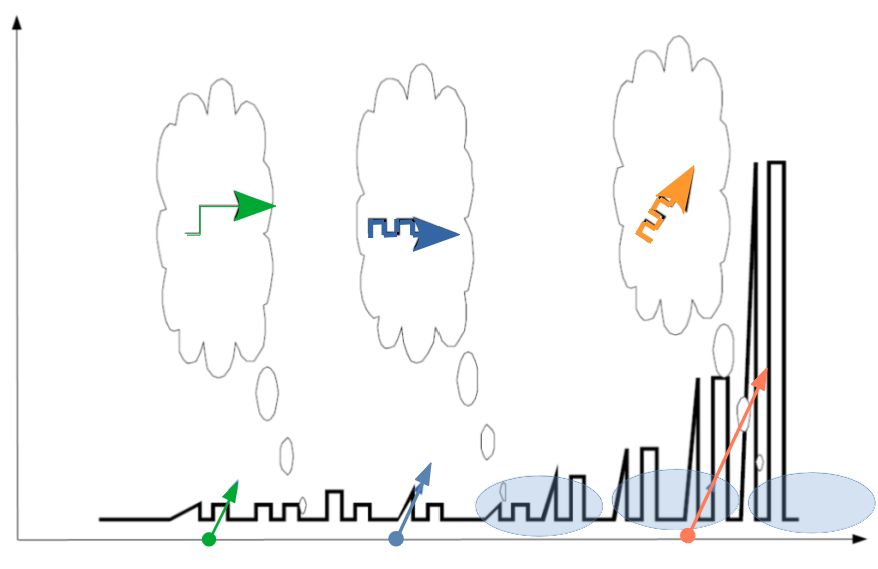
Consider the following graph:

(c) Andreas Körber 2018

It is to visualize the idea that increasing recognition of change in historic time (the x-axis) first leads to the development of the traditional type (asking for the origin of the currently valid, in cloud 1), then the experience that what has originated can also perish again and therefore asking for origins is not enough, lead to the development of the exemplaric type, asking for patterns and rules behind the change on the surface (cloud 2), and only modern experience of increased/accelerated change then led to the development of the genetic type, asking for the direction.

Each of these patterns leads to different expectations for the future. Initially (green perspective), the future may seem quite similar from the present. What is perceived as having begun, stays valid. Only from the (later) blue perspective, a pattern seems discernible, leading to the expectations that the future will also yield similar patterns of events as are detected in the past. From the (still later) orange perspective, an (additional?) increase in their „magniture“ can be perceived and its continuation be expected.
The graph also is to show that the rules and patterns as well as ideas of origins have not been rendered obsolete by each new type, but are superimposed or integrated into it.

I use this graph in my lecture. I now have added the small arrows. They are to indicate the learning-necessities of a person within a relatively short time-span of life or even youth. While in pre-modern times, they only encountered the then-developed patterns (if the model is valid), in modernity, they will have to use all patterns simultaneously, in order not make sense differentially.

The idea of a homology is problematic in another way, also. It might suggest that people in antiquity (or pre-modern-times) were developed rather like children or youths, not really grown-ups. This idea is not new, but is very problematic. As you might be aware of, Rudolf Steiner, founder of anthroposophy, suggested that the „ancient“ Greek had a mental age of about 7-years-olds. And there was a very influential German „didact“ of history in the 19th century (Friedrich Kohlrausch), who combined a similar idea of the homological development in the way people conceived „god“ with that of becoming of age. So only the modern man was really „grown up“ (and is was the Germans who did so — very nationalist).

Because of Rüsen’s idea of a „homology“ in the sequence of development of narrating types between mankind (phylogenesis) and individuals (ontogenesis), Bodo von Borries (and I as assistant to him) did a large-scale research in the early 1990s, were we presented students with items of different typological logic to dilemma-situations, like Rüsen himself has used for qualitative research and for explaining the narrative types. We did find a predominance of agreement to „traditional“ items with 6th-graders (abt. 11 yrs), but found no linear development. In fact, 9th-graders seemed even to regress. All this is published in German only, I fear.

I would strongly suggest to distinguish between the historical development and hierarchy of these patterns on the one hand and progression in learning on the other hand, for which I suggest the third dimension.

As for Lévesque’s revised table of competencies in a further comment in PHW and his evaluation that Gabriel Reich is correct in that the genetic type provides no solution to the question of whether to keep or get rid of monuments: Do these types really lead to specific political positions — especially if they are always combined? Or do they rather characterize part of their underlying understanding? I think there are different positions and solutions possible by each narrative. The value of the differentiation of types of meaning making and narration is rather analytical than prescriptive.

And that is also the pedagogical value: I think these typologies (your table and mine) can be used for classifying and discussing statements of people in the political debate. It will enhance students ability to recognize the logics behind specific political stances. And it may well show that both suggestions of keeping and of getting rid of can be underpinned by different types of narrative, but that would generate maybe different policies:

Take an example from Gabriel Reich’s patch, again: civil war monuments in Richmond.

One could argue for keeping the statutes on Monument Avenue on grounds of purely traditional thinking: to mark the origins of the specific state of things. This is both possible in partisan ways (only „our“ heroes), but also in a more „inclusive“ form, asking for such monument of both sides to be presented, to mark the origin of the countries „division“. Equally in traditional mode (but with different political background), one might call for their removal. If you hold that the division they mark is no longer given, they might be removed.

In exemplaric mode (as I opined earlier), one could speak out for the preservation of the monuments on the grounds that they exemplify a certain time and culture which we can still consider as „overcome“, but one can also argue for their removal because they represented outdated or politically non-supportable relations to the past, and that our time needs to find new ones, not „progressed“ ones, but such which reflect the „characteristics of our time“.

I do agree that to hold a specifically genetic view makes it hard to envision the whole question as one of keeping vs. removing, — but it doesn’t exclude it to the full extent.

If people are thinking predominantly in genetic mode, experiencing the country to having overcome that division, they object to a traditional logic they perceived the monuments to have. In this case, it would be the tension between one’s own genetic mode of thinking and that perceived in the monuments, which would generate a political position.

If the genetic perspective was upon how to improve commemoration, one might ask for making such commemorations „more inclusive“. This may have been behind erecting a monument for Arthur Ashe among the confederate generals – not a very consistent move, though, given that is merely additively combines monuments. In fact, it creates a „memorial landscape“ of a rather complex narrative structure, part of which is traditional („heroes“) and exemplary („each group“), but by doing so enforces a new kind of traditionality (keeping the racial groups apart, assigning each „their own“ tradition to hold up). So the intended „progress“ by inclusivity („An avenue for all people“) may in fact have created a multi-traditional narrative.1

But there are other possible solutions suggested by genetic thinking.  The concept of past people being „children of their own time“ is as genetic as it can get, referring to a fundamental change in time, so that morals and actions might be considered incommensurable across times. This concept has been used for exonerating past peoples views and actions. On this ground, one might call it „useless“. But it isn’t. Genetic historical thinking entails both — to recognize the temporal change and moral and political contexts for past actions different from ours, AND to recognize that our own context is valid, too.

From this point of view, it may underpin a present position transgressing the „keep/remove“-divide, namely to find ways of memorializing civil war „heroes“ (and/or „villains“ that is) that do NOT inadvertently invite for traditional or exemplaric heroic reading, but specifically marks the distance of time.

It is imperative, this thinking goes, to keep these memorials, but not as heroic marks to the past or as ambivalent markers. One should not just remove them, for that would put into oblivion not only the past, but also the whole discussion and reflections, the uneasiness about its representation which sparked the discussion in the first place. Genetic thinking would not be content to just remove the heroism (especially that of the wrong, side) with the effect to have no memory at all, but would call for a memorialization which specifically marks the change between that time and ours today.

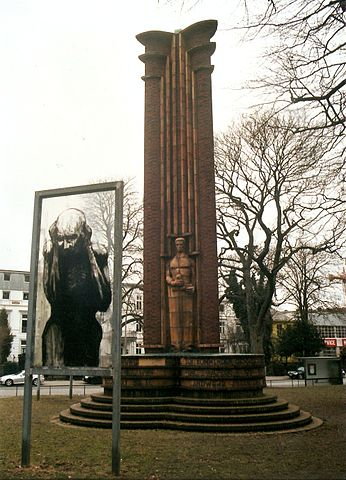
Again, take a Hamburg example. In an earlier contribution to this discussion I already hinted to counter-memorialisation. One of the best examples is here in Hamburg-Altona:

Monument and Counter-Monument next to at St. Johannis-Church in Hamburg-Altona2

Next to Altona’s St. Johannis Church, a monument had been erected in 1925 for the members of the 31st Infantry Regiment in WW1, commissioned by survivors of that regiment. Each of the three sides of the column-like monument made of clinker features an oversized, half-naked figure, representing a warrior with some antique weapon.

The inscription below reads „To the fallen for a grateful memory, to the living for a reminder, to the coming generations for emulation.“3. Clearly a very traditional proto-narrative, both extending the own warriorship of the soldiers into antiquity and calling for its emulation, lacking any transcendence. The formula was coined by August Böckh for Friedrich Wilhelm III of Prussia, and was used on monuments remembering the „liberation wars“ against Napoleon, but also later on those for the „unification wars“ of 1870/71. After the losses of millions in WW1, its usage – especially of the third element – is remarkable, albeit not alltogether uncommon4.


In the mid-1990s, the church’s congregation commissioned a counter-memorial, created by Rainer Tiedje, consisting of three acryl-glass-plates, each directly confronting one of the warriors, depicting „dark, emaciated, fearful creatures“, as the explanation on the page „denkmalhamburg.de“ states (thus on http://denkmalhamburg.de/kriegerdenkmal-an-der-st-johanniskirche/, my translation). It concludes „In the center the heroism and the exaltation, in front of it it the horror of war. A successful mixture.“ (my translation).


Gegendenkmal zum 31er Kriegerdenkmal (aus: Gedenkstätten in Hamburg. Wegweiser zu den Stätten der Erinnerung an die Jahre 1933-1945. https://www.gedenkstaetten-in-hamburg.de/gedenkstaetten/gedenkort/gegendenkmal-zum-31er-kriegerdenkmal/

To me, this countermemorial is not just a (exemplaric-mode) juxtaposition of (tradtional-mode) heroism and horror of war, but there is fundamentally genetic part in it: the counter-memorial does not merely point to timeless horrors of the consequences of warfare, but leans on a visual vocabulary established in Holocaust memorials: The „suffering men“ who wriggles with pain (and fear) on eye-level with the warriors, look like „muselmen“, the completely debilitated and immiserated inmates of the Nazi concentration camps. In its iconography, the counter-memorial belongs to the generation of monuments which coerce the viewer, the public to find and answer, not providing one themselves, either in being abstract or – as here – by visualizing death and disappearance in any but heroic form5. It is this feature, using a visual code depending not only abstractly on hindsight but on concrete knowledge about what such heroism-propaganda did help to bring about, together with the effective placing which renders impossible „commemoration ceremonies, at which the plaques are not noticed“, which indicate to a specific genetic thinking below it, trying to transgress the thinking of the time.

  1. Cf. https://onmonumentave.com/blog/2017/11/20/an-avenue-for-for-all-people-how-arthur-ashe-came-to-monument-avenue []
  2. Photo by 1970gemini in der Wikipedia auf Deutsch, CC BY-SA 3.0, https://commons.wikimedia.org/w/index.php?curid=19523318 []
  3. See http://denkmalhamburg.de/kriegerdenkmal-an-der-st-johanniskirche/  []
  4. Cf. Koselleck, Reinhart (1996): Kriegerdenkmäler als Identitätsstiftungen der Überlebenden. In: Odo Marquard und Karlheinz Stierle (Hg.): Identität. 2., unveränd. Aufl. München: Fink (Poetik und Hermeneutik, 8), S. 255–276; p. 261f []
  5. Cf. Koselleck, Reinhart (1994): Einleitung. In: Reinhart Koselleck und Michael Jeismann (Hg.): Der politische Totenkult. Kriegerdenkmäler in der Moderne. München: Fink (Bild und Text), S. 9–20, here p. 20 []