„UCL IOE Press is delighted to announce the launch of the HISTORY EDUCATION RESEARCH JOURNAL (HERJ) Focusing on the global significance and impact of history education, this international journal covers all aspects of history education theory, scholarship, and pure and applied research. Articles illuminate contemporary issues, concerns, policies and practice, drawing upon the eclectic methodologies of history education research. Editors: Jon Nichol, Hilary Cooper and Arthur Chapman
The History Education Research Journal
is abi-annual, open-access, peer-reviewed journal based at the
UCL Institute of Education and hosted
in partnership with the
Historical Association. It is a relaunch of the
International Journal of Historical Learning, Teaching and Research (IJHLTR) and this first issue is number 15.2 to mark it as a continuation from IJHLTR.
Back issues of IJHLTR will remain available
through the Historical Association until they are transferred to the new journal’s home page. For information about how to contribute to the
History Education Research Journal, visit UCL IOE Press.
Sie ist aber durchaus nicht vollständig. Einige wichtige Beiträge fehlen. Auch im Radio, auf Facebook und Twitter (und wohl auch weiteren Kanälen) haben intensive Debatten stattgefunden, von denen ich wiederum nur einige Threads und/oder Beiträge verlinke:
[Hoeres, Peter ]Einmischung in politische Debatten durch Historiker. Hoeres: Verabschiedete Resolution ist unausgewogen. Der Neu-Historiker Peter Hoeres kritisiert die auf dem diesjährigen Historikerkongress verabschiedete Resolution, die mehr Einmischung von ihm und seinen Kollegen bei politischen Debatten fordert. Die Resolution sei „extrem einseitig“, sagte er im Dlf. Es gebe bessere Möglichkeiten, sich einzumischen. Peter Hoeres im Gespräch mit Michael Köhler. Deutschlandfunk 19.10.2018 (https://www.deutschlandfunk.de/einmischung-in-politische-debatten-durch-historiker-hoeres.691.de.html?dram%3Aarticle_id=431031)
A crosstabulation of competencies and patterns/logic of sensemaking as suggested by Stéphane Lévesque(( Another such crosstabulation has been suggested (in German) by Wolfgang Hasberg (Analytische Wege zu besserem Geschichtsunterricht. Historisches Denken im Handlungszusammenhang Geschichtsunterricht. In: Meyer-Hamme, Johannes / Thünemann, Holger / Zülsdorf-Kersting, Meik (Hrsg.): Was heißt guter Geschichtsunterricht? Perspektiven im Vergleich. Schwalbach/Ts. / Wochenschau, S. 137–160, p. 140). For my critique see Körber 2016 (in German). I also provided a table, including the different niveaus, but restricted to „Fragekompetenz“ (similar to Lévesque’s „inquiry competence“). )) is indeed useful for „reading“ individual monuments and making sense of their „message“, also. Lévesque’s filling of the table is a bit abstract, general for this, so the following would in part be my own understanding.
It also is based on Rüsen’s notion that while the different patterns were developed sequentially over time, to „older“ ones are not lost, but still available and indeed visible in modern day thinking, in fact most of the time in combinations. What characterizes modern-time historical thinking, then, is the presence and dominance of „genetic“ thinking, while pre-modern thought would not have this type at its disposal at all. But then, our examples here are all „modern“, so that it may be a question of dominance and relative weight.
Take a monument for a civil war general:
A spectator today may read it as a reminder to the origin of the current state of affairs, possibly the „losing of the cause“ (e.g. both the honoured general and the spectator being southeners) or to the liberation of the slaves (both northeners). In both cases, the monument would be seen as pointing to an origin of what is seen as valid today (the very definition of Rüsen’s „traditional“ type). This might explain why people adhering to the northern narrative would oppose to southern monuments, and vice versa, not believeing their story in the first place — and maybe fearing that keeping the monuments would signify that their version was to be seen as valid.
In an exemplaric mode, however, both may accept the „other side’s“ monuments, because what they point at would not be seen as the origin of affairs, but rather a general rule, e.g. honouring people „bravely fighting for their respective (!) cause“. The logic would be that each society would honor „their heroes“, who do not so much stand for the specific cause but for a general rule. What happens on the ground in Gettysburg, e.g., is something along this line: „Traditional“ commemorating attracts most people going there, but an exemplary „cover-narrative“ allows for common remembrance.
Ernst Barlach: Relief (1931; Re-Construction of 1948) on Hamburg Town Hall Square Monument . Photo from Wikimedia Commons (public domain): https://upload.wikimedia.org/wikipedia/commons/2/2c/Hamburg_Mahnmal_01_KMJ-adj.jpg
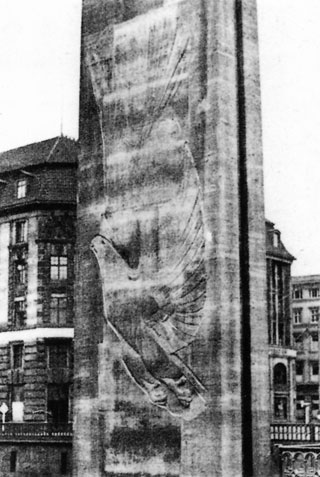
Hans-Martin Ruwoldt (1938): Phoenix on Hamburg Town Hall Square Monument. Photo by https://www.denk-mal-gegen-krieg.de/kriegerdenkmaeler/hamburg-lo-os/
In 1938, under Nazi rule, the relief was exchanged for a „phoenix“. Did it change the narrative and commemorative evaluation of the loss of the 40000 Hamburgians? To my view, it most certainly did.
The addition of the last part „FOR YOU“ to the inscription already before the initial installation of the monument was a concession to the right parties, changing (in Rüsen‘s terms) a more traditional message into a more exemplary one:
While the combination of the initial wording without the addition „FOR YOU“ and the mother-child-relief fit into a development of monument culture developed in WW1 which has been identified in retrospect, namely monuments which which do no longer provide an authoritative suggestion of the meaning of the protagonist‘s death, but rather question this meaning.(( On this type of monuments cf. Koselleck, Reinhart (1994): Einleitung. In: Reinhart Koselleck und Michael Jeismann (Hg.): Der politische Totenkult. Kriegerdenkmäler in der Moderne. München: Fink (Bild und Text), S. 9–20, here p. 18f. )) It did so because it expressed the continuous loss, referring to the dead soldiers rather as victims of a greater context of war, to be mourned, by pointing to their their death and loss as the rather tragic origins of the common grief.
Adding „FOR YOU“ to the inscription did not fully eradicate this negative-traditional narrative pattern, but added an additional layer of different narrative and evaluative character both to the deaths, which are ascribed a purpose, and to the conceptual framing of the dead, which are no longer only victims but also (self-)sacrifices for a common good. Interestingly, both concepts, that of victim and that of sacrifice, are present in the German term „Opfer“ explicitly used, but alluded to, here.
The exchange of the mourning mother/child-relief by a „phoenix“ in 1938, then, eradicated the thin layer of questioning the purpose and meaning of the loss, the notion of „victims“ and rendered the 40,000 Fathers, Brothers and „Sons of Town“ heroes – not only self-sacrifices for the wellbeing of their respective families, but role-models to be celebrated and emulated.(( According to Klingel, Kerstin (2006): Eichenkranz und Dornenkrone. Kriegerdenkmäler in Hamburg. Hamburg: Landeszentrale für Politische Bildung, p.71, the mourning-relief initially was to be replaced by „war symbols“ but all skteches handed in by artists (including a wrath with swords by Ruwoldt) were rejected, so that he was commissioned to create an eagle, which he did, but in a way which far more resembled a dove than an eagle. In how far this can be interpreted as a subversive rejection of the new martial character and even be evaluated as an act of defiance, is highly questionable, since the symbolism of the dove as the universial symbol for peace was created by Picasso only after WorldWar II. )) In 1948, then, the lost Barlach-relief, was restored, alas not by Barlach himself, who had meanwhile died.
I do have a hard time constructing a genetic understanding of such a monument, maybe because a modern, genetic way of thinking needs to have been informed by the „critical“ mode of at least partly de-legitimizing the orientating power of traditional and exemplaric thinking.
Maybe this is the background for modern monuments being quite different, either often non-figurative — as Peter Eisenman’s Memorial to the Murdered Jews in Berlin, or many works by Jochen Gerz(( Cf. e.g. his „Invisible Monument“ in Sarbrücken: https://en.wikipedia.org/wiki/Platz_des_Unsichtbaren_Mahnmals. )) — or taking on forms of counter-memorialization(( Cf. a.o. Wijsenbeek, Dinah: Denkmal und Gegendenkmal. Über den kritischen Umgang mit der Vergangenheit auf dem Gebiet der bildenden Kunst. München 2010. )), thus setting in motion a kind of change, not just re-present-ing a past, but encouraging or even enforcing critical reflection on it.
It is easier for the Hamburg monument: Genetic thinking would question whether not only this heroifying way of commemorating heroes (even if not individual), but also the concrete form of public acknowledging of tragic loss can be timely, after we experienced another war and an inhuman dictatorship and genocide which was not least based on feelings instigated by such commemorating.(( There’s a lot more to be reflected in commemorating: Who talks to whom, here? What do they say and expect? Who is the „you“? Is it “ us“ – still today? And if so: in how far is the message the same for all of us, those with Hamburg ancestors of the time, and those without, maybe immigrants? In how far can this aspect define our attitude? Can we force all recent immigrants into our own „national“ narrative (and even more so when it is not WW1, but Holocaust related)? But then, how can we not? (cf. also Körber 2014, and see below. ))
But there is something more to reflecting about narratives — and especially on how to relate to them. As I wrote above, Memorials are narratives. Rüsen calls them „narrative abbreviations“, pointing to them standing for a specific narrative, i.e. a specific relation between a past (under memory), the present (of the authors and erectors of the monument as well as the intended public), and with regard to a specific future, constructed only partly in verbal narrative form, but also with non-verbal and sequentially narrative elements (even though in some cases it is only the verbal inscriptions which really hint to any historical meaning).
Memorials are more than only proto-narratives. Their (often) prominent (albeit also often overlooked) positioning, their (proto-)narrative structure and their own quality for lasting a long time (cf. „monumentum exegi aere perennius), they do not only constitute a narrative relation from one temporal and social position towrds the past and the future, but also are meant to prolong the sense they make and to impose it on later generations. Monuments are about obligating their audience, the spectators with a certain narrative and interpretation. That qualifies them as parts of what we call „politics of history“, not only of commemoration, and what makes them political.
It therefore is paramount to read monuments as narratives, and not only in the de-constructive sense of „what did those erectors make of that past back then“, but also in the re-conctructive sense of „in how far or how does this narrative fit into my/our relation to that past). In other words: Standing before a monument and thinking about monuments, we all need to (and in fact do) think in a combination of understanding the others‘ and deliberating our own narrative meaning-making. Therefore we need to read them as narratives first, and become competent for it.
Monuments often take on the form of addressing people. Sometimes — as in the Hamburg case above — they address the spectator, reminding them of some kind of obligation to commemorate.(( My mother used to explain the German word „Denkmal“, literally referrring to a „mark(er)“ for initiating thinking, as an imperative: „Denk mal!“, referring to the other meaning of the word „mal“ as „for once“, resulting in „do think for once!“ )) But who is talking to whom? If the senate of Hamburg talkes to that to the Hamburg citizens of 1930-1932, can/will we accept that (a) the Hamburg Senate of today still admonishes us like that, and b) that we Hamburg citizens of today are still addressed in the same way?
In other cases, (inscriptions in) memorials might explicitly address the commemorated themselves, as e.g. in the confederate monument in Yanceyville, N.C., whose plaque reads „To the Sons of Caswell County who served in the War of 1861-1865 in answer to the Call of their County“, and continues in a „We-Voice“, signed by the Caswell Chapter of the United Daughters of the Confederacy“. So far so conventional. This might be rather unproblematic, since speaker-position and addressees are clearly marked. One might leave the monument even if one disagreed, not having to align with its narrative. Only if the presence of such commemorating in itself is inacceptable, action is immediately called for.
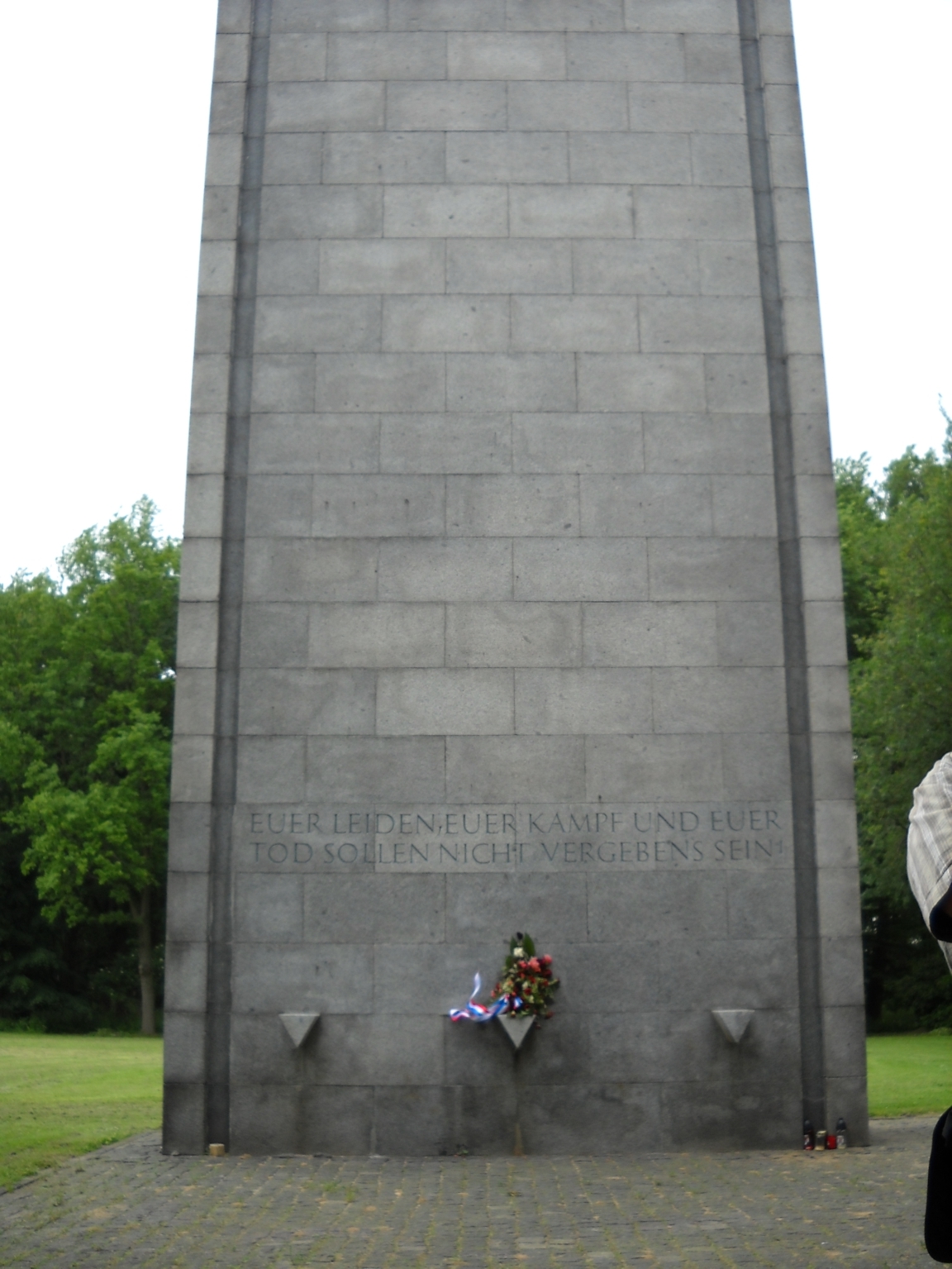
But there are other monuments which seem to talk from a neutral position, which in fact is that of the erectors, but by not being qualified, includes the spectator into the speaker position. The example I have ready at hand, is not from the US and not about war heroes, but again from Hamburg, this time from Neuengamme concentration camp memorial. In 1965, an „international monument“ stele(( Cf. https://upload.wikimedia.org/wikipedia/commons/thumb/1/15/Neuengamme_memorial.jpg/800px-Neuengamme_memorial.jpg, (photo by Hao Liu in the public domain) )) was erected there, together with a whole series of country-specific memorial plates. The inscription on the monument reads „Your suffering, your fighting and your death shall not be in vain“ (my translation). This now clearly is interesting in at least two respects: (1) it ascribes not only suffering and death, but also fighting to those commemorated and thereby possibly does not refer to those inmates who never had a chance or did not „fight“, who were pure victims, and (2) it speaks from a neutral voice which is not marked in time and social, political or event-related position. Whoever mourns at that place possibly silently co-signs the statement.
International Monument (1965) at Neuengamme Concentration Camp Memorial (partial photo; (c) 2006 Andreas Körber)
Consider an equal honouring of confederate generals in, say NC: „Your fighting shall not have been in vain.“ I would spark much more controversy and concers — and rightly so.
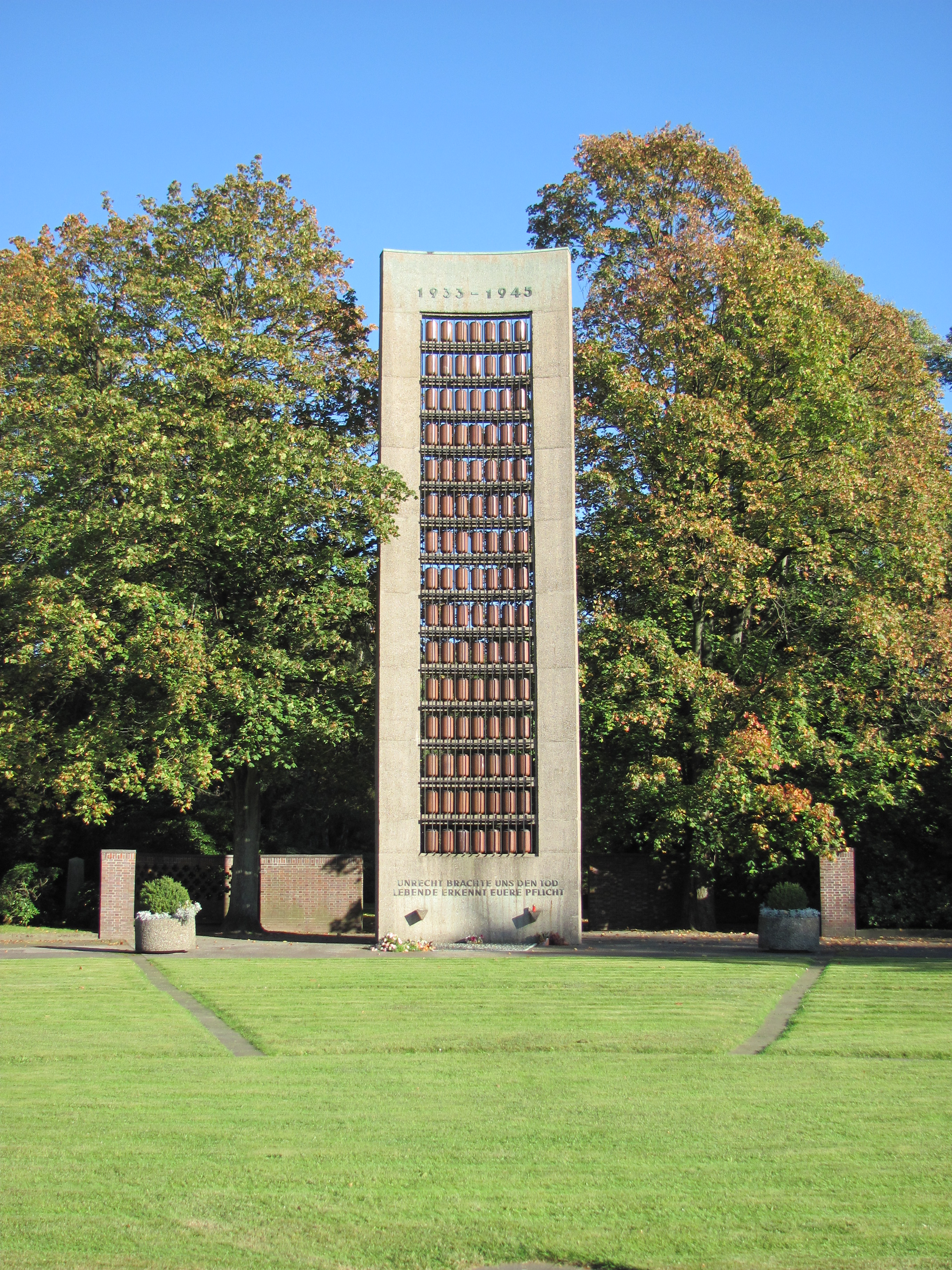
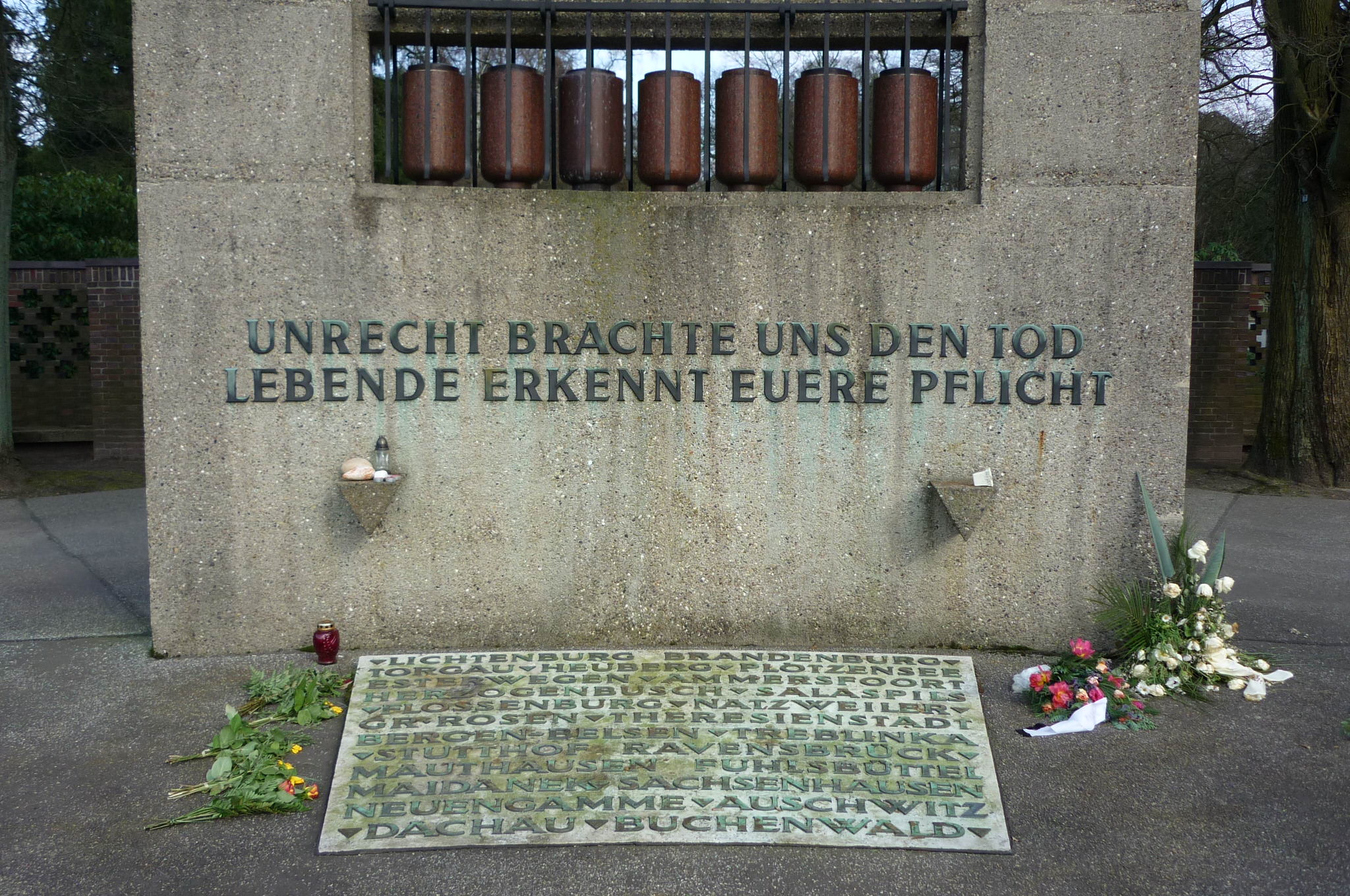
Still another example, the first Hamburg monument for the victims of National Socialism (from late 1945) on the Central Cemetry in Hamburg-Ohlsdorf, has an inscription „Injustice brought Us Death — Living: Recognize your Obligation“.
Erstes Hamburger Mahnmal für die Opfer des Nationalsozialismus von 11/1945 in Hamburg Ohlsdorf. Foto von NordNordWest/Wikipedia. Lizenz: CC-BY-SA 3.0; (https://creativecommons.org/licenses/by-sa/3.0/de/legalcode); Original: http://commons.wikimedia.org/wiki/File:Mahnmal_Opfer_der_NS-Verfolgung_Ohlsdorf.jpg
Erstes Hamburger Mahnmal für die Opfer des Nationalsozialismus von 11/1945 in Hamburg Ohlsdorf; Detail. Zustand 25.3.2010; Foto (c) Andreas Körber
Again, for analyzing and understanding, we need to recognize. The speaker position here, is clearly (metaphoricall) held by the victims to be commemorated. But whom do they speak to? Literally, it is the „living“. In a very broad understanding, the monument/memorial therefore addresses all humans, quite in a way what Rüsen has addressed as the highest level of normative plausibility: broadening the perspective to the level of humanity. This is not very problematic, since the inscription does talk of „duty“, not of „guilt“, it does not conflate the addressees with those who inflicted the injustice upon the victims. But it could have done. In 1945, the message would be clearly not merely universally humanistic, but at least also addressing the Germans as the society of the perpetrators. It does not condemn, but calls for recognizing the „duty“ and responsibility for commemorating and non-repeating as well as overcoming the structures of NS injustice, hinting at responsibility for not preventing them or even participating in them in the first place.
And today? In how far is the message the same for today’s society in Germany? The people living in Germany today do — apart from very few exceptions — not share any personal guilt or responsibility for what happened. In how far can or should they see themselves addressed?
Again, there is no question as to the very general, humanity-related address. This is directed at any audience. But would that mean that there is no difference between any other visitor to the memorial and Germans? Has the Nazi injustice (and similarly the Holocaust) become a matter of general, universal history only? Is there no special belonging to and message for German history? All these questions can and need to be addressed — and especially so, since a considerable part of German society consists not only of people born and raised (long) after the „Third Reich“, but also of many who immigrated from other countries, societies and cultures meanwhile. Are they simply counted into the perpetrators‘ society? — no, I think; but as people living in Germany, they also are adressed in a more specific way than any other visitor — and they are expected to feel addressed, also. While there may be (and often indeed is) not specific responsibility for what these memorials and monuments refer to, there surely is a specific responsibility from or out of this history — and these monuments therefore serve not only as general markers to a set past, but also as marks which have specific messages and different (but compatible) ones for different recipients. This is what also is a part of what is needed to be reflected and discussed with regard to monuments in public history culture and what history education needs to enable learners to partake in.
In order to make up our minds on monuments we have „inherited“ not only in political terms, we need to reflect their specific narrative message in a spectrum of time-relations. And we need to differentiate our terminology and enable our students to master a set of concepts related. We need, e.g., to distinguish honoring forms of commemoration from reminding and admonishing ones.
In Germany we have (not easliy) developed the notion of „Mahnmal“, admonishing, to be distinguished from a mere „Denkmal“ (literally a „thinking mark“). But even this distinction is insufficient. A Mahnmal (in fact the literal translation to „monument“, from Latin „admonere“) may admonish to remember our own suffering inflicted on us by ourselves, some tragic or by others, but also may admonish to not forget what we inflicted on others. This is the specific form „negative memory“ of German memorial culture.
Therefore, there’s a lot more to be reflected in commemorating:
Who „talks“? who authors the narrative — and is what capacity (e.g. in lieuf of „the people“, of a certain group, …)?
whom does the monument explicity address?
what is the relation of explicit addressees and factual spectators?
in how far is the message the same for us today as it was envisioned back then — and possibly realized? is it the same for all of us?
what kind of message is perceived?
(cf. Körber 2014)
References:
Hasberg, Wolfgang (2012): Analytische Wege zu besserem Geschichtsunterricht. Historisches Denken im Handlungszusammenhang Geschichtsunterricht. In: Meyer-Hamme, Johannes / Thünemann, Holger / Zülsdorf-Kersting, Meik (Hrsg.): Was heißt guter Geschichtsunterricht? Perspektiven im Vergleich. Schwalbach/Ts. / Wochenschau, S. 137–160, p. 140.
Klingel, Kerstin (2006): Eichenkranz und Dornenkrone. Kriegerdenkmäler in Hamburg. Hamburg: Landeszentrale für Politische Bildung.
Körber, Andreas (2014): De-Constructing Memory Culture. In: Teaching historical memories in an intercultural perspective. Concepts and methods : experiences and results from the TeacMem project. Hrsg. von Helle Bjerg, Andreas Körber, Claudia Lenz u. Oliver von Wrochem. Berlin 2014, 145-151.
Körber, Andreas (2016): Sinnbildungstypen als Graduierungen? Versuch einer Klärung am Beispiel der Historischen Fragekompetenz. In: Katja Lehmann, Michael Werner und Stefanie Zabold (Hg.): Historisches Denken jetzt und in Zukunft. Wege zu einem theoretisch fundierten und evidenzbasierten Umgang mit Geschichte. Festschrift für Waltraud Schreiber zum 60. Geburtstag. Berlin, Münster: Lit Verlag (Geschichtsdidaktik in Vergangenheit und Gegenwart, 10), S. 27–41.
Rüsen, Jörn (2017): Evidence and Meaning. A Theory of Historical Studies. Unter Mitarbeit von Diane Kerns und Katie Digan. New York, NY: Berghahn Books Incorporated (Making Sense of History Ser, v.28).
The graphic version of the model consists of four „competences“, visualized as smaller cogwheels arranged around and interacting with a central cogwheel titled with „historical consciousness“. For each of the four competencies, a short, monument-related definition is given.
Prompted by a commentary by Gabriel Reich of Virginia Commonwealth University, who also works extensively on monuments in memory culture, Stéphane Lévesque added a (more general) table version (a Spanish translation by Elizabeth Montanares Vargas has been presented on facebook, meanwhile) in an answering comment, further detailing the competencies in his model.2.
As much as I appreciate this new model of competencies in general, I have also added a few comments to it (and to one point of Gabriel Reich’s comment, which is not in focus, here). The space provided by Public history weekly for commenting is limited and graphs are (at least not easily) allowed. I therefore use this my own blog for repeating my comment to Lévesque’s model, and to detail it a bit further.
First of all, I strongly support the initiative to analyse monuments as an expression of and factor for historical consciousness. Indeed, we need both a) to analyse them as experts by using our repertoire of historiographic methods and concepts in order to stimulate and support informed public discussion about whether a particular monument is still desirable (or at least acceptable) or whether it needs to be changed (and how) or even removed, and b) to develop people’s competences to address these issues themselves, i.e. to reflect on the nature, meaning and message of a monument both at the time of its construction and today (e.g. through preservation, maintenance, alteration, commenting or removal).
For this reason, I greatly appreciate Stéphane’s proposal for a competency model, especially the table version from the commentary above. This does not mean that I fully support the concrete model, but it has enriched the debate. Three comments on this:
(1) I doubt that competence as such can be “traditional”, “exemplary”, “genetic”, “critical” or “genetic”. These patterns, both as I understand Rüsen and for myself, characterize the logic of narratives. I would therefore rather read the table as “the competence to query in the traditional mode” … “the competence to narrate in critical mode” etc.
(2) This again raises the question of whether the four patterns actually constitute a distinction of competence niveaus. While I agree that the genetic mode of narrating history is the historically most recent, complex and suitable for explaining changes, I doubt – this time against Rüsen (cf. Körber 2016) – that the typology can describe competence levels. The competence progression would need to be defined transversally: From (a) a basic level of non-distinctive (and thus unconsciously confusing) forms and patterns, via (b) the ability to perform all these forms of operations in the various patterns of Stéphane’s table (which would this describe a fully developed intermediate level), to (c) an elaborated level of (additional) ability to think about the nature of these distinctions, etc.
For this, the model is very useful, full of ideas. It can help to think about what it takes to describe monuments neither as “the past” nor as “simply old”, but to identify and “read” them as narratives (or narrative abbreviations) from a certain time, whose current treatment adds new narrative layers to them, so that their existence (or absence), form, and treatment of them can always be seen and evaluated as contemporary statements about the respective past. To recognize this and to deal with it in a socially responsible way requires these competences.
As far as Gabriel Reich’s commentary is concerned, I only ask whether his characterization of an attitude to the confederation monuments can really be addressed with Rüsen as “exemplary”, since this mode is not concerned with the maintenance and support of a conventional identity, but with the derivation of a supertemporal rule. I would refer to the example as “traditional”. An “exemplary” attitude towards retention would be more likely to be: “At all times, monuments of one’s own heroes have helped the losers of war to hold on to their cause. Then that must be possible for us too.” Or something along that line.
So far the comment already published in Public History Weekly.
That said, I might add, that I don’t mean that the „genetic“ way of sensemaking is not in some way superior to the others, and more apt for historical meaning-making, especially in its integration of a notion of directed change over time. My scepticism focuses on the idea that today’s people’s („ontogenetic“) competencies of historical thinking progresses along the same line as the cultural („phylogenetic“) development of Rüsen’s patterns of sensemaking throughout the history of historiography. Today’s youth simultaneously encounter manifestations of historical thinking using all three (rather than four)3 patterns of sensemaking. While there is a kind of „development“ of power of historical meaning-making and explanation from traditional via exemplaric to genetic, I doubt that people and students have to move from the former to the latter — or do so.
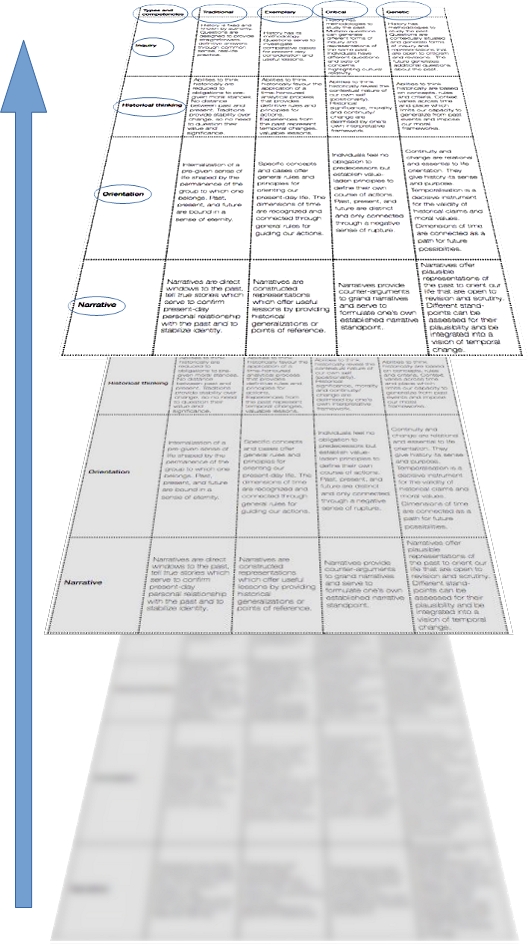
My own idea of development of competencies of historical thinking can rather be visualized as follows (adopting Lévesque’s table):
A „basic“ niveau (and possibly early stage) would be defined by the inability of distinguishing different modes of historical narrating in general and referring to monuments in this specific case. (Young) people on this niveau (at this stage) will relate to them. They will ask questions (and thus exercise their „inquiry competence“), think („historical thinking competence“), orientate themselves („orientation competence“), and narrate („narrative competence“). But this basic niveau will not be defined by being „traditional“, but by an uninformed mixing (possibly only half-understood) forms of all three patterns. This performance will be both instable and inconsistent. Half-baked traditional questions will stand next to unreflected exemplary statements, and so on. In the graph above, this is symbolized by the blurred table below.
The ability to apply the different patterns in a somewhat clarified way, to distinguish them and select one, to identify inconsistencies in their mixing, etc., then marks the intermediary niveau, and possible a major stage in the development of these competencies. On this niveau, at this stage, people will be able to discuss about the message a monument expresses and the meaning it has for us today, but they might disagree and even quarrel because they apply different patterns of meaning-making. In a way, Lévesque’s table describes this intermediate niveau, the different forms of historical inquiring, thinking, orientating, and narrating can take, depending from the general pattern of sensemaking. The table (the middle one in the graph above) clearly points at something, I have also tried to express in my German article challenging Rüsen’s own idea of the different patterns forming different nivueaus of competencies4: Each of the different operations (inquiring, narrating, orientating) will take on a specific stance of narrating. It is a difference whether I ask for a tradition or for a rule to be derived from past examples, or about a patterns of change across time. These questions are informed by more general stances and understandings of history (maybe coded in Lévesque’s central cogwheel of „historical consciousness“) and will generate different forms of orientation and narrating. This does not mean that the initial stance determines the outcome of the story, rendering historical thinking a matter of self-affirmation – not at all. A person inquiring in traditional will look for an origin for something valid and might — via historical thinking and research — learn of a quite different origin. The mode of meaning-making will still be traditional, but the concrete history will have changed. But people might also be forced to change their pattern in the process, e.g. learning of the limits of exemplary thinking when gaining insight into fundamental change, and thus „progress“ in a way from exemplary to genetic sensemaking.
The highest niveau, however, will be reached not by finally arriving at the genetic forms of thinking and the respective competencies, but by complementing the ability to recognize, distinguish and apply the different forma with a transgressing ability to reflect on the nature, value and limits of this (and other) typologies themselves. Only on this niveau (at this stage) are people fully at command of their historical reflection. They can address the limits societally accepted concepts and terminology pose and suggest new or amended ones, etc. In the graph above, this is symbolized by the additional focus to the rubrics of Lévesque’s table, marked by the blue rings.
Post Views:523
Lévesque, Stéphane: Removing the “Past”: Debates Over Official Sites of Memory. In: Public History Weekly 6 (2018) 29, DOI: dx.doi.org/10.1515/phw-2018-12570. There also is a German and a French version. [↩]
The table can be found under the same address as the original contribution, down the page [↩]
Rüsen’s „critical“ type of narrating does not really fit into the typology, presenting not a new logic of interconnecting temporal information, but merely de-elgitimizing others. In 1988 already, Bodo von Borries commented on this and presented a graphical concept of the interrelation of the different types, in which a „critical“ type was placed between both the traditional and the exemplary and the latter and the genetic, thus assigning it the function of a catalyst of development (Borries, Bodo von (1988): Geschichtslernen und Geschichtsbewusstsein. Empirische Erkundungen zu Erwerb und Gebrauch von Historie. 1. Aufl. Stuttgart: Klett, p. 61; cf. Körber, Andreas (2015): Historical consciousness, historical competencies – and beyond? Some conceptual development within German history didactics. Online verfügbar unter http://www.pedocs.de/volltexte/2015/10811/pdf/Koerber_2015_Development_German_History_Didactics.pdf, p. 14f.). In the new version of his „Historik“, Rüsen presents a similar version. Cf. Rüsen, Jörn (2013): Historik. Theorie der Geschichtswissenschaft. Köln: Böhlau, p. 260. English: Rüsen, Jörn (2017): Evidence and Meaning. A Theory of Historical Studies. Unter Mitarbeit von Diane Kerns und Katie Digan. New York, NY: Berghahn Books Incorporated (Making Sense of History Ser, v.28), p. 198. [↩]
Körber, Andreas (2016): Sinnbildungstypen als Graduierungen? Versuch einer Klärung am Beispiel der Historischen Fragekompetenz. In: Katja Lehmann, Michael Werner und Stefanie Zabold (Hg.): Historisches Denken jetzt und in Zukunft. Wege zu einem theoretisch fundierten und evidenzbasierten Umgang mit Geschichte. Festschrift für Waltraud Schreiber zum 60. Geburtstag. Berlin, Münster: Lit Verlag (Geschichtsdidaktik in Vergangenheit und Gegenwart, 10), S. 27–41. [↩]
Paderborn: Fakultät für Kulturwissenschaften, Universität Paderborn
19.05.2017 – 20.05.2017
Hier eine Fassung in arabischer Sprache, die dankenswerterweise die Kolleg*innen in Paderborn haben durch ein Übersetzungsbüro anfertigen lassen:
الجانب الآخر للثنائيات والذكريات المتعارضة؟
ورشة عمل مع خبراء في التاريخ وثقافة الذاكرة في مجتمع بعد الهجرة من لاجئين وغير لاجئين
المكان: بادربورن
المنظم: جامعة بادربورن, كلية الآداب والعلوم الإنسانية
التاريخ: 19.05.2017ـ20.05.2017
الكاتب: أندرياس كوربر, كلية التربية, قسم تدريس التاريخ, جامعة هامبورغ
الهجرة ليست فقط فردية وإنما لمجتمع يواجه تحديات مثل الثقافة التاريخية بما في ذلك مؤسساته من علم التاريخ و تدريس التاريخ. هذا ينطبق بشكل خاص عندما لا يتم أخذ وجهة نظر المجتمع المضيف ـ بمعنى المجتمع الشامل بعد التقليدي و مجتمع بعد الهجرة ـ وهذا يتطلب إمكانيات التوجه المشتركة والمنفصلة للتاريخ. لا تتضاعف هذه فقط من ماض (المجتمعات الأصلية) ذات الصلة, وإنما أيضا من كل اهتمام تاريخي للقضايا والمفاهيم. في أوقات الهجرة الجماعية من الحروب ومناطق الحروب الأهلية يجب أن يؤخذ بعين الاعتبار أن هويات المهاجرين قد تكون هشة وبخطورة أو أنهم بحاجة إلى توجه تاريخي جديد. يمكن للمهاجرين أنفسهم من نفس المناطق أن يحضروا معهم احتياجات توجه وخبرات مختلفة. علم وفن تدريس التاريخ بحاجة إلى تجديد فرص وأساسات هذا الانعكاس.
لقد تم تمويل هذه القضايا المطروحة في المؤتمر من قبل مؤسسة “ الذكرى, المسؤولية, المستقبل“ وخصصت لصالح مشروع عمل نظرية وفن تعليم التاريخ من قبل (يوهانس مايرـ هامي و فيليكس هينز) والتاريخ المعاصر( سيباستيان بيسشوف) في جامعة بادربورن وجمعت مؤرخين ومدرسين للتاريخ مع توجهات احترافية مختلفة وقصص هروب (خاصة من سوريا والعراق) وشملت الكثيرين (من الطلاب وحتى مدير متحف) و أيضا زملاء غير لاجئين.
هذا ضروري ومبتكر كإنتاج لوجهات نظر متعددة لكنه تتطلّب أيضا الكثير من الجهد التنظيمي مثل الترجمة الفورية وحساسية التجمع ,المشاركين ,البرنامج والتنفيذ الفعلي. هذه التحديات تم التغلب عليها بسهولة متناهية من قبل المنظمين ومساعديهم المحترفين, فريق المترجمين والمشاركين.
وبعد التحية التي ألقاها فولكر بيكوس (عميد جامعة بادربورن) وسونيا بيجالك (مندوبة مؤسسة „ذكرى, مسؤولية, المستقبل„, برلين) و يوهانس مايرـ هامي (بادربورن) على أساس المبادئ الانعكاسية لتعلم التاريخ بين الثقافات و „ما بعد المهاجرين„, تم توضيح إمكانية التبادل المتماثل. جنبا إلى جنب فتح التواصل مناخا مفتوحا للمناقشة والتشاور والجدال.
جاء ثلاثة منظمين من القادة السابقين في هذا البلد (وأحيانا يكون مهاجر سابق)، في أعمال اللاجئين مدرسين للتاريخ من ذوي الخبرة فضلا عن كلمة لاجئين. [1]
أولا قدم إبراهيم ميرزايف ـ الذي يعمل مدرسا في دورات الاندماج و طالب دكتوراه في علم التاريخ (إيخستات)ـ تجربة مع التحديات والفرص للتفاوتات الكبيرة في مهارات اللغة وتعدد الحساسيات المتعلقة بالصدمة للكثير من اللاجئين باعتبارات التعلم التاريخي مع تقديم أساليب من الأحداث السمعية والكلامية.
ديمتري شترايفسكي من (برلين)، طالب دكتوراه في التاريخ, وباحث في العلوم السياسية يعمل في مجال تربية الهجرة, تحدث عن تحديات أحد مبادئ المقابلة والتعلم „على مستوى العين“ وأخذ على محمل الجد التعليم التاريخي. وبناء على خمسة جوانب رئيسية, بما في ذلك صفات ثقافية أو عرقية „نهج مجموعة محددة„, و „خطر التربية الخاصة„, كما شدد على إمكانية التعلم من خلال التحديات المشتركة, شريطة الاعتراف بقضايا وآفاق الشباب وتناولها, ولكن أيضا مناقشة بعبارات واضحة من القيم الإنسانية.
في مساهمة كل من جينيفر فاربر (فوغلسانغ) وجينز هيكر(سيني) تم التركيز على القضايا الشاملة وانتقاد نهج هدف المجموعات. واستنادا إلى نتائج مناقشات أحد مجموعات العمل على انتشار النصب التذكارية المبينة علة أنها افتتاح مفاهيم انعكاسية, تشاركية وتوسيع وجهات النظر „نقل التاريخ دون هويات“ (أستريد ميسرشميدت) حول مواضيع معاداة السامية ومجتمع الهجرة.
أوركيدي إسكيمند وميلاني كامب (برلين) قدما مشروع „اكتشاف التنوع„, الذي ينتج عن تحليل احتياجات الشباب من عمر 12-15 سنة لفرص تعليمية مع خبرة في معاداة السامية, يتم ربطها في تجارب الحياة الخاصة بهؤلاء الشباب ومنهجة تاريخهم وكذلك تمكّن من وضع ثقافة الذكرى.
وجهات النظر الأخرى كانت مما يمكن لاللاجئين أخذه على محمل الجد من دروس التاريخ والثقافة التاريخية في بلدانهم الأصلية. قدمت في أربع مساهمات مختلفة خلال ورشة العمل هذه وشملت التاريخ, مفاهيم التاريخ, مفاهيم الهوية.
حيث شدد يوسف كنجو (توبينعن) عالم الآثار الدولي الشهير والمدير السابق لمتحف حلب في سوريا على أهمية البحوث الآن. لكن في الوقت الحاضر وبشكل ملموسفإن المواقع الأثرية بخطر أو دمرت بالفعل في سوريا وهذا سيضيف مشاركات السوريين إلى التاريخ البشري. هذه النواة المحتملة غالبا لا يدرك السكان بناء التاريخ بشكل غير ثنائي, وهو ما يفسر وجود جزء كبير من المخاطر على هذا التراث. يتم توزيع كتاب عبر مشاريع مختلفة ومجانية في مخيمات اللاجئين في دول الجوار عن سوريا القديمة الذي ينبغي أن يؤثر في مكافحة الخطر على الهوية.
محمد عيسى (برلين)، لاجئ ومدرس تاريخ ،أكد في المقابل على أهمية الوحدة العربية والتوسع الإسلامي, ووضح أنه تم تدميرهما من قبل سيطرة واستغلال الاستعمار الأجنبي ومثالا على ذلك „اتفاقية سايكس بيكو“ (1916), حيث كانت السبب الرئيسي للتطرف الحالي واللاجئين.ووصف تدريس التاريخ في سوريا اليوم – على النقيض من الوضع قبل الثورة – اعتبارا من التدخل السياسي والنظام الافتراضي و التفسيرات الموالين للنظام, وبالتالي تميزت بالخوف,التي من المقرر أن تكون ناجمة عن القوى الاستعمارية التي تجدد الصراع.المنهجية المفتوحة وتعددية التفكير الذاتي ليست ممكنة. لذا يجب إعادة توجيه تدريس التاريخ وإزالة المعلومات „الوهمية„, وأعطاء الطلاب الحرية في تعلم القيم الإنسانية الشاملة. واعتماد المفاهيم الغربية في الحرية، و الحكم الناقد.
نظيره العراقي نور حمود (برلين) اتفق معه حول الكثير.تقليديا، ليس فقط في السنوات الأخيرة, كان يتم قبول المحتوى التدريسي لتدريس التاريخ, مع عدم الفهم أو حتى المناقشة, حتى مع الشكوك.وشدد على الدور الهام للمحتوى الديني وتخصيص التفسيرات ومثالا على ذلك تمجيد وصف („شونستر فرهود„) من المذبحة اليهودية عام 1941 في بغداد وفورا مشكلة الهويات الدينية المعرّفة[2]. خلاصة العمل, في فهم سمات تاريخه, تعرف عليها في دورة الاندماج في ألمانيا وكان غير معروف وغير مألوف للاجئ. ومن هنا تأتي أهمية دورات الاندماج في تسهيل التفاهم المتبادل والغفران للجميع. في العراق أيضا يجب أن يتطوّرتأثير تدريس التاريخ و يشجّع الأطفال على السؤال والفهم.
أوضحت في المقابل ناريمان دريباتي مفاهيم الهوية بانتقاد (هايدلبيرغ), وهي من سوريا ومدرسة التاريخ المهاجرة وطالبة الدكتوراه في مناهج تدريس التاريخ.عرضت النتائج الأولى لتحليلها لكتب التاريخ المدرسية السورية الحالية والتي نشرت قبل عام 2010. مركزيا ملزم ومقدم, عززت أعمال ومصالح الحزب الحاكم „حزب البعث“ والنخبة. وفقا لذلك – بسبب الأغلبية السنية، لبناء هوية دينية ـ وطنية لسوريا كجزء من العالم العربي الشامل.وأساسا تتكرر فقط في النصوص من وجهات نظر مؤلفين عرب. المصادر تستخدم ربما للتوضيح, ولكن ليس للتحليل.
مدرسة التاريخ اللاجئة رحاب اليوسف (إسبلكامب) لفتت الأنظار إلى تدريس التاريخ في ألمانيا. وقدمت موجزات بشأن أوضاع العديد من اللاجئين فيما بين „كرسيين“ من البلد الأم والبلد المضيف, وشددت على أهمية الاندماج.جوهريا „نكبر معا“ إلى مجتمع جديد هو الحصول على التعارف – وأيضا المعرفة الدينية – والاختلافات الثقافية والاعتراف المتبادل. حيث يوجد اختلافات واضحة بين اللاجئين وبين الألمان.الإشكالية تكون على حد سواء في المطالبات, إذ يجب على المهاجرين التخلي عن هويتهم,ولكن أيضا يستخدم هذا الرفض لترحيلهم كذريعة لعدم الاندماج.وأبرزت أيضا صعوبات الدراسة الملموسة للاجئين التي تنشأ في المقام الأول من اللغة والأشكال المختلفة جدا من التعلم والدراسة في ألمانيا
دروس التاريخ في سوريا وألمانيا تم عنونتها وشرحها مع اثنتين من الطلاب السورريين اللاجئين جنبا إلى جنب مع دومينيك يروخ (سيجن).وأكدوا على التباين الحالي التي تهيمن عليها أغلب القصص من الدولة, تدريس التاريخ „غير الحر“ قبل الحرب الأهلية ومع التعلم في ألمانيا „,فضلا عن مطالب التعارف المتبادل والاعتراف وموضوعية تاريخ الوطن. وشددوا بوجه خاص على الحاجة إلى معلومات أكثر موثوقية, لا سيما بشأن الصراع الفلسطيني الإسرائيلي بوصفه جوهر مشكلة الشرق الأوسط برمتها وعن الاشتراكية الوطنية.
بعد النقاشات, تم الحوار والسؤال حول مفهوم الهوية، فضلا عن التحديات التي تواجه المجتمع والمدرسة والمؤرخين. وقد كان مفهوما مختلفا للمفاهيم والطلبات على الهوية فضلا عن إدراجها في تدريس التاريخ: أفكار الهوية غير المنقطعة من الأصل والاستقبال والهوية, وبالتالي مطالب التعارف المتبادل, وكان تصور وقبول „الآخر“ في المؤرخين يعارضون الشك في جميع الهويات المحددة مسبقا, الأمر الذي شدد على تنوع تجارب المهاجرين ووجهات نظرهم, بحيث أعطيت دروس المدارس والتاريخ مهمّة دعم كل تشكيل فردي للهوية. وقد أعطي التعلم التاريخي ومواضيع محددة وظائف مختلفة, ، لذا (1) كخلفية لفهم النظام القانوني الألماني والديمقراطية فضلا عن (2) على النقيض من التفسيرات والتقييمات الإيديولوجية أو غير المنكوبة، مثل الاشتراكية الوطنية والمحرقة، والتي غالبا ما يتم جلبها من الأوطان. وتركزت سابقا على ألمانيا وأوروبا في دروس التاريخ الألماني ولذلك ينبغي فتح موضوعية تاريخ مناطق المنشأ.
وبالإضافة إلى ذلك، فإن المناقشة المثيرة للجدل كانت حول دور الإسلام التاريخي كنقطة مرجعية لهوية مشتركة, ومدى وطابع العداء اليهودي أو الإسرائيلي في الثقافات العربية, فضلا عن أهمية الاستعمار في ظهور حالات الصراع الحالية في المنطقة وكخلفية لتمثيل التاريخ المغلق في المدارس.
مع إلقاء نظرة على دروس التاريخ في المستقبل في البلد المضيف يتم تفضيل مفاهيم مختلفة: التنظيم في التاريخ اليومي في مكان السرد التاريخية الوطنية, (الإقليمية) مفاهيم الحرية الخاصة، فضلا عن مفاهيم الانحراف الغربية عن التاريخ. وأخيرا، دعيت أيضا إلى تحديد موضوعي للفروق المفاهيمية في المصادر والتمثيل، كتعلم تاريخ دولة ـ ودين بعيد, حتى يمكن إجراء مناقشة حرة مع تفسيرات مختلفة وإدخال مصادر مطبوعة أخرى في الكتب.
واستكمل البرنامج بمساهمة: ميشائيل شوبرت (بادربورن)حيث حاضر في مفهوم „التنوع الفائق“ الذي وضعه ستيفن فيرتوفيك في عام 2007 لتسجيل مفهوم „فائق التنوع“ على الأقل في ضعف تنوع المجتمع (في أبعاد التمايز وأشكال الإقامة) في مجتمعات الهجرة الغربية منذ الثمانينيات. ناقش الأداء والجوانب الإشكالية لتعريفه وتفعيله في „مؤشر التنوع“ وناقش أيضا المفارقة (باستثناء) آثار الاستخدام العام من مفاهيم التنوع, على سبيل المثال الصورة المتوقعة للتجانس في الماضي („الإحياء العرقي„). وسمحت المفاهيم البنائية فقط بمشاركة الجميع في التفاوض والتفكير في التنوع والحدود. يمكن أن تشمل ثقافات النصب التذكارية وتؤخذ في الحسبان, مثل استخدام التجارب التاريخية المشتركة والمحددة (الضحايا والجناة, تجربة الهجرة) باعتبارها آفاق للسؤال. وفي نهاية المناقشة, وردا على سؤال عن الكيفية التي يمكن بها لمفاهيم الهوية البنائية هذه أن تجسد المصالح المشروعة للمهاجرين في تنمية بلدانهم الأصلية, فضلا عن تجارب مختلفة.
وأخيرا، تحدث جوهانس هوفمان (هامبورغ) عن مقابلاته مع المهاجرين الشباب الذين هاجروا مؤخرا من سوريا, الذين ما زالوا يتابعون المدرسة، لتجاربهم مع التاريخ والمؤرخين. في حالتين محددتين, رسم مختلف التصورات وردود الفعل والهياكل الشخصية, والتي هي انعكاس حاسم لدروس التاريخ الخاصة, والتوجه الديني, والتمكين إلى التفكير النقدي الخاص, ودائما تأخذ على تركيبات مميزة مختلفة. كان من الممكن تصور معنى بناء الهوية التاريخية وراء التفسيرات المعطاة في المثال المكثف.
بياتريس زيجلر (آراو) أبرزت التحديات التي تواجه عملية تحويل المواضيع الرئيسية إلى مجتمعات غير متجانسة بسبب الهجرة وأهمية التعامل مع وجهات نظر مختلفة في كل حالة. وأوضح المؤتمر التناقض بين التفسيرات المشتركة والمعاني بين ثقافات المنشأ والاستقبال. ومن الضروري تعميق المناقشات. وعلى وجه الخصوص، ينبغي توضيح مفاهيم الهوية والعلاقة بين الهوية والتاريخ.
وتجدر الإشارة إلى أن الجو كان لطيف وجماعي, سمح لإظهار أوجه التشابه والاختلاف بين مجموعات المشاركين وكذلك داخل هذه المجموعات بحيث يمكن أن تستمد الأسئلة والموضوعات لمزيد من المحادثات والبحوث والتي لا تتطابق ببساطة مع الإحالات الثنائية. وفي الوقت نفسه، أصبح من الواضح أن مفاهيم الهوية المرنة المعقولة جدا لما بعد التقليد وما بعد المهاجر في مواقع متعددة مناسبة لتحليل مجال التجارب الموصوفة والمفاهيم المعرب عنها, ولكنها لا تتوافق إلا بشكل مشروط مع المشاركين الذين هاجروا أنفسهم. ولا سيما فيما يتعلق بالمفهوم المعياري للهوية, من الواضح أنه لا يزال هناك الكثير من الترجمة التي يتعين القيام بها ليس فقط من طابع لغوي.
نبذة عن المؤتمر:
فولكر بيكهاوس (جامعة بادربورن, عميد كلية الدراسات الثقافية): تحية
يوهانس ماير–هامي (جامعة بادربورن): الجانب الآخر للثنائيات والذكريات المتعارضة؟ طرق لثقافة الذاكرة الانعكاسية
الجلسة الأولى الاعتدال: فيليكس هينز, جامعة بادربورن
إبراهيم ميرزايف (طالب دكتوراه, الجامعة الكاثوليكية في إيشستات): جوجل والماركات التجارية: كيفية شرح التاريخ الألماني؟
ديميتري ستراتيفسكي (برلين): كيف يمكننا أن ننشر ثقافة الذكرى لأشخاص ذوي خلفية مهاجرة؟
رحاب اليوسف (إسبلكامب): التكامل / لم شمل الشعوب في بوتقة الثقافات والحضارات الجديدة
جينيفر فاربر (أكاديمية فوجيلسانغ) و يانس هيكر (مركز توثيق ستالاج, 326): انعكاس عمل النصب التذكارية في مجتمع غير متجانس: فتح أبواب مساحة العمل
محاضرة مساء
مايكل ششوبيرت (جامعة بادربورن): في الطريق الاختلاف „فائقة التنوع„؟ أهمية „الحدود“ وتنظيمها في مجتمع الهجرة
الجلسة الثانية, الاعتدال: د. سيباستيان بيشوف (جامعة بادربورن)
يوسف كنجو (جامعة توبنغن): دور التاريخ في الهوية والتراث
محمد عيسى (برلين): دروس التاريخ في سوريا
نور حمود (برلين): دروس التاريخ في العراق وماذا تعني دورة الاندماج للاجئين؟
الجلسة الثالثة, العرض: ماير هامي (جامعة بادربورن)
ناريمان دريباتي (طالبة دكتوراه, جامعة هايدلبرغ): الهوية العربية السورية؟! تحليل كتب التاريخ السورية الحديثة
أوركيد إزغيمن / ميلاني كامب (كيغا برلين): فرص وتحديات التعليم السياسي مع اللاجئين منهم وإليهم
ورش العمل:
دومينيك جيروش, رنا الزهر, علياء شعباني, رغد عامر (تلاميذ الصف العاشر): دروس التاريخ الألماني من منظور اللاجئين في (فورست–جوهان–موريتز–غيمناسيوم في سيجن)
يوهانس هوفمان (جامعة هامبورغ): الهجرة والوعي التاريخي. إعادة بناء وتحليل تاريخ المهاجرين فيما يتعلق بالتوجه والهوية
ملاحظات:
[1] ولم تكن الأفرقة موضوعية تماما، ولكن اختلطت وجهات النظر، التي كانت من بين أمور أخرى النقاش الحيوي في نهاية الفريق جاء بالفائدةض, مع ذلك, أحيت المواضيع على نطاق الفريق مرة أخرى. ويتمحور التقرير بطريقة مواضيعية
Körber, Andreas (01.09.2018): Historical Consciousness, Knowledge, and Competences of Historical Thinking. Towards an integrated Model of Historical Thinking and Curricular Consequences. History Education Research Network (HEIRNET) Conference; 31.08.-02.09.2018. HEIRNET. Corfu.
Körber, Andreas (01.09.2018): Historical Consciousness, Knowledge, and Competences of Historical Thinking. Towards an integrated Model of Historical Thinking and Curricular Consequences. History Education Research Network (HEIRNET) Conference; 31.08.-02.09.2018. HEIRNET. Corfu, 01.09.2018.
Weise, Mara (29.6.2018): „Zur Förderung von Zeitbewusstsein“. Vortrag auf dem FUER-Nachwuchs-Kolloquium 28. – 30. Juni 2018 an der Katholischen Universität Eichstätt-Ingolstadt
Weise, Mara (29.6.2018): „Zur Förderung von Zeitbewusstsein“. Vortrag auf dem FUER-Nachwuchs-Kolloquium 28. – 30. Juni 2018 an der Katholischen Universität Eichstätt-Ingolstadt
Stork, Annika (29.6.2018): „Perspektivensensibilität innerhalb des Geschichtsunterrichts“. Vortrag auf dem FUER-Nachwuchs-Kolloquium
28. – 30. Juni 2018 an der Katholischen Universität Eichstätt-Ingolstadt
Stork, Annika (29.6.2018): „Perspektivensensibilität innerhalb des Geschichtsunterrichts“. Vortrag auf dem FUER-Nachwuchs-Kolloquium
28. – 30. Juni 2018 an der Katholischen Universität Eichstätt-Ingolstadt