Monuments and Memorials – A tabular instrument for analysing (still incomplete)

Körber, Andreas (2020): Monuments and Memorials – A tabular instrument for analysing (Blog Entry; still incomplete)

Introduction:

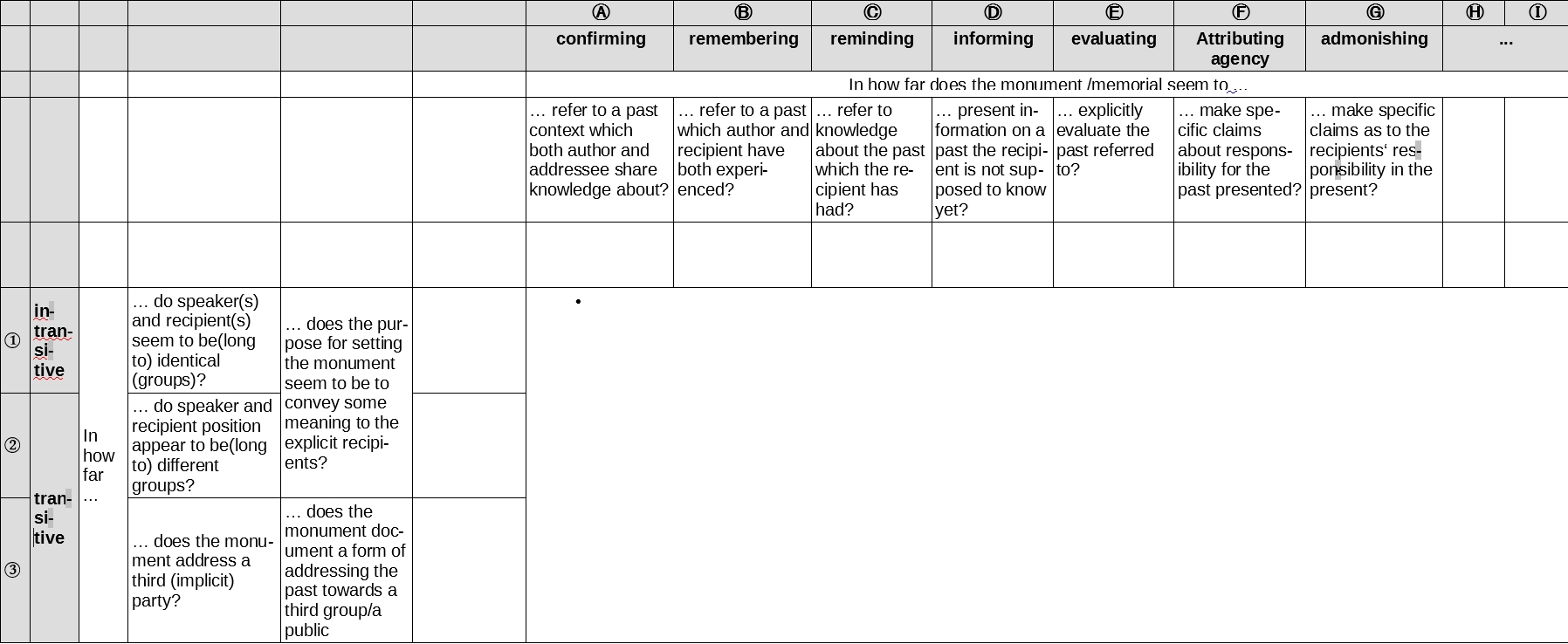
A table for analyzing narrative modes within monuments
Table for analyzing narrative functions in monuments.

Reference:
Körber, Andreas (2014): De-Constructing Memory Culture. In: Helle Bjerg, Andreas Körber, Claudia Lenz und Oliver von Wrochem (Hg.): Teaching historical memories in an intercultural perspective. Concepts and methods : experiences and results from the TeacMem project. 1. Aufl. Berlin: Metropol-Verlag (Reihe Neuengammer Kolloquien, Bd. 4), 145-151 + CD-File.

Reenactment: Nostalgische Sinnbildung per symbolisch-enaktiver „Wiedereinsetzung in den vorigen Stand“. Zur Logik und Typologie historischer Sinnbildung und ihrer (partiellen) Suspendierung im Reenactment.

Körber, Andreas (2020): Reenactment: Nostalgische Sinnbildung per symbolisch-enaktiver „Wiedereinsetzung in den vorigen Stand“. Zur Logik und Typologie historischer Sinnbildung und ihrer (partiellen) Suspendierung im Reenactment. In: Historisch denken lernen [Blog des AB Geschichtsdidaktik; Universität Hamburg], 17.08.2020. Online verfügbar unter https://historischdenkenlernen.blogs.uni-hamburg.de/reenactment-enaktive-wiedereinsetzung-in-den-vorigen-stand-zur-logik-historischer-sinnbildung-und-ihrer-partiellen-ausserkraftsetzung-im-reenactment/.

Einleitung

Über Reenactments als Geschichtssorte1 werden in letzter Zeit viele analytische Untersuchungen publiziert. Dazu gehört auch das (sehr empfehlenswerte) neue Buch von Ulrike Jureit, in welchem sie anhand unterschiedlicher Reenactments jeweils einen systematischen Aspekt der performativen Vergegenwärtigung von Vergangenheit erörtert.2 An einer Formulierung daraus möchte ich kurz einen Aspekt zum Charakter historischer Sinnbildung in Reenactments aufzeigen.

Narrative Begriffe

In Jureits Kapitel über Reenactments des Amerikanischen Bürgerkriegs heißt es:

„In der geschichtskulturellen Debatte über Ursachen und Ziele des Amerikanischen Bürgerkriegs verengt sich die Kontroverse gegenwärtig darauf, welche Rolle die Sklaverei und ihre Abschaffung beziehungsweise ihre von der Konföderation angestrebte Beibehaltung für den War between the States spielte. Die internationale Forschung hat dazu bereits zahlreiche Studien vorgelegt, die den Civil War in erster Linie als einen für das 19. Jahrhundert typichen Staats- und Nationsbildungskrieg kennzeichnen.“3

An der hier zitierten Charakterisierung des Krieges lässt sich gut eine Spezifik historischer Sinnbildung aufzeigen: Begriffe dieser Art, welche Ereignisse bzw. Ereigniskomplexe einer bestimmten Ausprägung einer Typologie zuordnen, sind alles andere als rein typologisch. Sie sind selbst narrativ, insofern sie in der Dichte eines einzelnen Terminus einen Verlauf verdichten, der über das Ereignis hinausreicht. Solche Begriffszuweisungen sind nur retrospektiv möglich, in hindsight. Zum einen lässt sich erst in diesem Rückblick das Ereignis „Amerikanischer Bürgerkrieg“ überhaupt gänzlich fassen.

Selbst wenn bereits zeitgenössisch eine Bezeichnung als ein Bürgerkrieg benutzt worden sein sollte, musste sie in der konkreten Abgrenzung wenig sicher und unklar bleiben. Zeitgenössisch sind denn — wie Jureit auch vermerkt —4 ganz andere Bezeichnungen verwendet worden, so „War between the States“ aus konföderierter Perspektive (die Sezession voraussetzend und die Normalität und Legitimität des Konflikts als zwischenstaatlich betonend) bzw. „Rebellion“ — nicht nur die Unrechtmäßigkeit, sondern auch die Innerstaatlichkeit, d.h. die eigentlich weiterbestehende Zusammengehörigkeit hervorkehrend.

Jeder dieser Begriffe erzählt somit eine andere Geschichte. „War between the States“ setzt zunächst eine tatsächliche Abspaltung an den Beginn, „Rebellion“ leugnet ihre Tatsächlichkeit. Aber der wissenschaftliche Begriff des „(typischen) Staats- und Nationsbildungskriegs“ rekurriert neben der abschließenden Abgrenzung des Ereigniskomplexes noch auf mindestens zwei weitere Elemente: Zum einen eine Regelhaftigkeit solcher Prozesse, wenn nicht über alle Zeiten, so doch innerhalb einer Zeitspanne (hier 19. Jh.), zum anderen aber auf die Kenntnis der Wirkung und des Nachlebens des Abgeschlossenen Konflikts. „Nationsbildungskrieg“ kann nur sein, was der Nationsbildung geholfen hat. Dem tun auch bereits im Krieg erkennbare Bestrebungen keinen Abbruch, genau eine solche Nationsbildung explizit anzustreben — wie etwa schon in Lincolns Gettysburg Address vom 19. November 1863 erkennbar.5

Im vollen Sinne aber setzt die Qualifikation des Krieges als „Staats- und Nationswerkungskrieg“ nicht nur die erkennbare Absicht, sondern die entsprechende Wirkung voraus. Für die Zeitgenoss:innen der Auseinandersetzung — sei es als Politiker, Soldaten, Angehörige — aber kann der Konflikt diese Qualität nicht gehabt haben. Für sie war es ein Konflikt nicht nur mit offenem Ausgang, sondern auch mit erhofften und befürchteten, nicht aber mit garantierten oder eingetretenen Wirkungen.

Bei den Reenactments von Schlachten dieses Bürgerkriegs nun mischen — nein: kombinieren und durchdringen — sich nun die unterschiedlichen Perspektiven und ihre Narrative — und sie tun es gewissermaßen „schief“: Auf kleinem Maßstab — also mit hohem Abstraktionsgrad — überwiegen Betonungen von Gemeinsamkeit und Versöhnung. Sie implizieren zudem die Anerkennung des tatsächlichen Ergebnisses, weshalb sie auf größerem Maßstab (also bei Betrachtung einzelner Gebiete, Schicksale, in einzelnen kleineren Erinnerungsformen) aus Unionsperspektive auch überwiegen dürfte, wogegen auf dieser selben Ebene Narrative des „Lost Cause“, der Verursachung des Krieges durch die Negation der „States‘ Rights“ etc. eher bei Anhängern konföderierter Sichtweisen vertreten sein dürften.

Reenactments: Spannung zwischen narrativer Retrospektive und ihrer Suspendierung

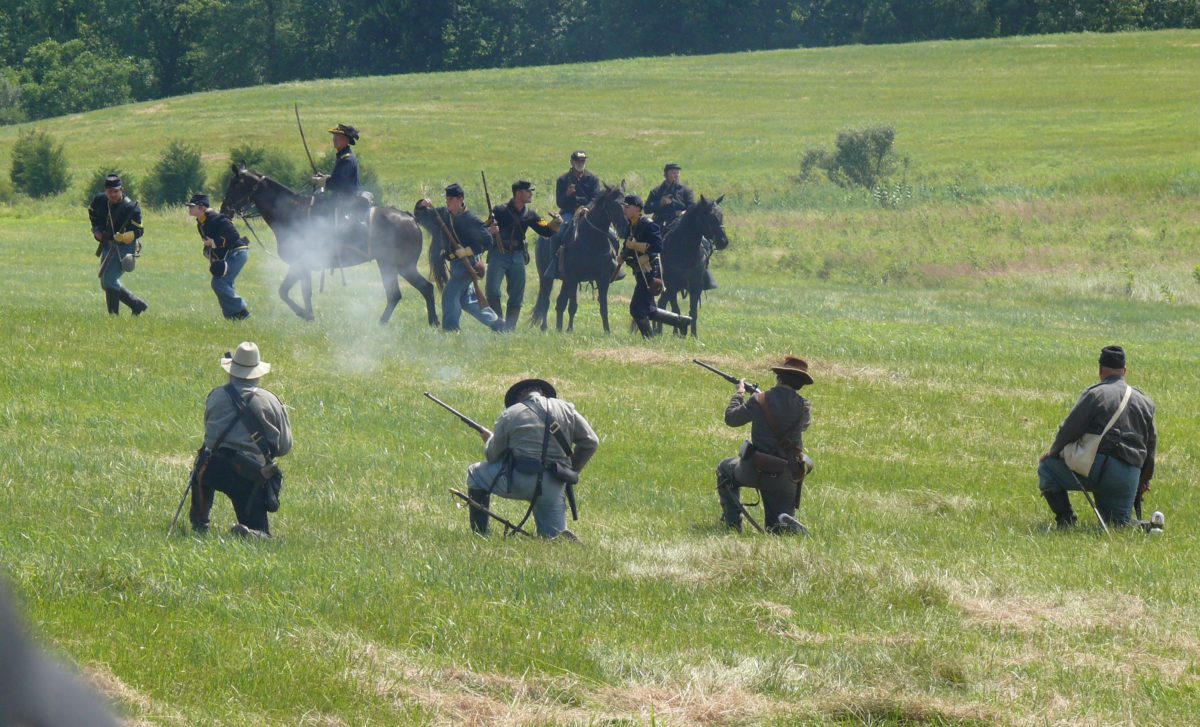
Gleiches findet sich im Reenactment. Es gibt Beispiele dafür, dass Darsteller*innen ihre zu spielenden Truppen nicht nach ihrer eigenen Interpretation des Krieges auswählen, sondern aus deutlich pragmatischeren Gründen — etwa Wohnortnähe. Das stützt die Interpretation, dass es um das Erinnern an die von Nord- und Südstaaten(soldaten und -bewohner:innen) gemeinsam durchlittene Prüfung geht. Es kommt der Interpretation des „Second Birth“ und der retrospektiv attestierten Nationsbildungswirkung am nächsten.

Gleichzeitig aber hat Reenactment auch eine zumindest partielle Facette der Aufhebung des retrospektiven Wissens und somit der aus hindsight erstellten oder bestätigten Charakterisierung des Krieges. Im Erleben des wiedervergegenwärtigten Kampfes — insbesondere bei den Tacticals, welche nicht einen realen Ablauf abbilden, sondern quasi ergebnisoffen ‚ausgefochten‘ werden, findet sich so etwas wie eine symbolische und psychische „Wiedereinsetzung in den vorigen Stand“ (um eine juristische Formulierung zu entlehnen).

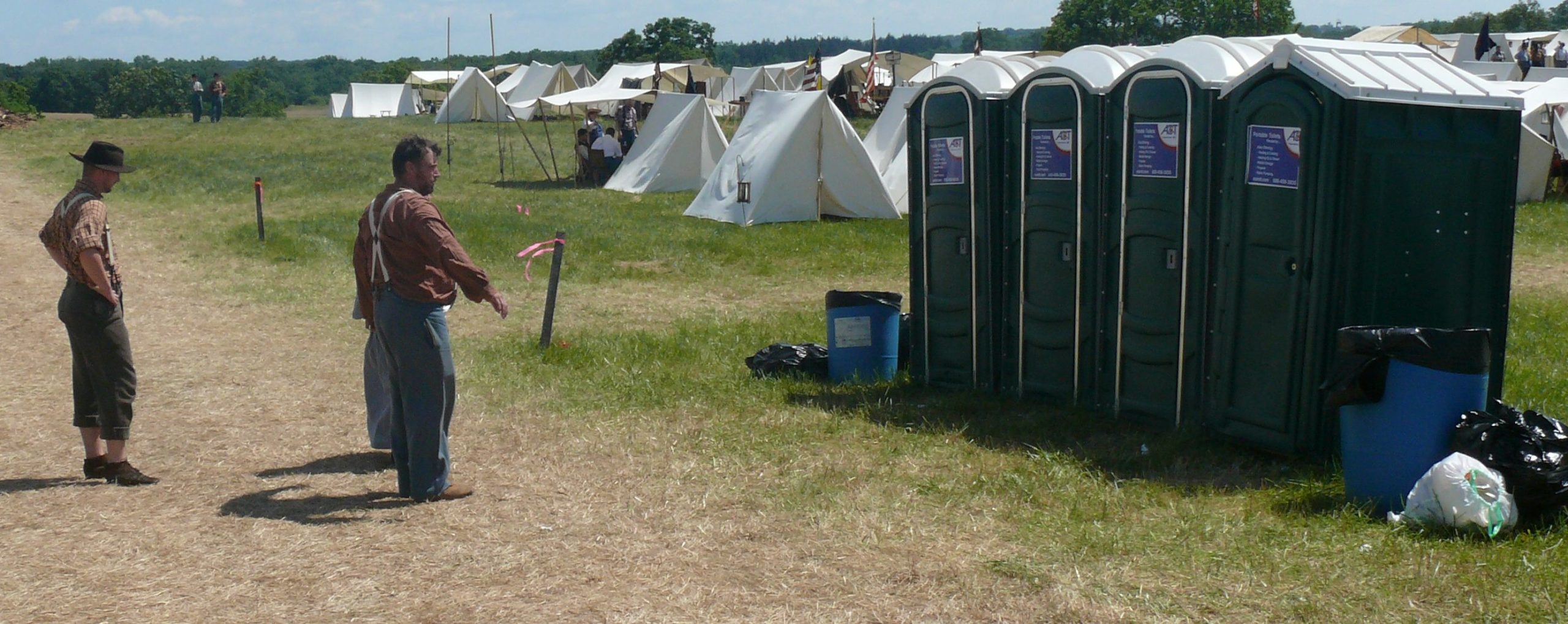
Einige in Uniformen des US-Bürgerkriegs gekleidete Männer stehen im Zeltlager vor einer Reihe Dixi-Toiletten. Gettysburg 7/2017. (c)A.Körber
„Nacherleben, wie es wirklich war (?). Einige in Uniformen des US-Bürgerkriegs gekleidete Männer stehen im Zeltlager vor einer Reihe Dixi-Toiletten. Gettysburg 7/2017. (c) A. Körber“

In diesem Sinne ist in Reenactment zumindest partiell als eine symbolische Suspendierung der Retrospektive und retrospektiver Sinnbildung zugunsten einer suggestiv-immersiven Wiederinkraftsetzung der Offenheit zu erkennen. Dies erzeugt natürlich eine unauflösbare Spannung, denn aus der Retrospektive können Aktive natürlich nicht wirklich austreten. Zudem kann keineswegs vorausgesetzt werden, dass die imaginierten Vergangenheiten zwischen den einzelnen Aktiven wirklich kompatibel wären. Das eine gemeinsame Agieren hat dabei eine besondere Bedeutung der Authentifizierung.

Der Gleichzeitigkeit unterschiedlicher individueller sowie (teil-)gesellschaftlicher und politischer Bedürfnisse und Motive entprechend dürften bei Reenactment-Ereignissen ganz unterschiedliche Kombinationen narrativer Formen historischer Sinnbildung nebeneinander und ineinander verschränkt im Spiel sein — und zwar sowohl zwischen Beteiligten (Organisator:innen, Akteur:innen, Zuschauer:innen und Außenstehenden) als auch im Denken und Handeln (aller?) einzelner. Letzteres deutet keineswegs auf eine Art historiographischer bzw. historisch denkender Inkonsequenz oder ‚Schizophrenie‘ hin, sondern ist durchaus ein Merkmal allen historischen Denkens.

Konsequenzen für die Sinnbildungstypologie?

Historische Darstellungen und Aussagen, folgen selten einem einzigen Sinnbildungsmuster, sondern kombinieren zumeist mehrere, wie schon bei der Entwicklung der Typologie Jörn Rüsen festgestellt hat.6 Es kommt daher sowohl für eine Charakterisierung und Interpretation weniger auf eine „Reinheit“ der Erzähl- und Sinnbildungsmuster an als auf die narrative Triftigkeit gerade auch der Kombinationen. Diese können etwa sequentiell miteinander verknüpft werden.7

Ebenso ist aber auch eine Parallelisierung denkbar. Gerade in den eher nach innen gerichteten Facetten der nacherlebenden Qualität von Reenactments ist zuweilen eine solche Verschränkung zweier Sinnbildungsmuster zu einer charakteristischen Kombination zu erkennen. Zusammengefasst kann man sie auch als „nostalgische Sinnbildung“ bezeichnen: Dem ‚immersiven‘ Nacherleben einer vergangenen Situation oder Lebensweise wird die Qualität eines Ausstiegs aus einer als belastend empfundenen Gegenwart zugeschrieben. Die Vergangenheit wird dieser Gegenwart positiv gegenübergestellt. So verbindet sich im Wunsch der Fortgeltung damaliger Lebensverhältnisse eine ins normativ-optativ verschobene traditionale Sinnbildung mit einer desktiptiv-genetischen in der Anerkennung ihrer seitherigen (negativen) Veränderung.

Ob hinsichtlich der ersteren von einer ‚Verschiebung‘ der Sinnbildung gesprochen werden sollte, muss weiter diskutiert werden. Man kann auch  grundsätzlich postulieren, dass alle Sinnbildungen nicht nur in positiv-affirmativer Form und zwei kritischen Varianten vorkommen 8, sondern auch jeweils in deskriptivem und normativem bzw. optativem Modus. Eine solche Erweiterung des Sinnbildungsmodells passt insofern zur theoretischen Begründung historischen Denkens als Orientierungsleistung, als der deskriptive Modus zur Domäne der ‚Naturzeit‘ und der normative/optative/hypothetische Modus hingegen zu derjenigen der ‚Humanzeit‘ gehört.9

Historisches Denken und Erzählen charakterisiert sich dann keineswegs allein durch die Kombination und Verschränkung von Erzählmustern unterschiedlichen Typs im rein deskrptivem Modus, nicht nur als eine Sinnbildung über manifeste und geahnte Zeiterfahrung, sondern insbesondere aus als ein Modus der sinnbildenden Verbindung zeitbezogenen Erkennens und Verarbeitens mit entsprechendem Wünschen, Phantasieren etc. Dies scheint sich gerade an solchen Geschichtssorten (also geschichtskultureller Verarbeitungsformen) zu zeigen, die ein hypothetisches Agieren in einer symbolisch ‚wiedereingesetzten‘ Vergangenheit ermöglicht.

Enaktivität als handelnde Suspendierung der narrativen Retrospektive

Das allerdings legt es nahe, die nicht nur kognitive, sondern körperlich-räumliche Facette dieser Geschichtssorten eher als ‚enaktiv‘ denn als ‚performativ‘ zu bezeichnen. Das ist durchaus konsistent mit Matthias Meilers linguistischer Herleitung des Wortpartikels „enact“ im Begriff „Reenactment“ aus der angelsächsischen Verwaltungssprache.10 Demnach geht die Bezeichnung „to enact“ auf die Bezeichnung für einen Rechtsakt zurück, in dem ein Beschluss, ein Gesetz o.ä. „in Kraft gesetzt“ wurde. „Re-enact-ing“ ist demnach das Wiederinkraftsetzen der Offenheit der Situation — und im Fall von Schlachten-Reenactments vielleicht auch mit der Hoffnung auf die Möglichkeit einer (ebenso symbolischen) Neuschaffung von Tatsachen.11.

Damit wäre zudem der Tatsache Rechnung getragen, dass sich diese Qualität ja gar nicht so sehr auf eine nach außen — auf ein wie auch immer geartetes oder vorgestelltes Publikum — richtet, sondern als wesentliche Facette der Qualifizierung der Situation und ihres Sinns auf die Agierenden selbst. Komplementär zur oben zitierten linguistischen Herleitung aus der englischen Verwaltungssprache wäre damit die Bedeutung des Agierens für die Konstruktion historischen Sinns angesprochen, wie etwa im Konzept des „Enaktivismus“ der konstruktivistischen Kognitionswissenschaft (etwa nach Francisco Varela) die spielerische „Koinszenierung von Wahrnehmenden und Wahrgenommenem“ begriffen wird, die gerade nicht eine reine autopoietische Erzeugung einer Vorstellung ohne jeglichen Bezug auf eine Wirklichkeit meint, sondern den kreative Entwurf derselben als Bild.12

Das ist durchaus kompatibel mit historischem Denken als Re-Konstruktion einer zwar als gegeben vorausgesetzten, nie aber beobachterunabhängig erkennbaren Vergangenheit. Insofern ist Re-Enactment eine Form re-konstruktiven historischen Denkens. Das unterscheidet sie etwa von äußerlich und hinsichtlich einiger Organisationsformen vergleichbaren Events und Subkulturen wie LARP und auch Science-Fiction-LARP13, aber auch von „literarischem Reenactment“.14 Beiden kommt nur indirekt auch historische Qualität zu, insofern in ihnen a) an fiktionalen Beispielen auch außerhalb der Fiktion gültige Lebensverhältnisse und Denkweisen präsentiert werden (bei Inszenierungen von Romanszenen geht es dann nicht um die konkreten Figuren und ihre Geschichten, wohl aber stehen sie für bestimmte Zeittypiken) und b) mit ihnen Welt- und Gesellschaftsbilder (inklusive Zukunftsvorstellungen) vergangener Autor:innen wiederbelebt werden. Wer „Star Trek“ spielt, spielt ja nicht einfach Zukunft, sondern ggf. die Zukunftsvorstellungen der 1960er Jahre (allerdings ggf. mit den Aktualisierungen gem. der ja fortgesetzten Reihe).

  1. Vgl. Logge, Thorsten: “History Types” and Public History. In: Public History Weekly 2018 (2018). []
  2. Jureit, Ulrike: Magie des Authentischen. Das Nachleben von Krieg und Gewalt im Reenactment. Göttingen 2020 (Wert der Vergangenheit). []
  3. Jureit 2020, S. 57, mit Verweisen auf McPherson, Sautter und Keegan. []
  4. Jureit 2020, S. 58, FN 57. []
  5. Auch dies reflektiert Jureit in einiger Ausführlichkeit wegen der dort erkennbaren Stiftung eines versöhnenden Sinns des Krieges als gemeinsam erlittene Herausforderung;  Jureit 2020, S. 53 u. 61ff). []
  6. Rüsen, Jörn: Lebendige Geschichte. Grundzüge einer Historik III: Formen und Funktionen des historischen Wissens. Göttingen 1989 (Kleine Vandenhoeck-Reihe 1489), S. 42, 57. []
  7. Ein Beispiel: Erzählungen eines gesellschaftlichen Fortschritts in technischer, wirtschaftlicher oder gesellschaftlicher Hinsicht sind oftmals keineswegs allein dem Typ genetischer Sinnbildung zuzuordnen. Sie kombinieren diesen vielmehr mit traditionaler Sinnbildung insofern, als der gerichteten Entwicklung ein Ursprung zugeschrieben wird, — etwa in den Entdeckungen der Renaissance und der Überwindung eines rein religiösen Weltbildes im Humanismus oder einer Erfindung als eher punktuelle Ursprünge für eine nachfolgende gerichtete Entwicklung. []
  8. Vgl. Körber, Andreas: Historische Sinnbildungstypen. Weitere Differenzierung. http://​www.pedocs.de​/​volltexte/​2013/​7264/​., nämlich einer auf Ersetzung der konkreten Erzählung durch eine gleichen Typs zielende ‚innere‘ Kritik und eine, welche die narrative Logik der Sinnbildung selbst kritisiert. []
  9. Vgl. Rüsen, Jörn: Historische Vernunft. Grundzüge einer Historik I: Die Grundlagen der Geschichtswissenschaft. Göttingen 1983 (Kleine Vandenhoeck-Reihe 1489), S. 51. []
  10. Meiler, Matthias: Über das -en- in Reenactment. In: Reenactments. Medienpraktiken zwischen Wiederholung und kreativer Aneignung. Hrsg. von Anja Dreschke, Ilham Huynh, Raphaela Knipp u. David Sittler. Bielefeld 2016 (Locating media 8). S. 25–42. []
  11. Dass zuweilen solche Reenactments auch mit dem Begriff des „Rematches“ verbunden und angekündigt werden, deutet darauf hin. Vgl. z.B. zur Schlacht von Hastings: Ungoed-Thomas, Jon (15.10.2006): „1066, the rematch: Harold loses again.“ In: The Times (15.10.2006). []
  12. Vgl. Weber, Andreas: Die wiedergefundene Welt. In: Schlüsselwerke des Konstruktivismus. Hrsg. von Bernhard Pörksen. Wiesbaden 2011. S. 300–318, S. 206. []
  13. Vgl. z.B. Engelhardt, Michael: To boldly go … – Star Trek-LARP in unendlichen Weiten. In: TeilzeitHelden. Magazin für gespielte und erlebte Phantastik (27.11.2015). []
  14. vgl. Knipp, Raphaela: Nacherlebte Fiktion. Literarische Ortsbegehungen als Reenactments textueller Verfahren. In: Reenactments. Medienpraktiken zwischen Wiederholung und kreativer Aneignung. Hrsg. von Anja Dreschke, Ilham Huynh, Raphaela Knipp u. David Sittler. Bielefeld 2016 (Locating media 8). S. 213–236. []

Commemoration and Types or Patterns of Historical Meaning-Making (Narrating)

Körber, Andreas (2020): Commemoration and Types or Patterns of Historical Meaning-Making (Narrating) (Blogbeitrag)

(This is a text from last year’s discussion with Stéphane Lévesque and Gabriel Reich on narrative patterns‘ role in reflecting on monument and memorial policy. I never got round to finishing ist. Sorry for the delay.)

In their texts and in the earlier discussion (first on Public History Weekly: Lévesque, Stéphane (2018): Removing the Past?, then on Active History CA: A new approach to debates over Macdonald and other monuments in Canada, Part 1 and Part 2), Lévesque suggested a model of different levels of historical competencies following Jörn Rüsen’s typology of narrative patterns.

While I agree that there is a lot of plausibility in a sequential development of these types of narrating throughout (Western) history, and that the genetic type is the most complex and advanced one, I don’t find much plausibility in the idea that in the development of student‘ thinking within their lifetime, the traditional type should have any priority to the other ones. Instead, I think that students encounter full-fledged narratives as well as simple statements of all types simultaneously from the beginning, and will acquire them alongside each other — but only gradually learn to recognize them for what they are, grasping their logic.

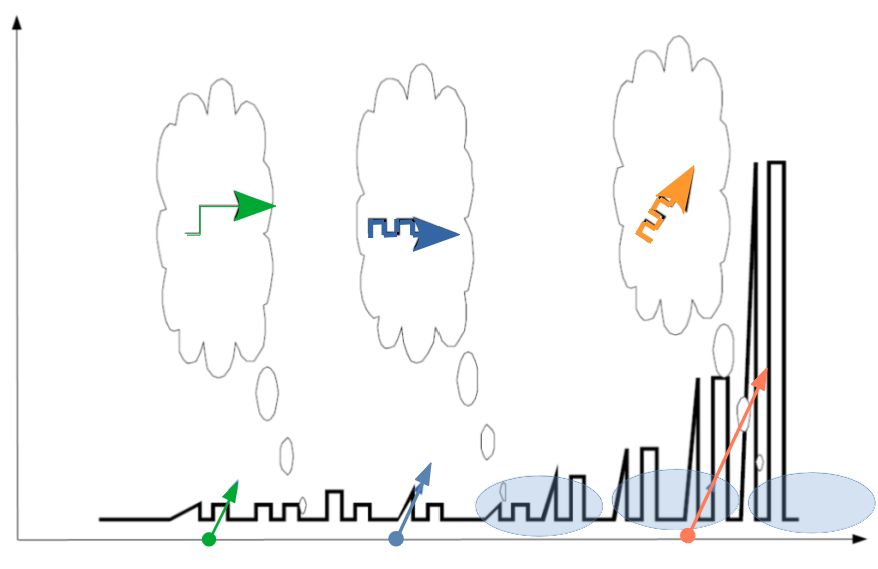
Consider the following graph:

(c) Andreas Körber 2018

It is to visualize the idea that increasing recognition of change in historic time (the x-axis) first leads to the development of the traditional type (asking for the origin of the currently valid, in cloud 1), then the experience that what has originated can also perish again and therefore asking for origins is not enough, lead to the development of the exemplaric type, asking for patterns and rules behind the change on the surface (cloud 2), and only modern experience of increased/accelerated change then led to the development of the genetic type, asking for the direction.

Each of these patterns leads to different expectations for the future. Initially (green perspective), the future may seem quite similar from the present. What is perceived as having begun, stays valid. Only from the (later) blue perspective, a pattern seems discernible, leading to the expectations that the future will also yield similar patterns of events as are detected in the past. From the (still later) orange perspective, an (additional?) increase in their „magniture“ can be perceived and its continuation be expected.
The graph also is to show that the rules and patterns as well as ideas of origins have not been rendered obsolete by each new type, but are superimposed or integrated into it.

I use this graph in my lecture. I now have added the small arrows. They are to indicate the learning-necessities of a person within a relatively short time-span of life or even youth. While in pre-modern times, they only encountered the then-developed patterns (if the model is valid), in modernity, they will have to use all patterns simultaneously, in order not make sense differentially.

The idea of a homology is problematic in another way, also. It might suggest that people in antiquity (or pre-modern-times) were developed rather like children or youths, not really grown-ups. This idea is not new, but is very problematic. As you might be aware of, Rudolf Steiner, founder of anthroposophy, suggested that the „ancient“ Greek had a mental age of about 7-years-olds. And there was a very influential German „didact“ of history in the 19th century (Friedrich Kohlrausch), who combined a similar idea of the homological development in the way people conceived „god“ with that of becoming of age. So only the modern man was really „grown up“ (and is was the Germans who did so — very nationalist).

Because of Rüsen’s idea of a „homology“ in the sequence of development of narrating types between mankind (phylogenesis) and individuals (ontogenesis), Bodo von Borries (and I as assistant to him) did a large-scale research in the early 1990s, were we presented students with items of different typological logic to dilemma-situations, like Rüsen himself has used for qualitative research and for explaining the narrative types. We did find a predominance of agreement to „traditional“ items with 6th-graders (abt. 11 yrs), but found no linear development. In fact, 9th-graders seemed even to regress. All this is published in German only, I fear.

I would strongly suggest to distinguish between the historical development and hierarchy of these patterns on the one hand and progression in learning on the other hand, for which I suggest the third dimension.

As for Lévesque’s revised table of competencies in a further comment in PHW and his evaluation that Gabriel Reich is correct in that the genetic type provides no solution to the question of whether to keep or get rid of monuments: Do these types really lead to specific political positions — especially if they are always combined? Or do they rather characterize part of their underlying understanding? I think there are different positions and solutions possible by each narrative. The value of the differentiation of types of meaning making and narration is rather analytical than prescriptive.

And that is also the pedagogical value: I think these typologies (your table and mine) can be used for classifying and discussing statements of people in the political debate. It will enhance students ability to recognize the logics behind specific political stances. And it may well show that both suggestions of keeping and of getting rid of can be underpinned by different types of narrative, but that would generate maybe different policies:

Take an example from Gabriel Reich’s patch, again: civil war monuments in Richmond.

One could argue for keeping the statutes on Monument Avenue on grounds of purely traditional thinking: to mark the origins of the specific state of things. This is both possible in partisan ways (only „our“ heroes), but also in a more „inclusive“ form, asking for such monument of both sides to be presented, to mark the origin of the countries „division“. Equally in traditional mode (but with different political background), one might call for their removal. If you hold that the division they mark is no longer given, they might be removed.

In exemplaric mode (as I opined earlier), one could speak out for the preservation of the monuments on the grounds that they exemplify a certain time and culture which we can still consider as „overcome“, but one can also argue for their removal because they represented outdated or politically non-supportable relations to the past, and that our time needs to find new ones, not „progressed“ ones, but such which reflect the „characteristics of our time“.

I do agree that to hold a specifically genetic view makes it hard to envision the whole question as one of keeping vs. removing, — but it doesn’t exclude it to the full extent.

If people are thinking predominantly in genetic mode, experiencing the country to having overcome that division, they object to a traditional logic they perceived the monuments to have. In this case, it would be the tension between one’s own genetic mode of thinking and that perceived in the monuments, which would generate a political position.

If the genetic perspective was upon how to improve commemoration, one might ask for making such commemorations „more inclusive“. This may have been behind erecting a monument for Arthur Ashe among the confederate generals – not a very consistent move, though, given that is merely additively combines monuments. In fact, it creates a „memorial landscape“ of a rather complex narrative structure, part of which is traditional („heroes“) and exemplary („each group“), but by doing so enforces a new kind of traditionality (keeping the racial groups apart, assigning each „their own“ tradition to hold up). So the intended „progress“ by inclusivity („An avenue for all people“) may in fact have created a multi-traditional narrative.1

But there are other possible solutions suggested by genetic thinking.  The concept of past people being „children of their own time“ is as genetic as it can get, referring to a fundamental change in time, so that morals and actions might be considered incommensurable across times. This concept has been used for exonerating past peoples views and actions. On this ground, one might call it „useless“. But it isn’t. Genetic historical thinking entails both — to recognize the temporal change and moral and political contexts for past actions different from ours, AND to recognize that our own context is valid, too.

From this point of view, it may underpin a present position transgressing the „keep/remove“-divide, namely to find ways of memorializing civil war „heroes“ (and/or „villains“ that is) that do NOT inadvertently invite for traditional or exemplaric heroic reading, but specifically marks the distance of time.

It is imperative, this thinking goes, to keep these memorials, but not as heroic marks to the past or as ambivalent markers. One should not just remove them, for that would put into oblivion not only the past, but also the whole discussion and reflections, the uneasiness about its representation which sparked the discussion in the first place. Genetic thinking would not be content to just remove the heroism (especially that of the wrong, side) with the effect to have no memory at all, but would call for a memorialization which specifically marks the change between that time and ours today.

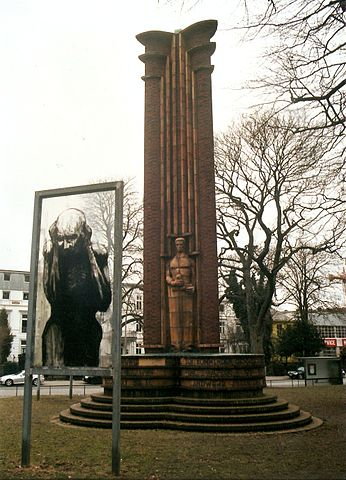
Again, take a Hamburg example. In an earlier contribution to this discussion I already hinted to counter-memorialisation. One of the best examples is here in Hamburg-Altona:

Monument and Counter-Monument next to at St. Johannis-Church in Hamburg-Altona2

Next to Altona’s St. Johannis Church, a monument had been erected in 1925 for the members of the 31st Infantry Regiment in WW1, commissioned by survivors of that regiment. Each of the three sides of the column-like monument made of clinker features an oversized, half-naked figure, representing a warrior with some antique weapon.

The inscription below reads „To the fallen for a grateful memory, to the living for a reminder, to the coming generations for emulation.“3. Clearly a very traditional proto-narrative, both extending the own warriorship of the soldiers into antiquity and calling for its emulation, lacking any transcendence. The formula was coined by August Böckh for Friedrich Wilhelm III of Prussia, and was used on monuments remembering the „liberation wars“ against Napoleon, but also later on those for the „unification wars“ of 1870/71. After the losses of millions in WW1, its usage – especially of the third element – is remarkable, albeit not alltogether uncommon4.


In the mid-1990s, the church’s congregation commissioned a counter-memorial, created by Rainer Tiedje, consisting of three acryl-glass-plates, each directly confronting one of the warriors, depicting „dark, emaciated, fearful creatures“, as the explanation on the page „denkmalhamburg.de“ states (thus on http://denkmalhamburg.de/kriegerdenkmal-an-der-st-johanniskirche/, my translation). It concludes „In the center the heroism and the exaltation, in front of it it the horror of war. A successful mixture.“ (my translation).


Gegendenkmal zum 31er Kriegerdenkmal (aus: Gedenkstätten in Hamburg. Wegweiser zu den Stätten der Erinnerung an die Jahre 1933-1945. https://www.gedenkstaetten-in-hamburg.de/gedenkstaetten/gedenkort/gegendenkmal-zum-31er-kriegerdenkmal/

To me, this countermemorial is not just a (exemplaric-mode) juxtaposition of (tradtional-mode) heroism and horror of war, but there is fundamentally genetic part in it: the counter-memorial does not merely point to timeless horrors of the consequences of warfare, but leans on a visual vocabulary established in Holocaust memorials: The „suffering men“ who wriggles with pain (and fear) on eye-level with the warriors, look like „muselmen“, the completely debilitated and immiserated inmates of the Nazi concentration camps. In its iconography, the counter-memorial belongs to the generation of monuments which coerce the viewer, the public to find and answer, not providing one themselves, either in being abstract or – as here – by visualizing death and disappearance in any but heroic form5. It is this feature, using a visual code depending not only abstractly on hindsight but on concrete knowledge about what such heroism-propaganda did help to bring about, together with the effective placing which renders impossible „commemoration ceremonies, at which the plaques are not noticed“, which indicate to a specific genetic thinking below it, trying to transgress the thinking of the time.

  1. Cf. https://onmonumentave.com/blog/2017/11/20/an-avenue-for-for-all-people-how-arthur-ashe-came-to-monument-avenue []
  2. Photo by 1970gemini in der Wikipedia auf Deutsch, CC BY-SA 3.0, https://commons.wikimedia.org/w/index.php?curid=19523318 []
  3. See http://denkmalhamburg.de/kriegerdenkmal-an-der-st-johanniskirche/  []
  4. Cf. Koselleck, Reinhart (1996): Kriegerdenkmäler als Identitätsstiftungen der Überlebenden. In: Odo Marquard und Karlheinz Stierle (Hg.): Identität. 2., unveränd. Aufl. München: Fink (Poetik und Hermeneutik, 8), S. 255–276; p. 261f []
  5. Cf. Koselleck, Reinhart (1994): Einleitung. In: Reinhart Koselleck und Michael Jeismann (Hg.): Der politische Totenkult. Kriegerdenkmäler in der Moderne. München: Fink (Bild und Text), S. 9–20, here p. 20 []

„Facts“ vs. „Fictions“ – the wrong opposition

„History is the fiction we invent
to persuade ourselves
that events are knowable
and life has order and direction“
(( Watterson, Bill (2010): „Calvin and Hobbes“ 19.7.1993; In: The complete Calvin and Hobbes. Book 3. Kansas City: Andrews McMeel., p. 210 ))

The question of „facts“ does not let go of historiography, history didactics and history teaching. A few years ago it had been the subject of a public controversy about the teaching of history – also and especially in the context of the Hamburg Historians‘ Conference – on which I also commented here in the blog.1 And, — according to the reports of some participants* on Twitter — it has been raised again at the (still running) „histocamp 2019“ in Berlin.

Finally, it was also the subject of the 2018 issue of the Zeitschrift für Geschichtsdidaktik, which I edited, where it was contrasted with „fictions“. Since I did not elaborate on it the necessary form and clarity in my introduction, I would like to argue here that both the concept of „facts“ and the opposition to „fictions“ are part of the problem, but not part of the solution (the repetition of this question already points to the problem). So what is the problem?

There is much truth in the quotation given as the motto of this article – as much about the function of history (orientation) as about the desire to simply „know“ and „convey“ things (events).

Exactly this latter need is what caters to the idea of „facts“ as given entities only to be taken note of and considered as the basis for all efforts of higher historical thought processes. Even if the concept of historical knowledge — contrary to some ideas in the broader public — cannot be reduced to it (procedural knowledge about procedures of gaining knowledge, conceptual and also metacognitive knowledge are widely acknowledged), the idea of „knowledge“ of facts as the basis, the starting material of historical thinking and the gaining of historical insights is still often part of it. The article quoted in the controversy quoted at the beginning „Pupils must learn facts“ by my Berlin colleague Thomas Sandkühler is just one example.

The idea that the availability of such knowledge is a rather low level of historical learning also underlies the widespread taxonomy of learning objectives according to Benjamin Bloom – at least its modelling of the cognitive dimension. This distinguishes in ascending order in the image of a pyramid „knowledge“, „comprehension“, „application“, „analysis“, „synthesis“ and „evaluation“.
Similarly – and perhaps even more sharply – it is formulate in the revised version after Lorin Anderson and David Krathwol, in which the nouns are replaced by verbs indicating operations and where the order is slightly reversed and the last stage is changed: „remember“, „understand“, „apply“, „analyze“, „evaluate“ and „create“.

The idea of progression of learning underlying this gradation is – at least for the domain and discipline of history – highly problematic: US historian and history educator Sam Wineburg recently postulated that historical knowledge cannot be the basis and starting point of historical thought, but rather is to be regarded as its result. He calls for the taxonomy, according to Bloom, to be rotated by 180° in order to turn it from head to toe, so to speak.2 In the background of this position stands Wineburg’s well-known position that historical thinking is not something innate to man — an „unnatural act“. Without a process of learning that is quite strenuous, we would be able to understand all the phenomena of the past with the help of the information that is available to us from our present lives – „presentist“, that is.

Not only must we learn abstractly that the past was different, that people had different (and by no means inferior) perspectives, horizons of understanding, and worldviews, but we must (according to Wineburg) laboriously train ourselves to assume and recognize this otherness in dealing with questions of the past and materials from the past. This also applies to the identification of what was the case. „Knowledge“ about the past with regard to its actuality is thus the supreme result of historical thought – but by no means an easy prerequisite.3 By the way, this also fits in perfectly with a statement of the German colleague Karl Ernst Jeismann, according to which value judgements („evaluation“) are by no means at the end, but at the beginning of many historical thought processes – at least in the form of relevance decisions, which set the preoccupation with the past and its meaning in motion.4

I myself consider Wineburg’s criticism of the taxonomy of Bloom or Anderson/Krathwol to be justified, but his solution its 180° rotation is not a solution, for it overlooks the fact that „knowledge“ or „remembering“ – like most abilities and activities – never exist only in a quality or elaboration stage. It would also be wrong to locate knowledge only at the end of long learning processes. This applies equally to the operations of application, synthesis, evaluation – and of course also to understanding. For all these operations apply, however, that they not only occur in simple everyday forms as well as in highly elaborated studies by experts and researchers, but are explicitly addressed.

Keeping in line with Wineburg’s pictorial metaphor, I therefore suggest that the taxonomies not be rotated by 180° but rather by 90° and that their pyramid form be dissolved. This would yield a set of „columns“ for the individual abilities and operations, which then can be differentiated individually as to the quality of the operation resp. ability described. „Learning“, then, is not to be understood as the progress from one operation to the next after the first one has been „completed“, but as a process of elaboration both of the individual operations or abilities and their respective connections.5

But then „facts“ are neither simply prerequisites nor the sole final goal of historical thought and learning processes. Rather, they are mental summaries of facets of past life, action, suffering and being at different levels of abstraction and reflection for the purpose of naming and communicating them and including them in further argumentation. They are neither a prerequisite nor a result, but complexes of knowledge, distinctions and assignments of meaning gained in a (historical) thinking and judgement – and as such they are both a result and a prerequisite of historical thinking. But with that they are not simply „given“, but require reflection and understanding again and again. This is especially so because the demarcation of such „facets“ of the past from others is by no means predetermined, for the „differentiation of things as they were and of things as we see them“ is, with Peter von Moos, „from the outset ‚an empty gesture‘, because we are exclusively confronted with a selection of linguistically composed memorabilia (or ‚facts‘) from myriads of events, filtered by interpretation and to be interpreted“.6. What can be isolated as a „fact“ is not only a question of the accuracy of historical work, but also a question of perspective, of questioning, of interest, of the ability to distinguish (so to speak the „glasses“), which is shaped by the horizon of perception and perception.

Not only must we learn abstractly that the past was different, that people had different (and by no means inferior) perspectives, horizons of understanding, and worldviews, but we must (according to Wineburg) laboriously train ourselves to assume and recognize this otherness in dealing with questions of the past and materials from the past. This also applies to the identification of what was the case. „Knowledge“ about the past with regard to its actuality is thus the supreme result of historical thought – but by no means an easy prerequisite.3 By the way, this also fits in perfectly with a statement of the German colleague Karl-Ernst Jeismann, according to which value judgements („evaluation“) are by no means at the end, but at the beginning of many historical thought processes – at least in the form of relevance decisions, which set the preoccupation with the past and its meaning in motion.

I consider Wineburg’s criticism of the taxonomy of Bloom or Anderson/Krathwol to be justified, but his solution its 180° rotation is not a solution, for it overlooks the fact that „knowledge“ or „remembering“ – like most abilities and activities – never exist in one quality or elaboration stage only. It would also be wrong to locate knowledge only at the end of long learning processes. This applies equally to the operations of application, synthesis, evaluation – and of course also to understanding. For all these operations apply, however, that they not only occur in simple everyday forms as well as in highly elaborated studies by experts and researchers, but are explicitly addressed.
The taxonomies must rather (if one already follows Wineburg’s pictorial solution) not be rotated by 180°, but by 90° and their pyramid form dissolved, so that several „columns“ for the individual abilities and operations arise, which can be „stepped“ individually in each case. „Learning“ is then not to be understood as the progress from one operation to the next after the first one has been „completed“, but as a process of elaboration both of the individual operations or abilities and their respective connections.7

But then „facts“ are neither simply prerequisites nor the sole final goal of historical thought and learning processes. Rather, they are mental summaries of facets of past life, action, suffering and being at different levels of abstraction and reflection for the purpose of naming and communicating them and including them in further argumentation. They are neither a prerequisite nor a result, but complexes of knowledge, distinctions and assignments of meaning gained in a (historical) thinking and judgement — and as such they are both a result and a prerequisite of historical thinking. But with that they are not simply „given“, but require reflection and understanding again and again. This is especially so because the demarcation of such „facets“ of the past from others is by no means predetermined, for the „differentiation of things as they were and of things as we see them“ is, with Peter von Moos, „from the outset ‚an empty gesture‘, because we are exclusively confronted with a selection of linguistically composed memorabilia (or ‚facts‘) from myriads of events, filtered by interpretation and to be interpreted“.8. What can be isolated as a „fact“ is not only a question of the accuracy of historical work, but also a question of perspective, of questioning, of interest, of the ability to distinguish (so to speak the „glasses“), which is shaped by the horizon of perception.
Does this now lead to a relativism? Not at all, – or at the most with regard to the aspect of delimitation and identification of the „facts“ mentioned last, but not with regard to their actuality. Whoever rejects the concept of „facts“ by no means asserts arbitrariness and by no means necessarily speaks for (free) fiction, even if all names of facts and events always adhere to conjectural parts due to the particularity of tradition, selectivity and perspective. The problem with the „facts“ does not consist in their factuality, but in their presumed and maintained character as given units, which as such one can know and know, without considering the perspectivity and the interest that led to their differentiation. „Auschwitz“ (to take a very clear example) is not a „fact“. This sentence does not deny that there has been Auschwitz, but it recognizes that (1.) the term „Auschwitz“ designates more than a neutral, clearly delimitable and also not further decomposable unit of the past, which only in retrospect gains reference to and meaning for others. No, what we call „Auschwitz“ is gradually different for the people who suffered and were murdered there, for the survivors and their descendants who also suffered, but also for the perpetrators and their descendants, and finally for us today. There is not one Auschwitz, there were and there are many. But this does not mean that they had nothing to do with each other, that they existed separately, or even that Auschwitz was „only“ constructions.

What is at stake here, however, is not whether „Auschwitz“ is „a fact“, but rather the facticity of the events and experiences specifically described by the term „Auschwitz“. This is very well documented (in the vast majority of cases). The opposite of speaking of the „fact of Auschwitz“ is therefore not the assertion of its fictionality. Not „fact“ or „fiction“ is the correct opposition, but „presupposed fact“ or „insight into the past and its facticity gained by thinking“. Both, the respective concrete delimitation and summary as well as their property of „factuality“ can be gained in the mode of historical thinking, are the results of such thought processes. Otherwise „fake news“ and lies could not be identified and separated. The „memories“ of „Benjamin Wilkomirski“ (actually Bruno Dösseker) and the „Auschwitz“ figuring therein (only „identified“ outside the book), for example, could and had to be denied factuality, without this also applying to Auschwitz as a whole.

The fact that both the identification and delimitation of the respective event or occurrence and its factuality are results of thought processes does not prevent them from being addressed as facts in communication about the past and history. To let such „facts“ learn as „as such“ and to „convey“ them to schoolgirls as a prerequisite for interpretation and interpretation undermines the development of the competences that are necessary to be able to exist critically thinking in the diverse and problematic historical culture.

Not only order and sense („order and direction“), but also the „knowledgeability“ of events (and, add: circumstances)9 are thus result, but not condition of historical thinking – and should also figure as such in historical learning processes. And if it were not for the slightly ironic-fatalistic tone of Calvin’s wisdom (which serves him in the comic to want to write a „revisionist“ biography of himself), much of the quote would be quite seriously worth considering. One would, however, have to replace the terms „fiction“ and „invent“ not by their opposites („facts“ and „find out“), but by „narratives“ and „create“ — or even „construct“. „Stories are the narratives we construct to convince ourselves that we know something [about the past] that offers us order and orientation in our lives.“

That is what is meant by historical thinking being „contingency management“ („Kontingenzbewältigung“). The concept of „contingency“ here describes far more than „coincidence“. It refers to the uncertainty that arises between the two beliefs (a) that everything in the world and in life is clearly predetermined, and (b) that there are no connections between details of life whatsoever (both within and across times).
The first conviction would make historical thinking unnecessary, because we ourselves would have to judge ourselves as completely determined and thus without any possibility of decision, without any freedom of attention, perception, judgement and decision. „Orientation“ would not only be useless – we would not even come up with the idea of searching for it. The latter position in turn (complete coincidence) would have to lead us into an absolute aporia, because strictly speaking we could not expect anything with any degree of certainty. The fact that we also always have a connection of some kind between phenomena, circumstances and occurrences in life, even beyond time, is thus an essential element of contingency (con-tingere, lat.: to touch, to transfer), but also that this connection is not simply given and recognizable, but offers comprehensive (albeit not infinite) degrees of freedom. It is this area of contingency between presupposed, but not unquestionably and unambiguously determinable meaning of the past for the present and the future, for our expectations and plans, that makes historical thinking necessary – and with it „knowledge“ about the past, which, however, is not simply given. Knowledge of „facts“ can also be opened up historically thinking, in the form of conclusions about the factuality of details, namely, as such about synchronous and diachronic connections and, finally, also as conclusions and evaluations about significance and meanings for our own and all present and future.

What consequences could be drawn for history education and history lessons in schools? Does it mean that no more „facts“ are allowed to appear in teaching units and lessons, that it were no longer permissible or acceptable to no longer present facts (structures) and occurrences (events, event sequences, actions, etc.) in teacher lectures, timelines and tables, author texts in books, etc. — to make them available to students as material for their work? Not at all! Such references are not only instruments of school learning, but also part of social communication about history. And depending on the concrete question and task, it is not only helpful but also necessary to make them available to pupils or to let them work them out themselves. However, this does not mean that these occurrences and structures should not or even must not come into the focus of reflective, differentiating and evaluative thinking in the course of working with them. QUite to the contrary: it is almost part of the task of historical learning not only to consider, but also to examine and, if necessary, reformulate, differentiate or reject statements and assertions made in the materials (especially those in primary sources and accounts from different perspectives).

And more: The understanding of „facts“ (if one does not want to drop the term completely) not as givens, but as references to facets of history, „provisionally“ being formulated within the course of thought, research and communication not only renders it possible to differentiate and to interpret them, but also to compare culturally and linguistically different forms not only of their designation and interpretation, but also of their definition. This enables the explicit thematization and reflection of such different terms as „Seven Years‘ War“, „French and Indian War“, „3rd Silesian War“, „Great War for the Empire“, „Guerre de la Conquête“ and „Third Carnatic War“ as terms both for different, but also (more or less) connected events and – even more – for the political, cultural and temporal perspectives inherent in such terms (some of these terms only being possible retrospect). It is also possible to explicitly discuss designations in Simple and Easy Language with regard to their power (for the development of the facts and the participation in the learning processes and interpretations) and limitations, and the need for further explanations and additions.

The consequence of the problematization of the concept of „facts“ due to its possible connotation (especially in the case of learners) of them being – so to speak – „upstream“ of historical thinking and learning and thus also partially detracted from it, and from the alternative focus on „factuality“ as the actually intended and relevant characteristic, is, therefore, not relativism, but rather the necessary facilitation at all times of the thematization and reflection both of the constitution of the individual „facts“ and of their qualification as „factual“. The latter operations are represented by the concept of validity („Triftigkeit“) or plausibility, above all in empirical terms10, which renders it possible – in an elementaryized, or more precisely: graduated form – for students to arrive at their own conclusions on the factuality of asserted events. Finally, the focus on factuality instead of on „facts“ also opens up the construction of a learning progression in the recording and reflection of these dimensions of historical thought and historical communication that can be taught and learned „step by step“ so to speak.

  1. Cf. History – Competences and/or Facts? To some current newspaper articles and to the question of chronology and Progress of the „debate“ about the facts in history didactics []
  2. Wineburg, Samuel S. (2018): Why learn history (when it’s already on your phone). Chicago: University of Chicago Press, S XXX. []
  3. Wineburg, Sam (1999): Historical Thinking and Other Unnatural Acts. In: The Phi Delta Kappan 80 (7), pp. 488-499. and Wineburg, Sam (2001): Historical thinking and other unnatural acts. Charting the future of teaching the past. Philadelphia: Temple University Press (Critical perspectives on the past) [] []
  4. Jeismann, Karl-Ernst (2000): ‚Geschichtsbewusstsein‘ als zentrale Kategorie der Didaktik des Geschichtsunterrichts. In: Karl-Ernst Jeismann: Geschichte und Bildung. Beiträge zur Geschichtsdidaktik und zur historischen Bildungsforschung. Hg. v. Karl-Ernst Jeismann und Wolfgang Jacobmeyer. Paderborn: Schöningh, S. 46–72, p. 66. []
  5. Cf. also Körber, Andreas (2012): Graduierung historischer Kompetenzen. In: Michele Barricelli and Martin Lücke (ed.): Handbuch Praxis des Geschichtsunterrichts. Historisches Lernen in der Schule, vol. 1. Schwalbach/Ts.: Wochenschau Verlag (Wochenschau Geschichte), pp. 236-254. []
  6. Moos, Peter von (1999): Gefahren des Mittelalterbegriffs. Diagnostische und präventive Aspekte. [Dangers of the concept of Middle Ages. Diagnostic and preventive aspects]. In: Joachim Heinzle (Ed.): Modernes Mittelalter. Neue Bilder einer populären Epoche. 1st ed. Frankfurt am Main, Leipzig: Insel-Verlag (Insel-Taschenbuch, 2513), pp. 31-63, here p. 54; trans. AK []
  7. Cf. also Körber, Andreas (2012): Graduation of historical competences. In: Michele Barricelli and Martin Lücke (ed.): Handbuch Praxis des Geschichtsunterrichts. Historisches Lernen in der Schule, vol. 1. Schwalbach/Ts.: Wochenschau Verlag (Wochenschau Geschichte), pp. 236-254. []
  8. Moos, Peter von (1999): Dangers of the concept of the Middle Ages. Diagnostic and preventive aspects. In: Joachim Heinzle (Ed.): Modern Middle Ages. New Images of a Popular Era. 1st ed. Frankfurt am Main, Leipzig: Insel-Verlag (Insel-Taschenbuch, 2513), pp. 31-63, here p. 54 []
  9. „fact“ here does not mean that something from the past is given to us in a clearly recognizable way, but the conditions found by acting and suffering people at their time, here thus structures of the past. []
  10. Rüsen, Jörn (2013): Historik. Theorie der Geschichtswissenschaft. Cologne: Böhlau, p. 57ff; Rüsen, Jörn (2017): Evidence and Meaning. A Theory of Historical Studies. Unter Mitarbeit von Diane Kerns und Katie Digan. New York, NY: Berghahn Books Incorporated (Making Sense of History Series, v.28), pp. 38; cf. Körber, Andreas (2016): Translation and its discontents II. A German Perspective. In: JCS 48 (4), S. 440–456. DOI: 10.1080/00220272.2016.1171401. []

New Draft on Analysing Monuments with Students

Körber, Andreas (2019): How to Read a Monument as a Narrative in Class – a Suggestion. [unfinished draft]. In Historisch denken lernen [Blog des AB Geschichtsdidaktik; Universität Hamburg], 8/27/2019. Available online at https://historischdenkenlernen.blogs.uni-hamburg.de/wp-content/uploads/2019/08/2019_08_K%C3%B6rber-How-to-Read-a-Monument-as-Narrative-in-Class_1b-lit.pdf.

This is a new draft of a suggestion for analysing monuments with students. Please comment.
August 28th: I added some aspects (in the PDF in green).

2019_08_Körber How to Read a Monument as Narrative in Class_2-lit.pdf

==
Andreas Körber (Hamburg)
How to Read a Monument as a Narrative in Class – a Suggestion [unfinished draft]

I.
The following suggestions for addressing monuments in history education are based on a conception of monuments as proto- or abbreviate narratives1 by a present actor about a certain past and its relevance. Even though in many discussions about the removal of monuments, people deplore the removal of their “past”,2 what is at stake, is not the past itself, but a specific and often privileged communication of a certain interpretation of some past context, personage or event.
As such, they also address someone (mostly a specific group) – sometimes explicitly, sometimes implicitly only. These “addressees” need, however, not be identical with those really exploring the monument. But these (the actual “audience”) will also feel addressed, and since they might (will) be diverse, in quite different ways. This communicative shift is far from being an exception – it might even be the rule in times of change and of increased diversity of our societies. Consider, e.g., a monument hailing some hero of an imperial war addressing its audience with a reference to “our empire” visited by an immigrant British citizen. This applies not only to monuments depicting a group’s (e.g. nation’s) “own pride and pain” but also to critical memorials addressing a group’s actions in the past which are considered as problematic (to say the least) in retrospect. Consider, e.g., Germany’s memorials at former places of concentration camps. In most cases, they are called “Gedenkstätten” – “sites of remembrance”. As such, already, they (have to) express their narrative logic in diverse from, given that the society they address is not only sociologically and culturally diverse but also with respect to the past they refer to. For survivors and dependants (of both survivors and fatal victims), they are (mainly) a place of commemoration their own loss and also victimhood. In many cases these places tell a story of “we have this place for remembering what they (the Germans) have done to us”. But even within this group, there are many who are and still consider themselves Germans. For them, the narrative is quite different. And of course there is a difference between mourning a loss and remembering a survival or even own resistance. An inscription on the 1965 monument at Neuengamme Concentration Camp Memorial in Hamburg, e.g., reading “Euer Leiden, Euer Kampf und Euer Tod sollen nicht vergebens sein” (“Your Suffering, Your Fight and Your Death Shall Not be in Vain”) does prominently address a group of prisoners who actively resisted. But what is more, most of these places respectively monuments there are also known as “Mahnmale”, i.e. “monument” in the literal sense of “admonishing” someone. Who can or should be admonished there? Referring to the Nazi Crimes, they can (and have to) do it in two different ways: Towards surviving victims and their dependants they may be read as “Never let that be done unto you again” – but addressing the German society as such they refer to “Remember” (publicly, that is) “what you have done” (both to “others” and to “some of your own”, that is) – “and make sure that this never happens again”. Germans among the victims of NS-crimes (Jewish Germans, Communists, Social Democrats Jehova’s Witnesses, and many others), then, will specifically have to select (not choose) how they are addressed.

Metaphorically, monuments don’t cease to “speak” if addressing a different audience from what was intended or supposed. Since all perception and analysis (“de-construction”1) of a narrative also requires and implies re-constructive mental processes, the resulting narratives in diverse publica will differ, partially by becoming more complex. Consider the 1925 war monument in front of Hamburg-Altona’s Johannis Church: It depicts three medieval warriors with bare chest and leaning on a long sword.2 The inscription reads: “Den Gefallenen zum dankbaren Gedächtnis, den Lebenden zur Mahnung, den kommenden Geschlechtern zur Nacheiferung” (“to the fallen in grateful memory, to the living as a reminder, to the coming generations for emulation”). Even though there surely are some youths on the right-wing of the political spectrum to whom this may appeal, both most of them will have to engage in twofold interpretation: “Ethnic” will have to differentiate between their own position and perspective and that of the youth in the Weimar Republic, in order to recognize the message and to make their own sense of it, Germans with what is often termed as “migratory background” will have even more aspects to combine.

All these considerations also hold true for the “speaker’s position” in a memorial or monument’s narrative: Let’s take the example of German Concentration Camp memorials again: Who is it, admonishing the victims not to be victimized again, and (more prominently) the Germans not to become perpetrators again? In fact, one can even detect another layer in such monuments. The fact that (belatedly enough) the German society today designates and supports these “Gedenkstätten” (or even hosts them institutionally) can also be considered a message to both the survivors, their dependants and to the world at large: “See and that we address this past” – possibly also with a call for support: “By witnessing this commitment of ours to remembering this past – help us to resist and even fight tendencies to abandon it and to return to a socio-centric way or commemoration” again.3 But is it “the German Society” speaking here – or some specific group (e.g. the government, a political faction, …) speaking “for” the German people or in lieu of? Just like the targeted audience of a monument seldomly is just the one really visiting it (and trying to make sense of it), the position of “authorship” needs to be differentiated.
Given all this, the conventional questions of (1) who erected a monument (2) to (remembering) whom, (3) for what purpose, (4) with whose money, and to what effect (e.g. of appraisal, critique), are still necessary, but need to be complemented.
As a result, a monument’s “message” or “meaning” is neither fixed nor arbitrary, but rather a spectrum of narrative relations between a range of perceived-“authors” or ”speakers” and a similar range of targeted and factual addressees.
Furthermore, their interrelation is of utmost interest and may strongly differ: Does (and if so: in what way) the monuments message imply the author and the addressee(s) to belong to the same group? It it “intransitive” in that it at least seemingly expresses the fact of “remembering” (“We both know that we have knowledge about this past and we express that it is of importance to us”), while in fact it serves either as a transitive reminder (“I know that you know, but you must not forget”) or even as a first-time introduction of the addressee into the subject at hand (which will be the mode in most cases of visiting monuments with students). So where “remembering” and even “commemoration” is suggested and meant, “telling” is the factual mode.
Furthermore, commemorative modes are manifold. Monuments can not only call for neutral “remembering”, but also for revering or condemning, for feelings (pride and pain) – and they can appeal for action, e.g. for following an example. In culturally diverse societies, the specific linguistic and artistic modes of expressing may not be clear to all students, possibly leading to misunderstandings, but possibly also to identifying alternative readings which are worth considering.

II.
Another aspect is crucial: In (post-)modern, diverse and heterogeneous societies (at least), it will not suffice that each individual is able to think about the past and its representations in the public sphere, to consider the messages and to relate to them individually. The common task of organizing a peaceful and democratic life together within society as well as in respect to foreign relations requires that the individual members of society do not only sport their own historical consciousness – possibly different from that of their neighbours, they will have to be able to relate to these other perceptions, conceptualisations, interpretations and evaluations of past and history and to the appeals they hold for them. In plural societies it is not enough to just know history yourself and to be able to think historically – its is paramount to have at least some insight into the historical thinking of others and to be able to communicate about it. This also refers to monuments. What is needed is not only knowledge and insight about some possible different interpretations (as e.g. exemplified by classical or representative ones taken from literature), but also an insight into the actual (ongoing, possibly still unsure, blurred, unfinished) interpretations of others in one’s one relevant contexts. Learning about history in inclusive societies, therefore, be they diverse with regard to cultural, social or other differentiations, requires a dimension of mutuality, of learning not only about history and the past, but also about the other members of society and their relations to it, the meanings it holds for them, their questions, their hypotheses, etc.4

III.
On the backdrop of all these considerations, the following guideline therefore does not venture to help students to perceive the “true” “meaning” of a monument, but rather to foster communication about what is perceived as its “message” and meaning by possibly different people. Some of these perceptions will be affirmed by being shared among several and possibly quite different users, while others might be different. This, however, does not necessarily render them wrong or nonsensical (which, they might be, however). Comparing different answers might both sharpen the individual’s perception and broaden it to perceive relevance and meanings of memorials to people with different background, interest, culture, interest, and so on. These forms of relevance might (often will) differ from that intended by those who erected the monument. What does that mean? Is a monument dysfunctional if people feel addressed by it in a way differing from that originally intended? Or does it keep relevance but change significance?
These questions do not replace but complement other approaches to analysing monuments. It might be sensible, though, to not apply them after more direct approaches, but to use them as a start, resulting in more specific (and possibly also more) of questions to explore.
The questions can be used in different ways. It will be rather tedious to just answer them one by one – especially including all bullet points. The latter are rather meant as suggestions for formulating an answer to the main questions above them.
To work individually is possible, but because of the concept explained above, it might be more fruitful to apply a “Think-Pair-Share” -system and first work independently, then compare suggestions in small groups in a way which does not only look for common solutions, but also explores and evaluates differences, and then share both insights and remaining or newly arisen questions with the whole group.

Task:
I. Respond to the questions 1-6, using the bullet points below as directions and suggestions. Try e.g. to complete the given sentences, but formulate your own answer to the main questions. If you are unsure or have additional ideas, formulate your questions (instead)!
II. Compare your nots with your partner(s). Don’t standardize them! Instead: Formulate (a) a new version of those aspects which were similar and (b) on your differences! In what way did/do you differ? Make a suggestion why that might be! Keep your original notes! They will be valuable in further discussions!
III. Report on your findings from II to your class! Compare with insights and questions of other groups!

=======================

  1. Communicative Explicitness:
    In how far does the monument (seem to) …

    • … present or suggest a specific person or group in a speaker position? (e.g. “We, <…> erected this monument”?)
    • … address a specific person/group or suggests to be directed towards a specific group? (“You, <…>…” / “to <…>”)5
    • … address a third-party as some kind of witness as to the fact of remembering?6
    • … refer to some third party as involved in the past which is narrated? (e.g. “what they have done to us”)
  2. Narrative Explicitness:
    In how far does the monument (seem to) …

    • … presuppose that the recipient/addressee has sufficient knowledge about the context referred to?
    • … explicitly construct a specific context (explicitly tell a story),
    • … rely on a certain amount of common knowledge of speaker and addressee?7
    • …introduce actors, contexts and events?
    • ?
  3. Transitive/Intransitive communication:
    In how far does the monument (seem to) …

    • … embrace the recipient/addressee as a member of the same group (“we”) as the (purported) speaker?
    • … address the recipient/addressee as a member of a different group (“you”) as the (purported) speaker?
  4. . “Mono-” or “Heterogloss” communication:
    In how far does the monument (seem to) …

    • … embrace the recipient/addressee as undoubtedly having the same perspective/sharing the evaluation (“monogloss”)? e.g. by being implicit about it,
    • … address the recipient/addressee as not necessarily sharing the same perspective and evaluation (“heterogloss”)? e.g. by being explicit in statement, evaluation, etc.
  5. Communicative Intent:
    What is the relation of authors’/addressee(s)/third-party’s role in the (proto-)narrated story?, e.g.

    • Generic
      1. “<…> want(s) <…> to <know/remember/acknowledge/accept/judge> as <…>”
    • Specific:
      • “’We’ <…> want ‘you’ <…> (and others) to know what ‘we’ <…> have achieved!” (as e.g. in “Stranger, tell the Spartans …“)
      • „’We’ <…>want ‘us’ <…> to not forget what ‘we’ <…> have achieved!” (as e.g. in Monuments to Unification)
      • „’We’ <…> want ‘us’ <…> to not forget what ‘we’ <…> have caused!” (as e.g. in German Concentration Camp Memorials)
      • “’We’ <…> want ‘you’ <…> to know that ‘we’ <…> submit ourselves to not forgetting/remembering!”
      • „’We’ <…> want ‘us’ <…> to not forget what ‘they’ <…> have done to ‘us’ <…>!”
      • „’’We’ <…> want ‘you’ <…> to know that ‘we’ <…> acknowledge what ‘you’ <…> have done to ‘us’ <…>!”
    • In how far does one (or several) of the following forms describe the communicative intention of the monument?
      • to inform, e.g. if it introduces and details the past incidents, contexts etc.;
      • to confirm, e.g. if it almost tacitly – without giving details – refers to a past context which both author and addressee share knowledge about; intending to secure acknowledgement of factuality;
      • to commemorate, e.g. if it almost tacitly – without giving details – refers to a past context which both author and addressee share knowledge about, intending to express a certain evaluation;
      • to mourn, e.g. if it refers to a past context which both author and addressee share knowledge about, intending to express a feeling of loss of someone/something valued);
      • to remind, e.g. if it refers to a past context which both author and addressee should share knowledge about, intending to
        • prevent forgetting;
        • secure a certain evaluation which is supposed to have been shared before?
        • appeal, e.g. if it asks (invites?/requests?/summons?) the recipient/addressee to feel/identify/act in a certain way, e.g. by
          • referring to (a) person(s) as responsible for something, admonishing the addressee to evaluate this/these persons in a certain way, but not to follow her/his example, either
          • heroizing: presenting (a) person(s) as responsible for a special achievement and therefore to be revered;
          • giving thanks: presenting (a) person(s) as responsible for a special achievement and expressing gratitude;
          • condemning: presenting (a) person(s) as responsible for a special achievement and therefore to be condemned;
          • to present examples / role models, e.g. if it by presents (a) person(s) as responsible for something and addresses the recipient/addressee as possibly being in a similar position and having similar capacities, urging her/him either
            • to follow the example (e.g. of taking action, of resisting);
            • to not follow the example (e.g. of going along …);
          • to express gratitude, e.g. if it presents the addressee and/or his group as responsible for something good, expressing gratitude;
          • to accuse, e.g. if it presents the addressee and/or his group as responsible for something bad, expressing contempt;
    • other (specify) …
      ======
      References

      • „Gemütszustand eines total besiegten Volkes“. Höcke-Rede im Wortlaut. Nach dem Transkript von Konstantin Nowotny (2017). In Der Tagesspiegel, 1/19/2017. Available online at https://www.tagesspiegel.de/politik/hoecke-rede-im-wortlaut-gemuetszustand-eines-total-besiegten-volkes/19273518-all.html, checked on 3/14/2019.
      • Körber, Andreas (2014): Historical Thinking and Historical Competencies as Didactic Core Concepts. In Helle Bjerg, Andreas Körber, Claudia Lenz, Oliver von Wrochem (Eds.): Teaching historical memories in an intercultural perspective. Concepts and methods : experiences and results from the TeacMem project. 1st ed. Berlin: Metropol Verlag (Reihe Neuengammer Kolloquien, Bd. 4), pp. 69–96.
      • Körber, Andreas (2015): Historical consciousness, historical competencies – and beyond? Some conceptual development within German history didactics. Available online at http://www.pedocs.de/volltexte/2015/10811/pdf/Koerber_2015_Development_German_History_Didactics.pdf.
      • Körber, Andreas (2019; in print): Inklusive Geschichtskultur — Bestimmungsfaktoren und Ansprüche. In Sebastian Barsch, Bettina Degner, Christoph Kühberger, Martin Lücke (Eds.): Handbuch Diversität im Geschichtsunterricht. Zugänge einer inklusiven Geschichtsdidaktik. Frankfurt am Main: Wochenschau Verlag, pp. 250–258.
      • Körber, Andreas (2019; unpubl.): Geschichtslernen in der Migrationsgesellschaft. Sich in und durch Kontroversen zeitlich orientieren lernen. deutlich überarbeiteter Vortrag; unpubliziert. Geschichten in Bewegung“. Universität Paderborn. Paderborn, 6/14/2019.
      • Körber, Andreas; Schreiber, Waltraud; Schöner, Alexander (Eds.) (2007): Kompetenzen historischen Denkens. Ein Strukturmodell als Beitrag zur Kompetenzorientierung in der Geschichtsdidaktik. Neuried: Ars Una Verlags-Gesellschaft (Kompetenzen, 2).
      • Lévesque, Stéphane (2018): Removing the “Past”. Debates Over Official Sites of Memory. In Public History Weekly 2018 (29). DOI: 10.1515/phw-2018-12570.
      • Rüsen, Jörn; Fröhlich, Klaus; Horstkötter, Hubert; Schmidt, Hans Günther (1991): Untersuchungen zum Geschichtsbewußtsein von Abiturienten im Ruhrgebiet. Empirische Befunde einer quantitativen Pilotstudie. In Bodo von Borries (Ed.): Geschichtsbewusstsein empirisch. Pfaffenweiler: Centaurus (Geschichtsdidaktik : […], Studien, Materialien, [N.F.], Bd. 7), pp. 221–344.
      • Ziogas, Ioannis (2014): Sparse Spartan Verse. Filling Gaps in the Thermopylae Epigram. In Ramus 43 (2), pp. 115–133. DOI: 10.1017/rmu.2014.10.
  1. Cf. Rüsen et al. 1991, 230f. Cf. also my comment on Lévesque 2018, ibid. []
  2. Cf. Lévesque 2018. []
  3. That this danger is far from being hypothetical can be seen in the light of a speech by the right-wing (AFD)-politician Björn Höcke in Dresden on 18 January 2017, where he called for a “U-turn” in German memory culture, giving up the politics of “Vergangenheitsbewältigung”. In the same speech, he reproached to the Berlin Memorial to the Murdered Jews of Europe (the “Holocaust-Memorial”) as a “monument of shame”, which of course it is, but in a different sense: What Höcke meant is a “shameful” monument, but for the current German memorial culture he attacked, to address one’s own (in group’s) “crime and shame” is nothing shameful, but a necessity. Cf. the documentation of the speech in „Gemütszustand eines total besiegten Volkes“ 2017 (as of 28.8.2019). Any sense of pride, however, based on the development of this “critical” and even “negative” memory culture would be at least problematic – it would undermine the mind-set. The question remains of how to address this as an achievement without resorting to concepts of “pride”. []
  4. Cf. on the concept of inclusive history culture: Körber 2019; i. Dr.. Körber 2019. []
  5. As e.g. in a Hamburg monument commemorating the town’s dead of WW1: “Vierzig Tausend Söhne der Stadt ließen ihr Leben für Euch” (“Forty Thousand Sons of [our] Town Gave Their Lives for You”). []
  6. As e.g. in the verse of Simonides of Ceos (556–468 BCE) on the Spartan defenders at the Thermopylae, which Herodotus (VII, 228) reports to have been erected on the spot: “Oh stranger, tell the Lacedaemonians that we lie here, obedient to their words.” (transl. by Ioannis Ziogas). The original did not survive, but in 1955 a modern plate was erected bearing the Greek text again. For this and different translations of the inscription see the English Wikipedia-article: https://en.wikipedia.org/wiki/Battle_of_Thermopylae#Epitaph_of_Simonides (as of 27/8/2019). For a discussion of the wording see Ziogas 2014. []
  7. A monument in Oslo, on the premises of Åkershus Slot, near the Norwegian museum of resistance against German Occupation in WW2 (the Museum), e.g. states „de kjempet de falt – de gav oss alt“ (literally: „They fought, they fell – they gave us everything“), or rather: „they gave (sacrificed) everything for us.“ Even though the monument depicts tools and devices which can be used in resistance operations, the monument clearly requires knowledge of the whole context of Norwegian resistance. Körber 2014, p. 87. []

Neue Ausgabe des „History Education Research Journal“ (HERJ) erschienen

HERJ 16,1 Title

HISTORY EDUCATION RESEARCH JOURNAL (HERJ)

Focusing on the global significance and impact of history education, this international journal covers all aspects of history education theory, scholarship, and pure and applied research.

Editors: Jon Nichol, Hilary Cooper and Arthur Chapman

NEW for spring 2019:

Special issue: Triangulation in history education research

JOURNAL CONTENTS: vol. 16, no. 1

Special issue: Triangulation in history education research

Guest editors: Roland Bernhard, Christoph Bramann and Christoph Kühberger

This special issue sprang from an international symposium in Salzburg, Austria in 2017, called Triangulation in History Education Research. It includes articles on mixed-methods research and triangulation in history education research from seven different countries: Australia, Austria, Germany, the Netherlands, Portugal, Switzerland and the United Kingdom.

· Roland BERNHARD, Christoph BRAMANN & Christoph KÜHBERGER – Mixed methods and triangulation in history education research: Introduction

· Udo KELLE, Christoph KÜHBERGER & Roland BERNHARD – How to use mixed-methods and triangulation designs: An introduction to history education research

· Manuel KÖSTER & Thünemann – The untapped potential of mixed-methods research approaches for German history education research

· Terry HAYDN – Triangulation in history education research, and its limitations: A view from the UK

· Heather SHARP – Bricolage research in history education as a scholarly mixed-methods design

· Roland BERNHARD – Using mixed methods to capture complexity in a large-scale empirical project about teachers’ beliefs and history education in Austria

· Arie WILSCHUT & Koen SCHIPHORST – ‘One has to take leave as much as possible of one’s own standards and values’: Improving and measuring historical empathy and perspective reconstruction

· Christopher WOSNITZA & Johannes MEYER-HAMME – Student essays expressing historical thinking: A quantitative and dually qualitative analysis of 1,100 papers for the History Contest of the German President

· Bodo VON BORRIES – The experience of and reflection on triangulation and/or mixed methods, discussing a study on the ideal and reality, use and understanding of history textbooks

· Monika WALDIS, Martin NITSCHE & Corinne WYSS – Assessing pre-service history teachers’ pedagogical content knowledge with a video survey using open-ended writing assignments and closed-ended rating items

· Mariana LAGARTO – Profiles of teaching and learning moments in the history classroom

· Christoph KÜHBERGER, Christoph BRAMANN, Zarah WEIß & Detmar MEURERS – Task complexity in history textbooks: A multidisciplinary case study on triangulation in history education research

· Glória SOLÉ – Children’s understanding of time: A study in a primary history classroom

The History Education Research Journal is a bi-annual, open-access, peer-reviewed journal based at the UCL Institute of Education, in collaboration with the History Educators International Research Network (HEIRNET), and hosted in partnership with the Historical Association. It is a relaunch of the International Journal of Historical Learning, Teaching and Research (IJHLTR). Back issues of IJHLTR will remain available through the Historical Association until they are transferred to the new journal’s home page. For information about how to contribute to the History Education Research Journal, visit UCL IOE Press.

cid:image002.png@01D46248.8E63CEA0

See the UCL IOE Press catalogue for books and open-access journals on education and related areas of social science and professional practice

Here’s our Privacy Policy

Gamification und Historisches Lernen – wichtiger Artikel von Daniel Bernsen

Auf seinem Blog „Medien im Geschichtsunterricht“ hat der Kollege Daniel Bernsen unter dem Titel „Gamification gone wrong“ einen wichtigen Artikel zum Einsatz von Spielen für historisches Lernen veröffentlicht, der auch gleich einige Diskussionen dort und auf Twitter hevorgerufen hat.
Die Diskussion in den Kommentaren unter dem Artikel (unter meiner zweimaligen Beteiligung, hier und hier) ist weiterführend. Einschlägig sind auch die Spielentwicklungen von Brenda Romero (bzw. Brathwaite). Vgl. Takahasi, Dean (2013): Brenda Romero’s Train board game will make you ponder. In: Venturebeat, 11.05.2013. Online verfügbar unter https://venturebeat.com/2013/05/11/brenda-romero-train-board-game-holocaust/amp/. Vgl. auch zu anderen Spielen von ihr: Brathwaite, Brenda (2013): Gaming for Understanding. TED Talks: TED.

Falsche Anreize — Offener Brief Hamburger Hochschullehrer/innen an Schulsenator Rabe

PDF-Fassung: Offener Brief Hamburger Hochschullehrer/innen an Schulsenator Rabe; Stand 28.2.2019

Boni für frühe Schulpraxis in der Bewerber/innenwahl für den Vorbereitungsdienst gefährden Errungenschaften der akademischen Lehrer/innenbildung (gerade) in Hamburg und untergraben laufende Innovationen in Richtung auf Qualitätsentwicklung und Nachhaltigkeit.

Offener Brief an den Schulsenator der Freien und Hansestadt Hamburg, Ties Rabe

Sehr geehrter Herr Senator,

Anfang des Monats wurden turnusgemäß neue Absolvent/innen von Lehramtsstudiengängen in den Vorbereitungsdienst an Hamburger Schulen und somit in die zweite Phase der Lehrer/innenbildung aufgenommen. Aus diesem Anlass wurde vor der Presse – und in dieser kontrovers kommentiert –1 auf ein neues Auswahlverfahren hingewiesen, welches solchen Bewerber/innen nennenswerte Vorteile verschafft, die bereits neben dem Studium umfangreiche Erfahrungen mit Unterrichts- und unterrichtsähnlicher Tätigkeit in der Schule gesammelt haben.2
In den letzten Jahren nehmen sehr viele Lehramtsstudierende der Universität Hamburg solche Lehraufträge wahr. Sie übernehmen unterschiedliche Aufgaben, nicht wenige erteilen auch selbstverantwortlich Unterricht – zum Teil schon früh im ersten Studienabschnitt (der Bachelorphase). Diese Praxis ist offenkundig dem derzeitigen Mangel an Lehrpersonen geschuldet. Sie ist bei Studierenden anscheinend beliebt, weil sie ihnen gleichzeitig eine studiennahe Erwerbsmöglichkeit bietet und einem Bedürfnis nach „Praxiserfahrung“ entgegenkommt. Dennoch muss aus mehreren Gründen vor dieser Praxis gewarnt werden. Sie bedeutet nicht nur eine deutliche Absenkung des Qualifikationsniveaus der derzeit an Hamburger Schulen Unterrichtenden und überträgt die Aufgabe der Befähigung für diese Tätigkeit den Studierenden selbst – weitgehend ohne Anleitung und Möglichkeit qualifizierter Beratung. Selbst dort, wo sie eine solche erhalten, sind ihnen grundsätzlichere und weitsichtigere Reflexionen über Bedingungen und Konzepte nicht systematisch zugänglich oder werden von ihren eigenen Erfahrungen (als Schüler/innen oder in dieser Tätigkeit) überlagert.
Damit gefährdet die genannte Praxis wesentliche Errungenschaften der Hamburger universitären Bildung aller Lehrämter in den nunmehr 100 Jahren ihres Bestehens. Es war gerade die Hamburger (Ober-)Schulbehörde, welche zunehmend auf einer Ausrichtung der Lehrer/innenbildung durch Wissenschaftlichkeit und Reflexivität auf die Bildung zukunftsfähige Lehrer/innen aller Schularten bzw. -stufen bestanden und diese bis zur Akademisierung unter dem Bologna-System forciert hat. In gleichem Sinne untergräbt die benannte Praxis die derzeit laufenden Prozesse und Projekte einer Orientierung der Lehrer/innenbildung auf Professionalität und Nachhaltigkeit – etwa im Rahmen der Projekte der „Qualitätsoffensive Lehrerbildung“ – und somit auch wesentliche Bestrebungen des von Universität und Schulbehörde gemeinsam getragenen Zentrums für Lehrerbildung.
Konkret ist an der geschilderten Praxis unter anderem – die Reihe ließe sich mühelos ergänzen – zu bemängeln:

  1. Der Beruf der/des Lehrer/in hat – trotz seiner Organisation – wesentlich mit dem der Jurist/innen, Ärzt/innen und weiteren die Qualität einer „people processing profession“ gemeinsam, also einer Tätigkeit an immer neuen, prinzipiell nicht vollständig systematisierbaren und eigenlogischen „Fällen“ (hier der individuellen Schüler/innen und ihrer Lernbedürfnisse und -prozesse) mit wesentlichen Eingriffen in deren Lebenschancen. Als solcher erfordert er die Befähigung zu eigenverantwortlicher Fallanalyse und ‑beurteilung aufgrund umfassenden, nicht aber einfach „anwendbaren“ theoretischen Wissens in mehreren Disziplinen (Pädagogik, Erziehungswissenschaft, Psychologie, Soziologie, und den Bezugsdisziplinen der Unterrichtsfächer).3 Diese umfassenden Kompetenzen sind nicht einfach in eigener praktischer Tätigkeit zu erwerben, sondern nur in einer von unmittelbarer Handlungerfordernis befreiten Phase wissenschaftlicher Reflexion auf Praxis und ihrer Grundlagen. Frühe eigene Lehrerfahrungen, die nicht die Gelegenheit zu umfassender Reflexion und Aufarbeitung bieten, gefährden dieses Erfordernis.
  2. Die frühe praktische Erfahrung der künftigen Lehrer/innen mit selbst verantwortetem Unterricht ohne eine zwischenzeitliche Phase ihrer Distanzierung von eigener Schul- und Unterrichtswahrnehmung aus Schüler/innensicht erschwert oder verhindert gerade nötige Unterscheidungen zwischen allgemeinen und besonderen Bedingungen schulischen Lernens. Letztere ist Voraussetzung dafür, dass Lehrer/innen nicht einfach den von ihnen selbst (als Schüler/innen) und durch Beobachtung von Kolleg/innen erfahrenen Unterricht weiterführen, sondern grundsätzlich und offen für Veränderungen ihr eigenes professionelles Handeln reflektieren und dieses anpassen können. Diese Distanzierung erfordert die reflexive Verarbeitung systematischer und vergleichender Beobachtungen, nicht die Einübung in Praxis. Damit wird eine wesentlich über Jahrzehnte von der Hamburger Schulbehörde geförderte Orientierung auf die Förderung wissenschaftlicher Orientierung und Selbstständigkeit der künftigen Lehrer/innen über Bord geworfen.4
  3. Die hier beklagte Praxis droht aber auch, das Praktika-System der Hamburger Lehrer/innenbildung zu unterminieren, das als „Leuchtturm“ der Reform der Lehrer/innenbildung an der Universität Hamburg gilt und mehrfach positiv evaluiert sowie in der Drucksache zur gegenwärtigen Reform ausdrücklich lobend hervorgehoben und zur Weiterentwicklung empfohlen wurde. Gerade die Kernpraktika des Master-Studiums mit ihrer Ausrichtung auf umfängliche, aber durch doppelte Begleitung auf Reflexivität ausgerichtete, keinem Handlungsdruck ausgesetzte Praxiserfahrungen wird gefährdet, wenn Studierende staatliche Anreize erhalten, in größerem Umfang eigenverantwortlich zu unterrichten, statt reflexive Praxis zu erproben.
  4. Nicht nur aus erziehungswissenschaftlicher Sicht im engeren Sinne, sondern auch mit Blick auf die „Fachlichkeit“ ist eine frühe selbstständige und nicht systematisch reflektierte Praxis abzulehnen. Sie kann nur die Tradierung handwerklichen Tuns, nicht aber reflektierte Lehr-Lernprozesse befördern, die vor dem Hintergrund veränderter sozialer Bedingungen und neuer disziplinärer Erkenntnisse erfolgen.
  5. In fachlicher (fachwissenschaftlicher) Hinsicht droht durch frühen Unterricht vor vertieften Studien eine Einübung in die Verwendung nicht mehr aktueller Konzepte, Paradigmen und Methodiken, in fachdidaktischer Sicht der Rückfall in verkürzte, oft als „Abbilddidaktik“ titulierte Konzepte einer nicht differenzierten Übermittlung von Wissen. Gerade den Herausforderungen durch die gegenwärtigen Prozesse der Heterogenisierung und Inklusion, aber auch der Digitalisierung kann nur eine Lehrer/innenbildung gerecht werden, die nicht durch verfrühte Praxis unterlaufen wird.

Dies sind nur einige Beispiele für Gefährdungen der Qualität und Nachhaltigkeit der Lehrerbildung durch eine kurzsichtige Reparaturpolitik einer langjährig verfehlten quantitativen Planung der Lehrer/innenbildung. Auch die praktische Lehrer/innen(aus)bildung in der zweiten Phase wird unter ihr leiden, wie auch die Studierenden selbst mangels Begleitung und Beratung Nachteile in ihrer Ausbildung werden hinnehmen müssen, die ihnen aufgrund der zunächst willkommenen „Praxis“ zunächst oft gar nicht bewusst werden. Gleiches gilt mit Sicherheit für die Qualität des Unterrichts.

Mit freundlichen Grüßen

  1. Prof. Dr. Andreas Körber; Didaktik der Geschichte und der Politik; Fakultät für Erziehungswissenschaft, Universität Hamburg
  2. Prof. Dr. Dietmar Höttecke; Didaktik der Physik; Fakultät für Erziehungswissenschaft, Universität Hamburg
  3. Prof. Dr. Thomas Zabka; Didaktik der deutschen Sprache und Literatur; Fakultät für Erziehungswissenschaft, Universität Hamburg
  4. Prof. Dr. Ingrid Bähr; Sportdidaktik; Fakultät für Erziehungswissenschaft, Universität Hamburg
  5. Prof. Dr. Dagmar Killus; Schulpädagogik; Fakultät für Erziehungswissenschaft, Universität Hamburg
  6. Prof. Dr. Gabriele Ricken; Sonderpädagogische Psychologie und Diagnostik; Fakultät für Erziehungswissenschaft, Universität Hamburg
  7. Prof. Dr. Telse Iwers, MHEd; Pädagogische Psychologie; Prodekanin für Studium, Lehre und Prüfungswesen; Fakultät für Erziehungswissenschaft, Universität Hamburg
  8. Prof. (i.R.) Dr. Johannes Bastian; Schulpädagogik; Fakultät für Erziehungswissenschaft, Universität Hamburg
  9. Prof. Dr. Ute Berns; Britische Literatur und Kultur; Fakultät für Geisteswissenschaften, Universität Hamburg
  10. Prof. Dr. Andreas Bonnet; Englischdidaktik; Fakultät für Erziehungswissenschaft, Universität Hamburg
  11. Prof. (i.R.) Dr. Mechthild Dehn; Didaktik der deutschen Sprache und Literatur; Fakultät für Erziehungswissenschaft, Universität Hamburg
  12. Prof. Dr. Jörg Doll; Projektevaluation ProfaLe; Fakultät für Erziehungswissenschaft, Universität Hamburg
  13. Prof. Dr. Hannelore Faulstich-Wieland; Erziehungswissenschaft mit Schwerpunkt Sozialisationsforschung; Fakultät für Erziehungswissenschaft, Universität Hamburg
  14. Prof. Dr. Robert Fuchs; Englische Sprachwissenschaft; Fakultät für Geisteswissenschaften, Universität Hamburg
  15. Prof. Dr. Sara Fürstenau; Interkulturelle und International Vergleichende Erziehungswissenschaft; Fakultät für Erziehungswissenschaft, Universität Hamburg
  16. Prof. Dr. Ulrich Gebhard; Biologiedidaktik; Fakultät für Erziehungswissenschaft, Universität Hamburg
  17. Prof. (i.R.) Dr. Hans-Werner Goetz; Mittelalterliche Geschichte; Fakultät für Geisteswissenschaften, Universität Hamburg
  18. Prof. Dr. Frank Golczewski; Osteuropäische Geschichte; Fakultät für Geisteswissenschaften, Universität Hamburg
  19. Prof. Dr. Tilman Grammes; Didaktik der Sozialwissenschaften; Fakultät für Erziehungswissenschaft, Universität Hamburg
  20. Prof. Dr. Florian Grüner; Experimentalphysik; Fakultät für Mathematik, Informatik und Naturwissenschaften, Universität Hamburg
  21. Prof. Frauke Haase; Schulmusik; Hochschule für Musik und Theater Hamburg
  22. Prof. Dr. Kaja Harter-Uibopuu; Alte Geschichte; Fakultät für Geisteswissenschaften, Universität Hamburg
  23. Prof. Dr. Petra Hüttis-Graff; Didaktik der deutschen Sprache und Literatur; Fakultät für Erziehungswissenschaft, Universität Hamburg
  24. Dr. Christoph Jantzen; wissenschaftlicher Mitarbeiter für die Lehre; Deutschdidaktik; Fakultät für Erziehungswissenschaft; Universität Hamburg
  25. Prof. Dr. Sylvia Kesper-Biermann; Historische Bildungsforschung; Fakultät für Erziehungswissenschaft, Universität Hamburg
  26. Prof. Dr. Ulrich von Knebel; Pädagogik bei Beeinträchtigungen der Sprache und des Sprechens; Fakultät für Erziehungswissenschaft, Universität Hamburg
  27. Prof. Dr. Hans-Christoph Koller; Qualitative Bildungsforschung und Wissenschaftstheorie; Fakultät für Erziehungswissenschaft, Universität Hamburg
  28. Prof. Dr. Günter Krauthausen; Mathematikdidaktik; Fachbereichsleiter FB 5; Fakultät für Erziehungswissenschaft, Universität Hamburg
  29. Prof. (i.R.) Dr. Jürgen Kreft; Didaktik der deutschen Sprache und Literatur; Fakultät für Erziehungswissenschaft; Universität Hamburg
  30. Prof. Dr. Andrea Liesner; Erziehungs- und Bildungswissenschaft; Fakultät für Erziehungswissenschaft, Universität Hamburg
  31. Prof. Dr. Thorsten Logge; Public History; Fachbereich Geschichte; Fakultät für Geisteswissenschaft, Universität Hamburg
  32. Prof. Dr. Sílvia Melo-Pfeifer; Didaktik der romanischen Sprachen; Fakultät für Erziehungswissenschaft, Universität Hamburg
  33. Prof. Dr. Kerstin Michalik; Didaktik des Sachunterrichts; Fakultät für Erziehungswissenschaft, Universität Hamburg
  34. Prof. Dr. Astrid Müller; Didaktik der deutschen Sprache und Literatur; Fakultät für Erziehungswissenschaft, Universität Hamburg
  35. Prof. Dr. Martin Neumann; Französische und Portugiesische Literaturwissenschaft; Institut für Romanistik, Fakultät für Geisteswissenschaften, Universität Hamburg
  36. Prof. Dr. Claudia Osburg; Grundschulpädagogik; Fakultät für Erziehungswissenschaft, Universität Hamburg
  37. Prof. Dr. Angelika Paseka; Schulpädagogik; Fakultät für Erziehungswissenschaft, Universität Hamburg
  38. Dr. Wilko Reichwein; Berufspädagogik, Vertretungs-Prof. für Fachdidaktik Elektro- und Metalltechnik; Fakultät für Erziehungswissenschaft, Universität Hamburg
  39. Prof. Dr. Jan Retelsdorf; Pädagogische Psychologie; Fakultät für Erziehungswissenschaft, Universität Hamburg
  40. Prof. Dr. Werner Rieß; Alte Geschichte; Fakultät für Geisteswissenschaften, Universität Hamburg
  41. Dr. Carola Roloff; Gastprofessorin; Buddhismus; Akademie der Weltreligionen, Universität Hamburg
  42. Prof. Dr. Andrea Sabisch; Kunstpädagogik; Fakultät für Erziehungswissenschaft; Universität Hamburg
  43. Prof. Dr. Ingrid Schröder; Niederdeutsche Sprache und Literatur; Fakultät für Geisteswissenschaften, Universität Hamburg
  44. Prof. Dr. Joachim Schroeder; Pädagogik bei Beeinträchtigungen des Lernens; Fakultät für Erziehungswissenschaft, Universität Hamburg
  45. Prof. (i.R.) Dr. Karl Dieter Schuck; Sonderpädagogische Psychologie und Diagnostik, Gründungsdekan der Fakultät für Erziehungswissenschaft, Psychologie und Bewegungswissenschaft; Fakultät für Erziehungswissenschaft, Universität Hamburg
  46. Prof. Dr. Knut Schwippert; Empirische Bildungsforschung; Fakultät für Erziehungswissenschaft, Universität Hamburg
  47. Prof. Dr. Peter Siemund; Englische Linguistik; Fakultät für Geisteswissenschaften, Universität Hamburg
  48. Prof. Dr. Sandra Sprenger; Didaktik der Geographie; Fakultät für Erziehungswissenschaft, Universität Hamburg
  49. Prof. (i.R.) Dr. Klaus Struve; Berufs- und Wirtschaftspädagogik; Fakultät für Erziehungswissenschaft, Universität Hamburg
  50. Prof. Dr. Benedikt Sturzenhecker; Sozialpädagogik; Fakultät für Erziehungswissenschaft, Universität Hamburg
  51. Prof. Dr. Thomas Trautmann; Schulpädagogik, Grundschulpädagogik; Fakultät für Erziehungswissenschaft, Universität Hamburg
  52. Prof. Dr. Jürgen Vogt; Musikpädagogik; Fakultät für Erziehungswissenschaft, Universität Hamburg
  53. Prof. (i.R.) Dr. Michael Wimmer; Systematische Erziehungswissenschaft; Fakultät für Erziehungswissenschaft, Universität Hamburg

… mit weiterer Unterstützung durch über 20 weitere Lehrende anderer Mitgliedergruppen.

  1. U.a. Kaija Kutter: Tüchtige an die Tafel. Schuldienst-Referendare in Hamburg. In: taz vom 4.2.2019; Peter Ulrich Meyer: Mehr angehende Lehrer beginnen Referendariat in Hamburg. In: Hamburger Abendblatt vom 1.2.2019. []
  2. Vgl. Verordnung über die Zulassung zum Vorbereitungsdienst für Lehrämter an Hamburger Schulen vom 4. September 2018 (http://www.rechtsprechung-hamburg.de/jportal/portal/page/bshaprod.psml?nid=0&showdoccase=1&doc.id=jlr-SchulLehrVHA2018rahmen&st=null), § 4 und 5. []
  3. Vgl. zum Professionscharakter des Lehrberufs Frank-Olaf Radtke: Autonomisierung, Entstaatlichung, Modularisierung. Neue Argumente in der Lehrerbildungsdiskussion? Anstelle einer Einleitung. In: Frank-Olaf Radtke (Hrsg.): Lehrerbildung an der Universität. Zur Wissensbasis pädagogischer Professionalität ; Dokumentation des Tages der Lehrerbildung an der Johann-Wolfgang-Goethe-Universität, Frankfurt am Main, 16. Juni 1999. Frankfurt am Main 1999 (Frankfurter Beiträge zur Erziehungswissenschaft Reihe Kolloquien, Bd. 2), S. 9–22; Frank-Olaf Radtke: Professionalisierung der Lehrerbildung durch Autonomisierung, Entstaatlichung,Modularisierung. In: Sowi OnlineJournal (2000), S. 1–8. []
  4. Vgl. u.a. die in den Begründungen für die Lozierung auch der Volksschullehrerbildung an der Universität bei Rudolf Roß (Hrsg.): Vorschläge zur Reform der Lehrerbildung in Hamburg. Zugleich ein Beitrag zur Universitätsfrage. Hamburg, Hamburg 1913; im (später von Fritz Blättner unter seinem Namen publizierten) Gutachten des Vorbereitenden Vorstandes der sich neu gründenden Gesellschaft der Freunde von 1946 (Staatsarchiv Hamburg, 361-2 VI/1902: Maßnahmen zur Wiederherstellung der akademischen Lehrerbildung 1947-1957, hier Bl. 7.; Fritz Blättner: Denkschrift über die Wiederherstellung der akademischen Lehrerbildung in Hamburg. In: Die Lehrerbildung im Pädagogischen Institut der Universität Hamburg. Hamburg 1948 (Die Hamburger Erziehungsbewegung, Bd. 2), S. 53–66.), die Begründung des Senats für das Gesetz über die Volksschullehrerbildung an der Universität von 1947 („Auf Grund einer solchen wissenschaftlichen Ausbildung wird“ der Volksschullehrer „später auch im Stande sein, sich in die übrigen Fächer, die er im Volksschuldienst zu vertreten hat, soweit einzuarbeiten, daß er von dem Schullehrbuch innerlich unabhängig und den Quellen, Tatsachen und Lehrmeidungen kritisch gegenüberstehen wird.“; Staatsarchiv Hamburg, 361-2 VI/1902: Maßnahmen zur Wiederherstellung der akademischen Lehrerbildung, 1947-1957 (Anm. 4), S. 81–83.), und insbesondere die vom damaligen OSR Jürgens in einer Sitzung der Schulräte (Volksschule) vertretene Auffassung, es genüge nicht mehr, „durch die Lehrerbildung Regeln und Gewohnheiten handwerklichen Tuns in der Schule zu tradieren. Dies geschah in den alten Lehrerseminaren […] Die Schule“ von damals „brauche Lehrer, deren Allgemeinbildung und deren Berufsbildung auf der Höhe unserer Zeit seien. Sie müßten die Wandlung der Zeit erkennen und verstehen und daraus Schlußfolgerungen für die Arbeit der Schule ziehen können.“ Angesichts der deutlichen gesellschaftlichen, technischen und medialen Veränderungen seither, deren Bedeutung für schulisches Lehren und Lernen nicht ohne Grund in Form von „prioritären Themen“ und „Querschnittaufgaben“ aufgegeben wurden, gilt dies um so mehr. Jegliche verfrühte Praxis muss die systematische Reflexion dieser Bedingungen und damit auch die Nachhaltigkeit von Lehrerbildung und Schule beeinträchtigen, wenn nicht gar gefährden. []

Pressemitteilung: Hamburger Hochschullehrer/innen in der Lehrerbildung kritisieren Boni für studienbegleitende Lehraufträge bei der Zulassung zum Vorbereitungsdienst

(aktualisiert; 8.3.2019)

Hochschullehrer/innen warnen: Immer mehr eigenverantwortlicher Unterricht von Lehramtsstudierenden erzeugt Qualitätsverlust in Unterricht und Lehrerbildung.

Inzwischen 53 Hochschullehrer/innen sowie fast 30 weitere Lehrende mehrerer Fakultäten der Universität Hamburg und weiterer an der Lehrerbildung in Hamburg beteiligter Hochschulen kritisieren in einem Offenen Brief Hamburger Hochschullehrer/innen zu Boni bei der Zulassung zum Vorbereitungsdienst im Lehramt die jüngst in Kraft getretene Auswahl der Bewerber/innen für den Lehramts-Vorbereitungsdienst (Referendariat), welche umfangreiche Unterrichtstätigkeit schon während des Studiums mit Boni belohnt. Hierzu erklären die Professorinnen und Professoren im Einzelnen: Die so geförderte Praxis umfangreicher früher Beschäftigung im Schuldienst ist bei Studierenden zwar beliebt, schadet jedoch nicht nur der Unterrichtsqualität und der individuellen Ausbildung, sondern besonders auch den bisherigen Errungenschaften sowie laufenden Prozessen in Richtung auf Qualitätssteigerung, Innovation und Nachhaltigkeit in der Lehrer/innenbildung. Der Lehrberuf sei eine Profession, vergleichbar mit der von Mediziner/innen und Jurist/innen. Er erfordere eine Ausbildung, die nicht auf frühe Einübung in Praxisroutinen unter gegenwärtigen Bedingungen ausgerichtet sei, sondern zunächst ein wissenschaftliches Studium der erziehungswissenschaftlichen und fachlichen Grundlagen sowie eine auf ihr basierende Reflexion der Bedingungen erfordere, bevor eigenes, dann reflektierbares und flexibles praktisches Handeln eingeübt werde. Mit der genannten Maßnahme breche die Schulbehörde unter Senator Rabe mit einer jahrzehntelangen Beförderung wissenschaftlich fundierter Bildung aller Lehrer/innen an der Universität.

Text des Offenen Briefes: https://www.ew.uni-hamburg.de/ueber-die-fakultaet/files-2019/2019-02-28-offener-brief-referendarauswahl.pdf

Inklusion, historisches Lernen und Leichte Sprache

[wird weiter ergänzt]:
Fragen eines Geschichtsdidaktikers zur Nutzung der „Leichten Sprache“ für das inklusive historische Lernen:

Bettina Zurstrassen hat — neben ihrer Kritik an mangelnder empirischer Überprüfung der Wirkungen der Verwendung Leichter Sprache —  darauf hingewiesen, dass

  • sprachliche Vereinfachungen auch inhaltliche Vereinfachungen bedeuten können,
  • durch die Übertragung von Texten in Leichte Sprache auch unbeabsichtigte Veränderungen des Sinngehalts nicht zu vermeiden sind,
  • durch die Nutzung der Leichten Sprache sogar das Ziel der Inklusion konterkariert werden kann, indem Menschen auf den letztlich restringierten Sprachstil (und die damit restringierten Möglichkeiten von Differenzierungen) hin sozialisert werden könnten.1

Ein paar Beispiele:

  1. In einer Hausarbeit zu einer Praktikumserfahrung reflektiert eine Studierende Bedingungen und Möglichkeiten sowie Erfahrungen mit dem Einsatz „Leichter Sprache“, um Schüler(innen) mit Förderbedarf (nicht nur Sprache, sondern auch Lernen) die Beteiligung an einem Lernen zu einem gemeinsamen Gegenstand zu ermöglichen. In einer Unterrichtseinheit an einer Stadtteilschule wurde folgende Darstellung verwendet:

    „Die Volksversammlung kann auch  ein Scherbengericht durchführen. Es droht besonders ehrgeizigen Politikern, die die Alleinherrschaft anstreben. Die Bürger ritzen dazu den Namen eines Politikers, den sie für gefährlich halten, auf eine Tonscherbe. Es sind Bruchstücke von Tongefäßen, die als Stimmzettel benutzt werden. Werden mindestens 6000 Tonscherben abgegeben, muss derjenige, dessen Namen mindestens 3001-mal auftauchtz, die Stadt für 10 Jahre verlassen. Der Politiker verliert allerdings nicht sein Ansehen und sein Vermögen. Das Schrebengericht dient dazu, die Macht von einzelnen Politikern einzuschränken.“

    In einer nur ansatzweise auf Leichte Sprache profilierten Fassung sah der Text dann wie folgt aus:

    „In Athen gab es ein Scherbengericht. Das sollte die Macht einzelner Politiker einschränken. Tonscherben wurden als Stimmzettel benutzt. Wer gewählt wurde, musste Athen für 10 Jahre verlassen.“

    bzw. in (nachträglich) noch verbesserter Form:

    „Bei den Griechen in Athen gibt es ein Scherben-Gericht.
    Die Macht von einem Politiker soll begrenzt werden.
    Ton-Scherben sind die Stimm-Zettel.
    Der Gewählte muss Athen für 10 Jahre verlassen.“

An diesem Beispiel lassen sich einige Problematiken aufzeigen — und ggf. einige Ansätze, ihnen zu begegnen, um eine Verletzung der Wesensgehaltsgarantie zu vermeiden:

  • Die Nutzung des Präsens. Die letzte Fassung des Beispieltexts, die sehr weitgehend mit den Regeln für leichte Sprache übereinstimmt2, steht (regelkonform) im Gegensatz zur nur ansatzweise vereinfachten zweite Fassung im Präsens. Dies ist ein vielschichtiges Problem:
    • Damit wird der zeitliche Horizont des behandelten Zusammenhang verunklart. Gegenüber der Aussage „In Athen gab es ein Scherbengericht“ fehlt in der leichten Fassung die Markierung darauf, dass es sich um einen vergangenen Zustand handelt.Die Aussage wir a-historisch.
    • Angesichts der anerkannten grammatischen Form des historischen Präsens nicht nur unter vereinfachten Sprachbedingungen, sondern als geradezu elaboriertes Stilmittel, mag man das für nebensächlich halten — zumal ja auch der ausführliche Text, der zum Ausgangspunkt der Vereinfachung genommen wurde, im Präsens steht.
    • Allerdings nimmt das die Sache zu einfach: Es ist sehr fraglich, inwiefern die Nutzung des historischen Präsens nicht gerade die elaboriertere Fähigkeit voraussetzt, angesichts der ständige präsenten Kenntnis, dass es sich um einen vergangenen Zusammenhang handelt, das so Gelesene bzw. Gehörte in ein mentales Imperfekt zu transponieren. Inwiefern diese Voraussetzung hier gemacht werden kann, ist doch sehr fraglich.
    • Diese Schwierigkeit ist aber — wie am Ausgangstext zu sehen — keineswegs der Leichten Sprache exklusiv — bei ihr aufgrund des Regelwerks aber konstitutiv.
    • Begegnen lässt sich dieser Problematik und der damit ggf. verbundenen Verletzung der Wesensgehaltsgarantie, insofern es um historisches, d.h. zeitbezogenes und nicht politisches Denken gehen soll, allerdings durch kompensatorische Maßnahmen, die eben diese Prämisse der Verortung des Zusammenhangs als Voraussetzung auf andere Wesies als durch die sprachliche Codierung sichern und präsent halten — etwa durch die durchgehende Verwendung eines Zeitstrahls, auf welchem sowohl die betrachtete Zeit als auch die eigene deutlich markiert sind.
  • Ein zweites Problem ist schwieriger. Es ist (wohl nicht nur auf den ersten Blick) auch gar nicht spezifisch historisch, betrifft aber das historische Denken: Es geht um die durch die Vereinfachung der Grammatik, die Reduktion auf Hauptsätze und den Verzicht auf Qualifikationen von Aussagen entstehenden Generalisierungseffekte. Der Text in Leichter Sprache mach dort Voraussetzungen in der Begrifflichkeit, wo im sprachlich komplexeren Ausgangstext Erklärungen zu finden sind: „Bei den Griechen in Athen gibt es ein Scherben-Gericht.“ Dass es sich dabei weder um ein „Gericht“ im alltagssprachlichen Sinne (ein Essen) noch um eine Institution im Sinne eines Amtes (Landgericht), sondern um eine Insttution im sozialen Sinne handelt, dass hier also keine Richter, sondern Volk über etwas entscheiden, ist vielleicht noch am ehesten durch die Einfügung zweier weiterer, sprachlich ebenso leichter Sätze zu korrigieren. Inwiefern aber „Gericht“ (so es einmal geklärt ist) nichts mit tatsächlicher Tat oder Streit, sondern mit Befürchtung und somit Prävention zu tun hat, ist schon schwieriger. Wenn dann noch das Wort „gewählt“ verwendet wird, welches zugleich schülernah (Klassensprecherwahl) als auch einfach ist, hier aber gerade keine positive, sondern eine negative Auslese bedeutet, wird es durchaus problematisch.
  • Ein drittes Problem Leichter Sprache wird ggf. an einem weiteren Text aus der gleichen Hausarbeit deutlich, der selbst nur teilweise den Regeln der Leichten Sprache“ entspricht. Neben einer Comic-Figur steht eine Information zu Perikles:
    „Perikles war ein berühmter Mann in Athen. Er setzte sich für die Demokratie ein. Demokratie bedeutet Volksherrschaft. In Athen gab es Demokratie. Das Volk darf entscheiden. dafür gibt es Wahlen. Die Mehrheit gewinnt. Die Teilnahme an der Volksversammlung ist wichtig.“
    Dass hier im ersten Teil gegen die Regelungen der Leichten Sprache das Präterium verwendet wird, ist geradezu als eine Stärke anzusehen. Auch der Wechsel zum Präsens in dem Satz „Demokratie bedeutet Volksherrschaft“ ist richtig und gerade auch intentional richtig, ermöglich er doch die Unterscheidung zwischen einer zeitbezogenen und einer zeitübergreifend generellen Aussage. Die folgenden Präsensformen jedoch sind — obwoihl nunmehr wieder völlig regelkonfom — problematisch, nicht nur weil der Vergangenheitsbezug fehlt (dazu siehe oben), sondern weil gleichzeitig eine Generalisierung enthalten ist („Das Volk darf entscheiden“), die sowohl in ihrer Überzeitlichkeit noch in der definitorischen Generalisierung stimmen: „Dafür gibt es Wahlen“.
  1. []
  2. Eine Prüfung mit dem „Language Tool. Leichte Sprache. deutsch“ (https://community.languagetool.org/?lang=de) auf „hurraki.de“ (http://www.hurraki.de/pruefung/pruefung) moniert nur die Passiv-Konstruktion im zweiten Satz. []